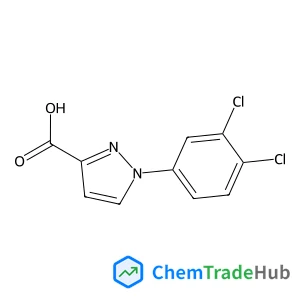
1-(3,4-Dichlorophenyl)-1H-pyrazole-3-carboxylic acid
CAS Number:
1152949-12-6
Molecular Formula:
C10H6Cl2N2O2
Jiafang Xu, Liwen Li, Jinxiang Liu, Xiaopu Wang, Youguo Yan, Jun Zhang
The inhibition properties of kinetic hydrate inhibitor (KHI) molecules on the dynamic growth of a hydrate/water interface are investigated by using molecular dynamics simulations. The shape of the hydrate interface is transformed from laminar to funnel by PVCaps. Results indicate that the inhibition effects not only depend on the adsorption capacity which was believed to determine inhibition, but also on the fact that PVCaps must have some non-binding-hydrate sites that don’t tend to combine with hydrate. By observing the time evolution of the distance between each component of PVCaps and hydrate, the heterocyclic ring of PVCaps mainly contributes to adsorption and can preferentially adjust itself to come into contact with a hydrate semi-large-cage. The distance between the amide of PVCaps and hydrate is about 4 Å and exceeds the range of a general hydrogen bond (3.5 Å), which proves that the non-binding-hydrate sites of PVCaps exist. On the other hand, the amide of PVCaps is at the intersection of the solid–liquid interface but has no adsorption affinity for hydrate, so this adsorption pattern indicates that the PVCaps at the hydrate interface are not stable. Due to this unstable adsorption, a repeated hydrate destruction phenomenon was revealed by the identification algorithm of hydrate and the calculation of the local number density of methane. The statistical evolution of water rings further proved the existence of non-binding-hydrate sites in PVCaps and the inhibition mechanism to destroy the hydrate cages by PVCaps. This unstable adsorption mechanism may shed light on the development of novel efficient KHIs.
Victoria H. J. Clark, Sergei N. Yurchenko
DOI: 10.1039/D1CP00839K
Suting Zhou, Qi Yang, Haijun Zhang, Xiaomeng Zhou
DOI: 10.1039/D0CP05956K
Xia Xu, Jianxiong Dai, Xing Guo, Cheng Qian, Pei Zhang, Yixiang Duan, Yonghui Tian
DOI: 10.1039/D1CP00903F
Jin Feng, Mengdi Cui, Huining Liu, Fengjie Zhou, Siwei Bi, Dapeng Zhang
DOI: 10.1039/D1CP00347J
Zezhong John Li, Simcha Srebnik
DOI: 10.1039/D0CP06708C
Aleksandr Bashkatov, Xuegeng Yang, Gerd Mutschke, Syed Sahil Hossain
DOI: 10.1039/D1CP00978H
Raphael M. Tromer, Ramiro M. dos Santos
DOI: 10.1039/D0CP04308G
Iain A. Campbell, Graham A. Turnbull
DOI: 10.1039/D1CP00835H
Sam Armenta Butt, Stephen D. Price
DOI: 10.1039/D1CP00918D
Yonghui Zeng, Yunzhe Jia, Tianying Yan, Wei Zhuang
DOI: 10.1039/D0CP06397E
Waste containing N-Methoxy-N-methyl-1,3-thiazole-5-carboxamide (CAS: 898825-89-3...
N-(4-Biphenylyl)dibenzo[b,d]furan-4-amine should be stored in a tightly sealed c...
The market for 3-Acetamido-5-amino-2,4,6-triiodobenzoic acid (CAS: 1713-07-1) is...
Benzyl 2-O-acetyl-3,4,6-tri-O-benzyl-beta-D-galactopyranoside (CAS: 61820-03-9) ...
2-Ethylpiperazine dihydrochloride (CAS: 438050-52-3) is regulated under the Glob...
1,1'-[1,3-Phenylenebis(methylene)]bis(3-methyl-1H-pyrrole-2,5-dione) (CAS: 11946...
Several alternatives can be used in the synthesis of 5-Fluoro-2-(1-pyrrolidinyl)...
Proper personal protective equipment (PPE) must be worn when handling this compo...
When handling 6-Bromoimidazo[1,2-a]pyridin-8-amine, it is important to wear appr...
Alternatives to (2S,4R)-4-(4-Nitrobenzyl)pyrrolidine-2-carboxylic acid hydrochlo...

Physical Chemistry Chemical Physics (PCCP) is an international journal co-owned by 19 physical chemistry and physics societies from around the world. This journal publishes original, cutting-edge research in physical chemistry, chemical physics and biophysical chemistry. To be suitable for publication in PCCP, articles must include significant innovation and/or insight into physical chemistry; this is the most important criterion that reviewers and Editors will judge against when evaluating submissions. The journal has a broad scope and welcomes contributions spanning experiment, theory, computation and data science. Topical coverage includes spectroscopy, dynamics, kinetics, statistical mechanics, thermodynamics, electrochemistry, catalysis, surface science, quantum mechanics, quantum computing and machine learning. Interdisciplinary research areas such as polymers and soft matter, materials, nanoscience, energy, surfaces/interfaces, and biophysical chemistry are welcomed if they demonstrate significant innovation and/or insight into physical chemistry. Joined experimental/theoretical studies are particularly appreciated when complementary and based on up-to-date approaches.