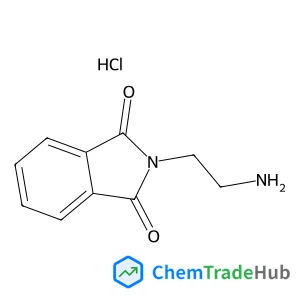
2-(2-Aminoethyl)-1H-isoindole-1,3(2H)-dione hydrochloride (1:1)
CAS Number:
30250-67-0
Molecular Formula:
C10H11ClN2O2
Lan Chen
Phosphoproteomics has become a popular proteomic technology for exploring cellular signaling networks. However, current approaches often require milligrams of protein samples which hamper their applications for translational studies with limited starting materials. In this study, we aimed to challenge the lowest starting material limit for phosphoproteome profiling. By carefully optimizing the well-established high-pH reversed-phase (RP) fractionation plus Ti4+-IMAC enrichment strategy, we achieved the identification of 15 260 and 8936 unique phosphopeptides from only 500 μg and 250 μg predigested peptides, respectively. To further improve the sensitivity of phosphoproteome analysis for low micrograms of protein samples, we developed an integrated strategy, termed Phospho-SISPROT. This technology integrates three tips in tandem for protein digestion by the simple and integrated spintip-based proteomics technology (SISPROT), phosphopeptide enrichment by the Ti4+-IMAC tip, and desalting by the StageTip, respectively, which could dramatically reduce the phosphoproteome analysis time from a couple of days to only 6 hours and improve the system sensitivity. The flow through of Phospho-SISPROT could be reused for the global protein identification, which is very helpful for accurate phosphoproteome analysis with limited starting materials. More than 5500 and 600 unique phosphopeptides were respectively identified from 20 μg and 1 μg pervanadate treated HEK 293T cell lysates processed by the Phospho-SISPROT. To the best of our knowledge, this performance is the highest reported to date by using the standard LC-MS/MS setup. We expect that the Phospho-SISPROT and the optimized high-pH RP fractionation plus Ti4+-IMAC enrichment strategy will be well suited for highly sensitive phosphoproteome analysis of rare biological samples.

Molecular Pharmacology

Journal of Heterocyclic Chemistry

Proceedings of the National Academy of Sciences of the United States of America

Pharmacological Reviews

Journal of Organometallic Chemistry

Israel Journal of Chemistry

Fibre Chemistry

Organic Preparations and Procedures International

European Journal of Wood and Wood Products

Pure and Applied Chemistry
Di Mu, Yang Zhao, Liwei Yu, Le Liu, Jingyu Xi
DOI: 10.1039/C7CP06249D
S. Benedetti, A. di Bona, G. Vinai, C. Castan-Guerrero, A. Catellani, P. Torelli, A. Calzolari
DOI: 10.1039/C7CP05864K
Min Xie, Zhitao Shen, S. T. Pratt
DOI: 10.1039/C7CP06433K
Katherine A. Forrest, Tony Pham, Brian Space
DOI: 10.1039/C7CP06128E
Ji-Eun Lee, Ye Ri Han, Sujin Ham, Chul-Ho Jun, Dongho Kim
DOI: 10.1039/C7CP04756H
Jianzhong Fan, Lili Lin, Chuan-Kui Wang
DOI: 10.1039/C7CP05451C
Jiu Chen, Ming Qian Wang, Xin Zhou, Ling Yang, Wei-Qi Li, Wei Quan Tian
DOI: 10.1039/C7CP05910H
Wei-Feng Xie, Hao-Ran Zhu, Shi-Hao Wei, Da-Yin Hua
DOI: 10.1039/C7CP04740A
DOI: 10.1039/C7CP06386E
Xin Xu
DOI: 10.1039/C7CP05969H
(1R,3S)-1,3-Cyclopentanediol finds applications in various industries. In the ph...
When handling N'-[4-(Dimethylamino)phenyl]-N,N-dimethyl-1,4-benzenediamine, it i...
There are several alternatives to 5-(2,4-Difluorophenyl)-2-methoxypyrimidine in ...
1-(3-Methoxyphenoxy)propan-2-ol (CAS: 382141-68-6) must comply with the Globally...
Tetrodotoxin Citrate is extremely dangerous and should be handled with extreme c...
2-Methyl-2-propanyl [(1R,3S)-3-hydroxycyclopentyl]carbamate (CAS: 225641-84-9) i...
Waste containing 4-(2-Hydroxyhexafluoroisopropyl)Benzoic Acid (CAS: 16261-80-6) ...
2-Methyl-2-proanyl {(2S)-1-[(benzyloxy)amino]-3-hydroxy-3-methyl-1-oxo-2-butanyl...
Benzeneethanamine, α-ethyl-, hydrochloride (1:1) is an organic compound with the...
In the synthesis of compounds similar to 3-{(E)-[4-(Dimethylamino)phenyl]diazeny...

Analyst publishes analytical and bioanalytical research that reports premier fundamental discoveries and inventions, and the applications of those discoveries, unconfined by traditional discipline barriers.