












Selection of DNA aptamers and establishment of an effective aptasensor for highly sensitive detection of cefquinome residues in milk
Literature Information
Publication Date
2018-05-14
DOI
10.1039/C8AN00709H
Impact Factor
4.616
Authors
Lihui Wang, Chuchu Wang, Hao Li
View Original
Abstract
Cefquinome (CFQ), which is a fourth-generation cephalosporin approved for veterinary use only, has been widely used for treating porcine or bovine respiratory infection, bovine mastitis and other diseases. However, the antibacterial effect of CFQ is based on the duration of drug concentration remaining in excess of the minimum inhibitory concentration in serum or tissues, thereby inevitably leading to CFQ residues with high levels in animal-sourced food. In this paper, four CFQ-specific ssDNA aptamers were selected via a magnetic bead-based systematic evolution of ligands by the exponential enrichment (SELEX) method. Aptamer W1 with the lowest dissociation constant (Kd) value of 40.13 ± 22.11 nM was chosen for establishing a fluorescence aptasensor based on magnetic separation and release of molecular beacons for detection of CFQ residues. This aptasensor exhibited a high sensitivity toward CFQ with a limit of detection (LOD) of 0.09 ng mL−1 (linear range from 0.5 to 150 ng mL−1). Moreover, the present aptasensor also showed high selectivity against ampicillin and CFQ's structural analogs (i.e., cefpirome sulfate and cefixime). Finally, this aptasensor was used to detect CFQ in real spiked milk. The recovery rate of CFQ from spiked milk samples ranged from 96.6% to 103.2%. These results indicated that the developed aptasensor is a promising, highly sensitive and specific method for CFQ residue detection in animal-sourced food.
Related Literature
A phase-field model for the evaporation of thin film mixtures
Olivier J. J. Ronsin, DongJu Jang, Hans-Joachim Egelhaaf
2020-03-05
Paper
DOI: 10.1039/D0CP00214C
Defect engineering, microstructural examination and improvement of ultrafast third harmonic generation in GaZnO nanostructures: a study of e-beam irradiation
Albin Antony, Poornesh P., I. V. Kityk, K. Ozga, J. Jedryka, G. Myronchuk, Suresh D. Kulkarni, Ganesh Sanjeev, Vikash Chandra Petwal, Vijay Pal Verma, Jishnu Dwivedi
2020-01-21
Paper
DOI: 10.1039/C9CP06323D
Steady semiconducting properties of monolayer PtSe2 with non-metal atom and transition metal atom doping
Ranzhuo Huang, Tianxing Wang, Xianqi Dai, Shuyi Wei, Yaqiang Ma
2020-02-13
Paper
DOI: 10.1039/C9CP06249A
Real-time degradation dynamics of hydrated per- and polyfluoroalkyl substances (PFASs) in the presence of excess electrons
Sharma S. R. K. C. Yamijala, Ravindra Shinde, Bryan M. Wong
2020-01-22
Communication
DOI: 10.1039/C9CP06797C
Structural relationships for the design of responsive azobenzene-based lyotropic liquid crystals
Luke W. Giles, Joshua B. Marlow, Calum S. G. Butler, Geosmin A. Turpin, Liliana de Campo, Stephen T. Mudie, Charl F. J. Faul, Rico F. Tabor
2020-01-30
Paper
DOI: 10.1039/C9CP05463D
Correction: Influence of residual water and cation acidity on the ionic transport mechanism in proton-conducting ionic liquids
Liming Wang, Tatiana Zinkevich, Sylvio Indris
2020-02-19
Correction
DOI: 10.1039/D0CP90046J
Interaction of hydantoin with solar wind minority ions: O6+ and He2+
Julie Renoud, Suvasthika Indrajith, Alicja Domaracka, Patrick Rousseau, Patrick Moretto-Capelle, Bernd A. Huber, Jean-Philippe Champeaux
2020-01-28
Paper
DOI: 10.1039/C9CP06230K
Xe⋯chalcogen aerogen bond. Effect of substituents and size of chalcogen atom
Ruijing Wang, Haojie Liu, Qingzhong Li, Steve Scheiner
2020-02-03
Paper
DOI: 10.1039/C9CP06648A
You might also like
Compound Q&A
What is the market or research trend for N-(4-Methoxybenzyl)-2-pyridinamine (CAS: 52818-63-0)?
N-(4-Methoxybenzyl)-2-pyridinamine (CAS: 52818-63-0) is increasingly being used ...
52818-63-0N-(4-Methoxybenzyl)-...
Compound Q&A
What precautions should be taken when handling Ethyl 4-(2-chlorophenyl)-1,3-thiazole-2-carboxylate (CAS: 1050507-06-6)?
When handling Ethyl 4-(2-chlorophenyl)-1,3-thiazole-2-carboxylate, appropriate p...
1050507-06-6Ethyl 4-(2-chlorophe...
Compound Q&A
What regulatory guidelines apply to diethyldiselane (CAS: 628-39-7)?
Diethyldiselane (CAS: 628-39-7) is classified under the Globally Harmonized Syst...
628-39-7Diethyldiselane
Compound Q&A
What is the market or research trend for oxocopper (CAS: 12053-18-8)?
The market for oxocopper (CAS: 12053-18-8) is primarily driven by its use in cat...
12053-18-8oxocopper; oxo-(oxoc...
Compound Q&A
What is the market or research trend for 5-{[(2-Methyl-2-propanyl)oxy]carbonyl}-5-azaspiro[2.4]heptane-7-carboxylic acid?
The market for 5-{[(2-Methyl-2-propanyl)oxy]carbonyl}-5-azaspiro[2.4]heptane-7-c...
1268519-54-55-{[(2-Methyl-2-prop...
Compound Q&A
What is 2-(1-Pyrrolidinyl)-4-pyridinamine (CAS: 35981-63-6)?
2-(1-Pyrrolidinyl)-4-pyridinamine is a chemical compound with the CAS number 359...
35981-63-62-(1-Pyrrolidinyl)-4...
Compound Q&A
What are the physical and chemical properties of 2-(3-Pyridinyl)-1-azabicyclo[2.2.2]octane (CAS: 91556-75-1)?
2-(3-Pyridinyl)-1-azabicyclo[2.2.2]octane (CAS: 91556-75-1) is a crystalline sol...
91556-75-12-(3-Pyridinyl)-1-az...
Compound Q&A
How is (S)-Alpha-allyl-proline hydrochloride (CAS: 129704-91-2) typically synthesized?
(S)-Alpha-allyl-proline hydrochloride is usually synthesized via a Wittig reacti...
129704-91-2(S)-Alpha-allyl-prol...
Compound Q&A
What is 3-Methyl-1,2-oxazole-5-carboxylic acid (CAS: 4857-42-5)?
3-Methyl-1,2-oxazole-5-carboxylic acid (CAS: 4857-42-5) is an organic compound w...
4857-42-53-Methyl-1,2-oxazole...
Compound Q&A
How is Lys-SMCC-DM1 (CAS: 1281816-04-3) typically synthesized?
Lys-SMCC-DM1 is synthesized via a multi-step process involving the coupling of S...
1281816-04-3Lys-SMCC-DM1
Source Journal
Analyst

CiteScore:
7.8
Self-citation Rate:
5.6%
Articles per Year:
653
Analyst publishes analytical and bioanalytical research that reports premier fundamental discoveries and inventions, and the applications of those discoveries, unconfined by traditional discipline barriers.
Recommended Compounds
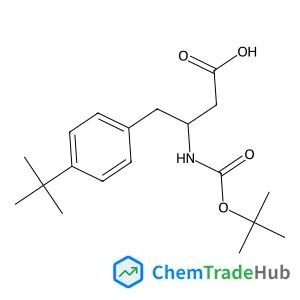
(S)-3-((tert-Butoxycarbonyl)amino)-4-(4-(tert-butyl)phenyl)butanoic acid
CAS Number:
403661-85-8
Molecular Formula:
C19H29NO4
Recommended Suppliers






Disclaimer
This page provides academic journal information for reference and research purposes only. We are not affiliated with any journal publishers and do not handle publication submissions. For publication-related inquiries, please contact the respective journal publishers directly.
If you notice any inaccuracies in the information displayed, please contact us at support@chemtradehub.com. We will promptly review and address your concerns.