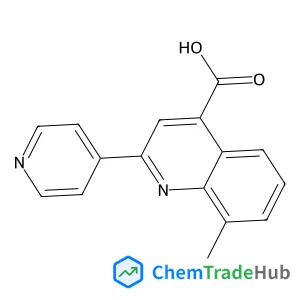
8-Methyl-2-pyridin-4-ylquinoline-4-carboxylic acid
CAS Number:
107027-42-9
Molecular Formula:
C16H12N2O2
Shinjita Acharya, Luciano M. Santino, Yang Lu, Hari Anandarajah, Aly Wayne
Keeping pace with the increasing energy demand, the scientific community continues to develop superior energy storage technologies by expanding the field of nanostructured organic electronics and by engineering advanced electrochemical capacitors. Here, we demonstrate enhanced performance of a nanofibrillar electrochemical capacitor from a conducting polymer, poly(3,4-ethylenedioxythiophene) (PEDOT), conformally deposited on a substrate via evaporative vapour phase polymerization (EVPP). The synthesis grafts polymer nanofibers to aromatic groups on a carbon paper current collector via Friedel–Crafts alkylation utilizing iron chloride oxidant facilitated by nitromethane as a catalyst activator. By grafting EVPP-PEDOT, our devices attain remarkable stability, retaining 90% of their initial capacitance over 350 000 cycles in 1 M H2SO4 at 5 A g−1 current density in a 1 V window; at 10 A g−1, 90% of the capacitance is retained over 200 000 cycles. Besides showing ultra-high stability, these devices possess high power density (25 kW kg−1 at 1 V and 30 kW kg−1 at 1.2 V) with a respective energy density of 4.3 W h kg−1 and 4.9 W h kg−1, as well as a 0.8 Ω minimal electrochemical series resistance that enables fast charge–discharge rates. For applications requiring high energy densities, 5.8 W h kg−1 at 1 V and 7.6 W h kg−1 at 1.2 V are obtained at power densities of 500 W kg−1, 1 V and 550 W kg−1, 1.2 V respectively. This work proposes a synthetic mechanism for the deposition of nanofibrillar PEDOT that controls device performance and demonstrates stable energy storage technology with high power density.

Journal of Saudi Chemical Society

Chemical Communications

Current Opinion in Solid State & Materials Science

Saudi Pharmaceutical Journal

Russian Journal of Coordination Chemistry

Journal of Peptide Science

Nature Medicine

Russian Journal of Applied Chemistry

Drug Discovery Today

Journal of Natural Medicines
DOI: 10.1039/C3CP53325E
Pablo Díaz-Rodríguez, John C. Cancilla, Natalia V. Plechkova, Gemma Matute, Kenneth R. Seddon, José S. Torrecilla
DOI: 10.1039/C3CP53685H
Himadri Chakraborti, Kommula Bramhaiah, Neena Susan John, Suman Kalyan Pal
DOI: 10.1039/C3CP53416B
Mounir Ben El Hadj Rhouma, Majdi Hochlaf, Vincent Mazet, Sylvain Faisan
DOI: 10.1039/C3CP53172D
Angelo Miguel Figueiredo, Joao Sardinha, Geoffrey R. Moore, Eurico J. Cabrita
DOI: 10.1039/C3CP53395F
Shiladitya Banerjee, Peter Saalfrank
DOI: 10.1039/C3CP53535E
Carmen López-López, Silvia Colodrero, Hernán Míguez
DOI: 10.1039/C3CP53939C
Hui-Fang Li, Huai-Qian Wang
DOI: 10.1039/C3CP53292E
Yongmin Kim, Hyunjae Baek, Jin Hee Lee, Shinyoung Yeo, Kibum Kim, Son-Jong Hwang, Bit Eun
DOI: 10.1039/C3CP52591K
Waste containing 6-Chloro-5-(2'-hydroxy-3'-methoxy-4-biphenylyl)-3-(3-methoxyphe...
(3alpha,5alpha)-3-Hydroxypregnane-11,20-dione is primarily used in the pharmaceu...
The market for 4-Amino-6-chloro-2-pyridinecarboxylic acid (CAS: 546141-56-4) is ...
Alternatives to (2-Benzoylethyl)trimethylammonium chloride (CAS: 24472-88-6) in ...
N-[4-Nitro-3-(trifluoromethyl)phenyl]acetamide (CAS: 393-12-4) is generally safe...
Alternative reagents such as other phosphates or similar functional groups can b...
There are alternatives to N,N'-Bis(3-aminopropyl)-1,3-propanediamine (CAS: 4605-...
When handling Aluminium trihexadecanoate, it is important to use appropriate per...
(1,1-Dioxido-3-oxo-1,2-benzothiazol-2(3H)-yl)acetic acid is a chemical compound ...
Several alternatives to 5,5-dimethyloxolan-2-one (CAS: 3123-97-5) can be used in...
![1-(2-Chlorophenyl)-6-[(2S)-3,3,3-trifluoro-2-methylpropyl]-1,7-dihydro-4H-pyrazolo[3,4-d]pyrimidin-4-one structure](https://static.chemtradehub.com/structs/794/794568-91-5-0c34.webp "1-(2-Chlorophenyl)-6-[(2S)-3,3,3-trifluoro-2-methylpropyl]-1,7-dihydro-4H-pyrazolo[3,4-d]pyrimidin-4-one structure")