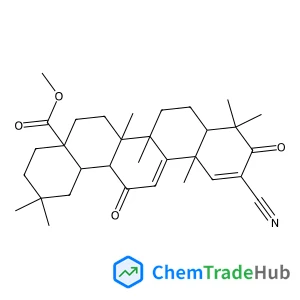
Methyl 2-cyano-3,12-dioxooleana-1,9(11)-dien-28-oate
CAS Number:
218600-53-4
Molecular Formula:
C32H43NO4
A new monomer stoichiometry imbalance-promoted polymerization tool for the synthesis of functional polymers was designed and investigated in this work. The polymerizations of aryl iodides and internal diynes were catalyzed by widely available Pd(OAc)2 and additives in o-xylene at 80 °C, producing a series of multisubstituted polynaphthalenes (PNs) with high molecular weights (up to 48 100) in nearly quantitative yields. The presence of excess aryl iodides significantly improved the reaction efficiency of these polymerizations and the underlying working mechanism was detailedly investigated. All the obtained polymers exhibited excellent solubility in common organic solvents and good film-forming ability. Their thin films possessed high refractive indices (n = 1.9013–1.6340) in a wide wavelength range of 380–890 nm. Fluorescent conjugated PNs were formed when tetraphenylethylene (TPE)-containing diynes were used. Taking advantage of their efficient solid-state emission and photosensitivity, well-resolved photopatterns with green emission can be generated by irradiating their thin films under UV light through copper masks. Moreover, all the polymers showed great thermal stability, losing merely 5% of their weight at a high temperature of 387–458 °C under nitrogen and at 350–392 °C in air. The TPE-containing PNs retained 72–79% of their weights after being heated to 800 °C under nitrogen due to their conjugated polymer backbones.

Journal of Catalysis

Israel Journal of Chemistry

Journal of Medicinal Chemistry

European Journal of Wood and Wood Products

Molecular Pharmacology

Journal of Organometallic Chemistry

Journal of Physics and Chemistry of Solids

Science Progress

Helvetica Chimica Acta

Proceedings of the National Academy of Sciences of the United States of America
DOI: 10.1039/A901888C
H. Böhm, A. Lamprecht, B. Atakan, K. Kohse-Höinghaus
DOI: 10.1039/B005252N
Marina Fix, Manfred Sieber, Michael Overs, Hans J. Schäfer, Hans-Joachim Galla
DOI: 10.1039/B003996I
DOI: 10.1039/A903458G
Danuta Leszczynska
DOI: 10.1039/B004698L
Paweł Borowicz, Jerzy Herbich, Andrzej Kapturkiewicz, Romana Anulewicz-Ostrowska, Jacek Nowacki, Günter Grampp
DOI: 10.1039/B005058J
When handling 4-(2-Furylmethyl)thiomorpholine 1,1-dioxide (CAS: 79206-94-3), it ...
When handling 4-Chloro-N-[2-(4-morpholinyl)ethyl]benzamide (CAS: 71320-77-9), it...
Waste containing this compound (CAS: 62921-74-8) should be handled according to ...
Waste containing (S)-Methyl 2-amino-3-cyclohexylpropanoate should be collected i...
This compound can be synthesized using a multi-step process involving the conjug...
There are several alternatives to (2E)-3-(3,4-Dichlorophenyl)acrylic acid in syn...
Ethyl 6-(2-nitrophenyl)imidazo[2,1-b][1,3]thiazole-3-carboxylate (CAS: 925437-84...
Waste containing 2-(1,3-Thiazol-2-yl)ethanamine (CAS: 18453-07-1) should be coll...
Methyl 5-iodo-2-methylbenzoate can be synthesized through the iodination of meth...
5-Chloro[1,2,4]triazolo[1,5-a]pyridine is commonly synthesized via the condensat...

Polymer Chemistry welcomes submissions in all areas of polymer science that have a strong focus on macromolecular chemistry. Manuscripts may cover a broad range of fields, yet no direct application focus is required.
![4-{2-[4-(2-Methyl-2-propanyl)phenyl]ethoxy}quinazoline structure](https://static.chemtradehub.com/structs/120/120928-09-8-d3db.webp "4-{2-[4-(2-Methyl-2-propanyl)phenyl]ethoxy}quinazoline structure")