












A self-healable fluorescence active hydrogel based on ionic block copolymers prepared via ring opening polymerization and xanthate mediated RAFT polymerization
Literature Information
Publication Date
2018-02-12
DOI
10.1039/C7PY01883E
Impact Factor
5.582
Authors
Sovan Lal Banerjee, Richard Hoskins, Thomas Swift, Stephen Rimmer, Nikhil K. Singha
View Original
Abstract
In this work we report a facile method to prepare a fluorescence active self-healable hydrogel via incorporation of fluorescence responsive ionic block copolymers (BCPs). Ionic block copolymers were prepared via a combined effect of ring opening polymerization (ROP) of ε-caprolactone and xanthate mediated reversible addition–fragmentation chain transfer (RAFT) polymerization. Here polycaprolactone (PCL) was modified with xanthate to prepare a PCL based macro-RAFT agent and then it was utilized to prepare block copolymers with cationic poly(2-(methacryloyloxy)ethyltrimethyl ammonium chloride) (PCL-b-PMTAC) and anionic poly(sodium 4-vinylbenzenesulfonate) (PCL-b-PSS). During the block formation, the cationic segments were randomly copolymerized with a trace amount of fluorescein O-acrylate (FA) (acceptor) whereas the anionic segments were randomly copolymerized with a trace amount of 9-anthryl methylmethacrylate (AMMA) (donor) to make both the segments fluorescent. The block copolymers form micelles in a DMF : water mixture (1 : 4 volume ratio). The ionic interaction of two BCPs was monitored via Förster resonance energy transfer (FRET) and zeta potential measurements. The oppositely charged BCPs were incorporated into a polyacrylamide (PAAm) based hydrogel that demonstrated self-healing behavior and is also highly fluorescent.
Related Literature
Lanthanide complexes derived from (R)-1,1′-binaphthyl-2,2′-bis(neopentylamine) – {Li(THF)4}{Ln[(R)-C20H12N2(C10H22)]2} (Ln = Sm, Yb) – novel catalysts for enantioselective intramolecular hydroamination
Jacqueline Collin, Jean-Claude Daran, Emmanuelle Schulz, Alexander Trifonov
2003-11-07
Communication
DOI: 10.1039/B310954B
Preparation and characterization of siliceous material using liposomes as template
R. Durand, D. A. Lerner, C. Charnay
2003-02-10
Communication
DOI: 10.1039/B210927A
Concise asymmetric syntheses of (−)-lentiginosine and of its pyrrolizidinic analogue
Tahar Ayad, Yves Génisson, Michel Baltas, Liliane Gorrichon
2003-01-29
Communication
DOI: 10.1039/B212217K
A novel role of zeolite NaY in the thermal reaction of alkyl aryl selenoxides in its supercages
Haitao Yu, Yu Gao, Jiben Meng, Teruo Matsuura
2003-01-23
Communication
DOI: 10.1039/B211833E
A metallosupramolecular tetrahedron with a huge internal cavity
Markus Albrecht, Ingo Janser, Sebastian Meyer, Patrick Weis, Roland Fröhlich
2003-11-03
Communication
DOI: 10.1039/B309495B
Continuous biphasic catalysis: palladium catalyzed cross coupling reactions
Jens Hillerich, Herbert Plenio
2003-11-03
Communication
DOI: 10.1039/B310504K
Contraction/extension molecular motion by protonation/deprotonation induced structural switching of pyridine derived oligoamides
Elena Kolomiets, Ibon Odriozola, Adrian-Mihail Stadler, Nathalie Kyritsakas, Jean-Marie Lehn
2003-10-27
Communication
DOI: 10.1039/B311578J
Crown-ether functionalised second coordination sphere palladiumcatalysts by molecular imprinting
Florian Viton, Peter S. White, Michel R. Gagné
2003-10-20
Communication
DOI: 10.1039/B309072H
A rational synthetic route leading to 3d–3d′–4f heterospin systems: self-assembly processes involving heterobinuclear 3d–4f complexes and hexacyanometallates
Ruxandra Gheorghe, Marius Andruh, Jean-Pierre Costes, Bruno Donnadieu
2003-10-17
Communication
DOI: 10.1039/B310082K
Reusable photonucleases: plasmid scission by a uranyl ion impregnated adenine homopolymer in the presence of visible light and sunlight
C. Madhavaiah, Sandeep Verma
2003-02-25
Communication
DOI: 10.1039/B300134B
You might also like
Compound Q&A
What precautions should be taken when handling lithium chloride hydrate (1:1:1) (CAS: 16712-20-2)?
When handling lithium chloride hydrate (1:1:1) (CAS: 16712-20-2), it is importan...
16712-20-2Lithium chloride hyd...
Compound Q&A
Is 4-(4H-1,2,4-Triazol-4-yl)piperidine (CAS: 690261-92-8) safe?
4-(4H-1,2,4-Triazol-4-yl)piperidine is generally considered safe for use in phar...
690261-92-84-(4H-1,2,4-Triazol-...
Compound Q&A
How should waste containing 1,3-Thiazole-2-carboxamide (CAS: 16733-85-0) be handled?
Waste containing 1,3-Thiazole-2-carboxamide (CAS: 16733-85-0) should be collecte...
16733-85-01,3-Thiazole-2-carbo...
Compound Q&A
What regulatory guidelines apply to 5-(Difluoromethyl)-2-fluorobenzonitrile (CAS: 934175-58-3)?
5-(Difluoromethyl)-2-fluorobenzonitrile (CAS: 934175-58-3) is subject to regulat...
934175-58-35-(Difluoromethyl)-2...
Compound Q&A
How is Methyl 3-acetamido-2-thiophenecarboxylate (CAS: 22288-79-5) typically synthesized?
Methyl 3-acetamido-2-thiophenecarboxylate can be synthesized by the reaction of ...
22288-79-5Methyl 3-acetamido-2...
Compound Q&A
What is 4-Isoquinolinecarbonitrile (CAS: 34846-65-6)?
4-Isoquinolinecarbonitrile is a chemical compound with the CAS number 34846-65-6...
34846-65-64-Isoquinolinecarbon...
Compound Q&A
How should Methyl 1H-1,2,3-triazole-4-carboxylate (CAS: 877309-59-6) be stored?
Store Methyl 1H-1,2,3-triazole-4-carboxylate (CAS: 877309-59-6) in a cool, dry p...
877309-59-6Methyl 1H-1,2,3-tria...
Compound Q&A
What regulatory guidelines apply to 6-Bromo[1,3]thiazolo[5,4-b]pyridin-2-amine (CAS: 1160791-13-8)?
6-Bromo[1,3]thiazolo[5,4-b]pyridin-2-amine (CAS: 1160791-13-8) is subject to the...
1160791-13-86-Bromo[1,3]thiazolo...
Compound Q&A
Is (2S,3S)-2-Ammonio-3-(3,4-dihydroxyphenyl)-3-hydroxypropanoate (CAS: 23651-95-8) safe?
(2S,3S)-2-Ammonio-3-(3,4-dihydroxyphenyl)-3-hydroxypropanoate (CAS: 23651-95-8) ...
23651-95-8(2S,3S)-2-Ammonio-3-...
Compound Q&A
What are the physical and chemical properties of 7-bromo-3-methyl-3,4-dihydroquinazolin-4-one (CAS: 1293987-84-4)?
7-Bromo-3-methyl-3,4-dihydroquinazolin-4-one is a solid with a crystalline form....
1293987-84-47-bromo-3-methyl-3,4...
Source Journal
Polymer Chemistry

CiteScore:
8.6
Self-citation Rate:
7.3%
Articles per Year:
457
Polymer Chemistry welcomes submissions in all areas of polymer science that have a strong focus on macromolecular chemistry. Manuscripts may cover a broad range of fields, yet no direct application focus is required.
Recommended Compounds
![N-[2-(2-Pyridinyl)ethyl]-1-propanamine structure](https://static.chemtradehub.com/structs/554/55496-57-6-22b4.webp "N-[2-(2-Pyridinyl)ethyl]-1-propanamine structure")
![[(2R)-6,6-Dimethyl-2-morpholinyl]methanol hydrochloride (1:1) structure](https://static.chemtradehub.com/structs/141/1416444-88-6-e06a.webp "[(2R)-6,6-Dimethyl-2-morpholinyl]methanol hydrochloride (1:1) structure")
[(2R)-6,6-Dimethyl-2-morpholinyl]methanol hydrochloride (1:1)
CAS Number:
1416444-88-6
Molecular Formula:
C7H16ClNO2
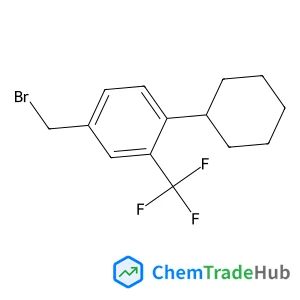
4-(Bromomethyl)-1-cyclohexyl-2-(trifluoromethyl)benzene
CAS Number:
800381-60-6
Molecular Formula:
C14H16BrF3
Recommended Suppliers





Disclaimer
This page provides academic journal information for reference and research purposes only. We are not affiliated with any journal publishers and do not handle publication submissions. For publication-related inquiries, please contact the respective journal publishers directly.
If you notice any inaccuracies in the information displayed, please contact us at support@chemtradehub.com. We will promptly review and address your concerns.