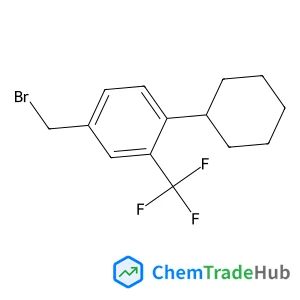
4-(Bromomethyl)-1-cyclohexyl-2-(trifluoromethyl)benzene
CAS Number:
800381-60-6
Molecular Formula:
C14H16BrF3
Characterization of the molecular structure of high-density well-defined polymer brushes with predictable number-average molecular weight (Mn), narrow molecular weight dispersity (MWD), and highly ordered tacticity, prepared by surface-initiated controlled radical polymerization or living anionic polymerization, is described. Ionic monomers, such as 3-(N-2-methacryloyloxyethyl-N,N-dimethyl)ammonatopropanesulfonate (MAPS), were polymerized by atom transfer radical polymerization in 2,2,2-trifluoroethanol in the presence of imidazolium chloride to give a polymer with Mn greater than 2 × 10⁵ g mol−1 maintaining a narrower MWD (Mw/Mn < 1.2). Neutron reflectivity measurement of poly(MAPS) (PMAPS) brushes at the water interface revealed that polymer brushes with narrow MWD form a relatively sharp boundary at the solution interface, while brushes with a broad MWD show a gradient solution interface due to the variety of chain length. The effect of MWD on swollen chain structure is described. This article also reviews surface-initiated stereospecific polymerization. High density poly(methyl methacrylate) (PMMA) brushes with well-controlled primary structures were prepared on flat and spherical substrates using surface-initiated living anionic polymerization in the presence of triethyl aluminum. The PMMA brushes so obtained showed highly controlled stereoregularity (rr > 88%). Grazing incidence wide-angle X-ray diffraction (GIWAXD) measurements indicated that the stereoregular PMMA brushes formed helical structures with about 1 nm diameter and encapsulated fullerenes in the cavities.
John M. Gardiner, Philip D. Crewe, Gillian E. Smith, Kenneth T. Veal
DOI: 10.1039/B212769P
Caroline S. Clarke, Delia A. Haynes, Jeremy M. Rawson, Andrew D. Bond
DOI: 10.1039/B307509P
John D. Holbrey, W. Matthew Reichert, Mark Nieuwenhuyzen, Oonagh Sheppard, Robin D. Rogers
DOI: 10.1039/B212726A
Asim Bhaumik, Mahendra P. Kapoor, Shinji Inagaki
DOI: 10.1039/B212680J
Elna Pidcock, W. D. Sam Motherwell
DOI: 10.1039/B310873B
Ian Paterson, Jose L. Aceña, Jordi Bach, David Y.-K. Chen, Mark J. Coster
DOI: 10.1039/B212651F
Tamotsu Horiuchi, Hidetoshi Miura, Satoshi Uchida
DOI: 10.1039/B307819A
Josefina Perles, Marta Iglesias, Caridad Ruiz-Valero, Natalia Snejko
DOI: 10.1039/B210034G
Aurora E. Clark, Ernest R. Davidson, Jeffrey M. Zaleski
DOI: 10.1039/B308633J
Markus Albrecht, Ingo Janser, Sebastian Meyer, Patrick Weis, Roland Fröhlich
DOI: 10.1039/B309495B
When handling lithium chloride hydrate (1:1:1) (CAS: 16712-20-2), it is importan...
4-(4H-1,2,4-Triazol-4-yl)piperidine is generally considered safe for use in phar...
Waste containing 1,3-Thiazole-2-carboxamide (CAS: 16733-85-0) should be collecte...
5-(Difluoromethyl)-2-fluorobenzonitrile (CAS: 934175-58-3) is subject to regulat...
Methyl 3-acetamido-2-thiophenecarboxylate can be synthesized by the reaction of ...
4-Isoquinolinecarbonitrile is a chemical compound with the CAS number 34846-65-6...
Store Methyl 1H-1,2,3-triazole-4-carboxylate (CAS: 877309-59-6) in a cool, dry p...
6-Bromo[1,3]thiazolo[5,4-b]pyridin-2-amine (CAS: 1160791-13-8) is subject to the...
(2S,3S)-2-Ammonio-3-(3,4-dihydroxyphenyl)-3-hydroxypropanoate (CAS: 23651-95-8) ...
7-Bromo-3-methyl-3,4-dihydroquinazolin-4-one is a solid with a crystalline form....

Polymer Chemistry welcomes submissions in all areas of polymer science that have a strong focus on macromolecular chemistry. Manuscripts may cover a broad range of fields, yet no direct application focus is required.
![[(2R)-6,6-Dimethyl-2-morpholinyl]methanol hydrochloride (1:1) structure](https://static.chemtradehub.com/structs/141/1416444-88-6-e06a.webp "[(2R)-6,6-Dimethyl-2-morpholinyl]methanol hydrochloride (1:1) structure")
![Ethyl 4-[8-chloro(5,5,6,6,7-~2~H_5_)-5,6-dihydro-11H-benzo[5,6]cyclohepta[1,2-b]pyridin-11-ylidene]-1-piperidinecarboxylate structure](https://static.chemtradehub.com/structs/102/1020719-57-6-37e2.webp "Ethyl 4-[8-chloro(5,5,6,6,7-~2~H_5_)-5,6-dihydro-11H-benzo[5,6]cyclohepta[1,2-b]pyridin-11-ylidene]-1-piperidinecarboxylate structure")