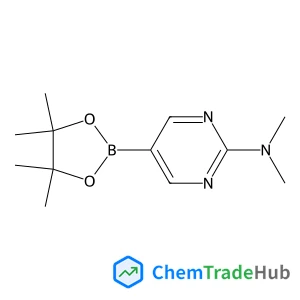
N,N-Dimethyl-5-(4,4,5,5-tetramethyl-1,3,2-dioxaborolan-2-yl)-2-pyrimidinamine
CAS Number:
1032759-30-0
Molecular Formula:
C12H20BN3O2
S. Weintraub, T. Shpigel, L. G. Harris, R. Schuster, E. C. Lewis, D. Y. Lewitus
A library of novel high molecular weight polymers based on the natural carotenoid astaxanthin (ATX) has been successfully synthesized. ATX is a powerful antioxidant, known for its various therapeutic properties including anti-inflammatory and antimicrobial activities. It is a xanthophyll with a symmetric chemical structure bearing two hydroxyl groups. Thus, its copolymerization with various diacids resulted in “polyactive” polyesters with varying chemico–physio–mechanico properties (e.g., storage moduli range: 125–1300 MPa and wetting angles of 40–110°). The potential of pATX as an antimicrobial agent was demonstrated in vitro against clinically relevant bacteria (Staphylococcus aureus MRSA252 and MSSA476; S. epidermidis 1457) showing significant reduction of both bacterial growth and biofilm formation. Lastly, we establish using pATX films in vivo had no adverse effect in direct contact with open wounds, or on the complete physiological process of whole animal wound healing.
Ta-Wei Wang, Tan-Ling Wang, Wan-Jou Chou, Li-Fan Wu, Shi-Hsin Lin
DOI: 10.1039/D0CP04789A
Supriya Ghosal, Arka Bandyopadhyay, Debnarayan Jana
DOI: 10.1039/D0CP90246B
Zhifan Wang, Minggang Guo, Fan Wang
DOI: 10.1039/D0CP90266G
Yuki Higuchi, Daigo Setoyama, Kazuhisa Isegawa, Yusuke Tsuchikawa, Yoshihiro Matsumoto, Joseph Don Parker, Takenao Shinohara, Yasutaka Nagai
DOI: 10.1039/D0CP03887C
Eliane Roos, Martin Brehm
DOI: 10.1039/D0CP04537C
Gang Chen, Xinquan Wang, Yuting Shi, Jonathan S. Tinkham, Thomas M. Brenner, Dana C. Olson, Alan Sellinger, Thomas E. Furtak
DOI: 10.1039/D0CP03306E
Ruizhi Qiu, Jun Tang, Jinfan Chen, Bingyun Ao
DOI: 10.1039/D0CP04824K
Zheng Li, Jianing Zhang, Baozeng Zhou
DOI: 10.1039/D0CP05028H
Inna Ermilova, Jan Swenson
DOI: 10.1039/D0CP05111J
Hecheng Han, Huiling Zheng, Qiushi Wang, Yu Yan
DOI: 10.1039/D0CP03803B
When considering alternatives to 1-(4-Chlorophenyl)-N-hydroxymethanimine (CAS: 3...
This compound should be stored in a cool, dry place away from direct sunlight. I...
3-(4-Bromophenyl)-5-(2-fluorophenyl)-1,2,4-oxadiazole is synthesized through a m...
5-Chloro-2-(4-chlorophenyl)-4-methyl-6-[3-(1-piperidinyl)propoxy]pyrimidine (CAS...
2-Chloro-4-(difluoromethoxy)pyridine is used in the pharmaceutical industry for ...
3-Chloro-6-methylpyridazine (CAS: 1121-79-5) is classified under the Globally Ha...
Several alternatives can be used in the synthesis of Methyl 4,5-dimethyl-2-nitro...
Alternatives to (2E,2'E)-3,3'-(1,4-Phenylene)bisacrylaldehyde include other acry...
3-Amino-5-chloropyridin-2-ol hydrochloride is an organic compound with the CAS n...
When handling 6,7-Difluoro-2,3-dihydro-4H-chromen-4-one, it is essential to wear...

Polymer Chemistry welcomes submissions in all areas of polymer science that have a strong focus on macromolecular chemistry. Manuscripts may cover a broad range of fields, yet no direct application focus is required.
![2-{[(1R,2S)-2-Aminocyclohexyl]amino}-4-{[3-(2H-1,2,3-triazol-2-yl)phenyl]amino}-5-pyrimidinecarboxamide structure](https://static.chemtradehub.com/structs/137/1370261-96-3-40df.webp "2-{[(1R,2S)-2-Aminocyclohexyl]amino}-4-{[3-(2H-1,2,3-triazol-2-yl)phenyl]amino}-5-pyrimidinecarboxamide structure")