












![[4-Amino-2-(methylsulfanyl)-5-pyrimidinyl]methanol structure](https://static.chemtradehub.com/structs/588/588-36-3-fc73.webp "[4-Amino-2-(methylsulfanyl)-5-pyrimidinyl]methanol structure")
Structure/property relationships in copolymers comprising renewable isosorbide, glucarodilactone, and 2,5-bis(hydroxymethyl)furan subunits
Literature Information
Publication Date
2017-06-12
DOI
10.1039/C7PY00575J
Impact Factor
5.582
Authors
Leon M. Lillie, William B. Tolman, Theresa M. Reineke
View Original
Abstract
Carbohydrates and their derivatives have great potential as building blocks for the development of renewable materials that are cost and performance competitive with conventional petroleum-based materials. To this end, the rigid carbohydrate-derived diols, glucarodilactone and isosorbide were functionalized with a castor oil derivative, 10-undecenoic acid, forming α,ω-dienes suitable for acyclic diene metathesis (ADMET) polymerization. Equimolar copolymerizations of these two monomers, glucarodilactone undecenoate (GDLU) and isosorbide undecenoate (GDLU), transform brittle homopolymers into elastic materials with shape memory capabilities. To understand the source of these properties, a series of copolymers consisting of a range of GDLU and IU compositions (100 : 0, 77 : 23, 76 : 24, 52 : 48, 48 : 52, 18 : 82, 0 : 100 mol percent GDLU to IU) was synthesized. The material and chemical properties were characterized by uniaxial tensile testing, small-amplitude oscillatory shear rheology, X-ray scattering and hydrolytic degradation testing. Small compositional changes in this family were shown to have a drastic impact on the observed mechanical performance and degradability of these materials. Rheological measurements of GDLU-containing copolymers found evidence for the presence of transient networking within these materials. We posit that the transient network within this material is responsible for the elasticity and shape memory abilities of the GDL-containing materials. In confirmation of these properties, a novel α,ω-diene 2,5-bis(hydroxymethylfuran) undecenoate (BHMFU) was developed and served as a direct replacement for either GDLU or IU in copolymerizations. The replacement of GDLU resulted in a total loss of the elasticity and shape memory of the copolymers, supporting the role of GDLU in the mechanical performance.
Related Literature
Nature of the lowest triplet states of 4′-substituted N-phenylphenothiazine derivatives
Paweł Borowicz, Jerzy Herbich, Andrzej Kapturkiewicz, Romana Anulewicz-Ostrowska, Jacek Nowacki, Günter Grampp
2000-09-08
Paper
DOI: 10.1039/B005058J
Isomerism in van der Waals molecules: A cryospectroscopic study of the complexes of buta-1,2-diene with hydrogen chloride
2000-10-10
Paper
DOI: 10.1039/B005457G
Effect of defect clustering on the high-pressure behaviour of wüstite. High-pressure X-ray diffraction and lattice energy simulations
Camilla Haavik, Svein Stølen, Michael Hanfland, C. Richard A. Catlow
2000-10-26
Paper
DOI: 10.1039/B006026G
Detection of muoniated organic free radicals in supercritical water
Paul W. Percival, Khashayar Ghandi, Jean-Claude Brodovitch, Brenda Addison-Jones, Iain McKenzie
2000-09-19
Paper
DOI: 10.1039/B005762M
Strongly subspectral pairs in C50+10n and C60+12n fullerenes via a common generic graph
Paper
DOI: 10.1039/A902553G
ENDOR study of a thiocytosine oxidation product in cytosine monohydrate crystals doped with 2-thiocytosine, X-irradiated at 15 K
Janko N. Herak, Krešimir Sanković, Eli O. Hole, Einar Sagstuen
2000-10-04
Paper
DOI: 10.1039/B004639F
Structures and phase transitions in aqueous dispersions of branched-chain glycerophosphoethanolamines
Frank Bringezu, Gert Rapp, Bodo Dobner, Peter Nuhn, Gerald Brezesinski
2000-09-18
Paper
DOI: 10.1039/B003516P
Temperature-dependent phase behaviour of dihydroxy octadecanoic acid methyl esters: Influence of stereochemistry and position of the second polar moiety
Marina Fix, Manfred Sieber, Michael Overs, Hans J. Schäfer, Hans-Joachim Galla
2000-09-29
Paper
DOI: 10.1039/B003996I
Influence of water on the pillaring of montmorillonite with aminopropyltriethoxysilane
Paper
DOI: 10.1039/A901888C
You might also like
Compound Q&A
What precautions should be taken when handling 4-(2-Furylmethyl)thiomorpholine 1,1-dioxide (CAS: 79206-94-3)?
When handling 4-(2-Furylmethyl)thiomorpholine 1,1-dioxide (CAS: 79206-94-3), it ...
79206-94-34-(2-Furylmethyl)thi...
Compound Q&A
What precautions should be taken when handling 4-Chloro-N-[2-(4-morpholinyl)ethyl]benzamide (CAS: 71320-77-9)?
When handling 4-Chloro-N-[2-(4-morpholinyl)ethyl]benzamide (CAS: 71320-77-9), it...
71320-77-94-Chloro-N-[2-(4-mor...
Compound Q&A
How should waste containing 2-[2-(2-Methoxyethoxy)ethoxy]ethyl 4-methylbenzenesulfonate (CAS: 62921-74-8) be handled?
Waste containing this compound (CAS: 62921-74-8) should be handled according to ...
62921-74-82-[2-(2-Methoxyethox...
Compound Q&A
How should waste containing (S)-Methyl 2-amino-3-cyclohexylpropanoate be handled?
Waste containing (S)-Methyl 2-amino-3-cyclohexylpropanoate should be collected i...
40056-18-6(S)-Methyl 2-amino-3...
Compound Q&A
How is 5-({4-[(2S,4R)-4-Hydroxy-2-methyltetrahydro-2H-pyran-4-yl]-2-thienyl}sulfanyl)-1-methyl-1,3-dihydro-2H-indol-2-one (CAS: 166882-70-8) typically synthesized?
This compound can be synthesized using a multi-step process involving the conjug...
166882-70-85-({4-[(2S,4R)-4-Hyd...
Compound Q&A
Are there alternatives to (2E)-3-(3,4-Dichlorophenyl)acrylic acid (CAS: 7312-27-8) in synthesis?
There are several alternatives to (2E)-3-(3,4-Dichlorophenyl)acrylic acid in syn...
7312-27-8(2E)-3-(3,4-Dichloro...
Compound Q&A
How should Ethyl 6-(2-nitrophenyl)imidazo[2,1-b][1,3]thiazole-3-carboxylate (CAS: 925437-84-9) be stored?
Ethyl 6-(2-nitrophenyl)imidazo[2,1-b][1,3]thiazole-3-carboxylate (CAS: 925437-84...
925437-84-9Ethyl 6-(2-nitrophen...
Compound Q&A
How should waste containing 2-(1,3-Thiazol-2-yl)ethanamine (CAS: 18453-07-1) be handled?
Waste containing 2-(1,3-Thiazol-2-yl)ethanamine (CAS: 18453-07-1) should be coll...
18453-07-12-(1,3-Thiazol-2-yl)...
Compound Q&A
How is Methyl 5-iodo-2-methylbenzoate (CAS: 103440-54-6) typically synthesized?
Methyl 5-iodo-2-methylbenzoate can be synthesized through the iodination of meth...
103440-54-6Methyl 5-iodo-2-meth...
Compound Q&A
How is 5-Chloro[1,2,4]triazolo[1,5-a]pyridine (CAS: 1427399-34-5) typically synthesized?
5-Chloro[1,2,4]triazolo[1,5-a]pyridine is commonly synthesized via the condensat...
1427399-34-55-Chloro[1,2,4]triaz...
Source Journal
Polymer Chemistry

CiteScore:
8.6
Self-citation Rate:
7.3%
Articles per Year:
457
Polymer Chemistry welcomes submissions in all areas of polymer science that have a strong focus on macromolecular chemistry. Manuscripts may cover a broad range of fields, yet no direct application focus is required.
Recommended Compounds
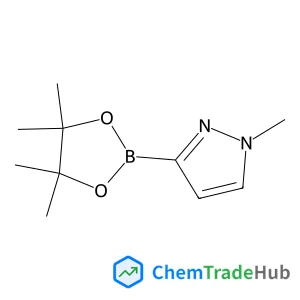
1-Methyl-3-(4,4,5,5-tetramethyl-1,3,2-dioxaborolan-2-yl)-1H-pyrazole
CAS Number:
1020174-04-2
Molecular Formula:
C10H17BN2O2

Recommended Suppliers






Disclaimer
This page provides academic journal information for reference and research purposes only. We are not affiliated with any journal publishers and do not handle publication submissions. For publication-related inquiries, please contact the respective journal publishers directly.
If you notice any inaccuracies in the information displayed, please contact us at support@chemtradehub.com. We will promptly review and address your concerns.