












A “green” method for preparing ABCBA penta-block elastomers by using RAFT emulsion polymerization
Literature Information
Publication Date
2017-04-11
DOI
10.1039/C7PY00464H
Impact Factor
5.582
Authors
Zhi Qiao, Teng Qiu, Weiwei Liu, Liangdong Zhang, Jinqiang Tu, Longhai Guo, Xiaoyu Li
View Original
Abstract
A clean method for preparing ABCBA penta-block terpolymers was developed in a surfactant and organic solvent free emulsion system via one-pot RAFT polymerization. The prepared ABCBA penta-block terpolymers show large fracture tensile strain, low permanent set and potential application as elastomer materials. During the preparation process, polyacrylic acid (PAA) was firstly synthesized as the A block via RAFT polymerization in water in the presence of a dual-functional RAFT agent. Subsequently, we selected a partially water-soluble monomer 2,2,2-trifluoroethyl acrylate (TFEA) to synthesize the B block, and ABA tri-block copolymers could be obtained via organic solvent free RAFT emulsion polymerization. Using the ABA tri-block copolymers as a surfactant, the ABCBA penta-block terpolymers were further synthesized using 2,2,3,4,4,4-hexafluorobutyl acrylate (HFBA) as the third monomer in an organic solvent free system. It has been found that the emulsification efficiency of the ABA tri-block copolymers is higher than that of the corresponding AB di-block copolymers. The assembly mechanism of penta-block terpolymers to form a tri-layer core–shell latex particle was proposed and confirmed by TEM images. Finally, we obtained a transparent and hydrophobic elastomeric film by directly casting the synthesized penta-block terpolymer latexes and subsequent heat treatment. The films have excellent mechanical properties and water resistance.
Related Literature
Nanometer-sized dynamic entities in an aqueous system
E. Mamontov, P. Zolnierczuk, M. Ohl
2015-01-05
Paper
DOI: 10.1039/C4CP05081A
ReaxFF molecular dynamics simulations on lithiated sulfur cathode materials
Md Mahbubul Islam, Alireza Ostadhossein, Oleg Borodin, A. Todd Yeates, William W. Tipton, Richard G. Hennig, Nitin Kumar, Adri C. T. van Duin
2014-12-16
Paper
DOI: 10.1039/C4CP04532G
Li/Ag ratio dependent structure and upconversion photoluminescence of LixAg1−xYb0.99(MoO4)2:0.01Er3+ phosphors
Fangrui Cheng, Xiping Jing, Ziyuan Wang
2014-12-18
Paper
DOI: 10.1039/C4CP03950E
Molecular dynamics simulation of spin–lattice NMR relaxation in poly-l-lysine dendrimers: manifestation of the semiflexibility effect
Denis A. Markelov, Stanislav G. Falkovich, Maxim Yu. Ilyash, Vladimir V. Matveev, Erkki Lähderanta, Petri Ingman
2014-12-08
Paper
DOI: 10.1039/C4CP04825C
Carbon nanoscroll from C4H/C4F-type graphene superlattice: MD and MM simulation insights
Yehan Tao, Xiaofang Li, Tiantian Wu, Yakang Jin, Zhongyang Zhang
2014-12-04
Paper
DOI: 10.1039/C4CP04102J
Preparation of water-dispersible porous g-C3N4 with improved photocatalytic activity by chemical oxidation
Hui-Jun Li, Bo-Wen Sun, Li Sui, Dong-Jin Qian, Meng Chen
2014-12-11
Paper
DOI: 10.1039/C4CP05020G
Performance improvement of multilayer InSe transistors with optimized metal contacts
Xin Zhou, Wei Quan Tian, PingAn Hu
2014-12-11
Paper
DOI: 10.1039/C4CP04968C
The origin of the absorption spectra of porphyrin N- and dithiaporphyrin S-oxides in their neutral and protonated states
Torsten Bruhn, Christian Brückner
2014-12-11
Paper
DOI: 10.1039/C4CP04675G
Benchmark thermochemistry of chloramines, bromamines, and bromochloramines: halogen oxidants stabilized by electron correlation
Daniela Trogolo, J. Samuel Arey
2015-01-02
Paper
DOI: 10.1039/C4CP03987D
Solution vs. gas phase relative stability of the choline/acetylcholine cavitand complexes
Hassan Abdoul-Carime, Bernadette Farizon, Michel Farizon, Jean-Christophe Mulatier, Jean-Pierre Dutasta, Henry Chermette
2015-01-12
Paper
DOI: 10.1039/C4CP05354K
You might also like
Compound Q&A
What precautions should be taken when handling 4-(2-Furylmethyl)thiomorpholine 1,1-dioxide (CAS: 79206-94-3)?
When handling 4-(2-Furylmethyl)thiomorpholine 1,1-dioxide (CAS: 79206-94-3), it ...
79206-94-34-(2-Furylmethyl)thi...
Compound Q&A
What precautions should be taken when handling 4-Chloro-N-[2-(4-morpholinyl)ethyl]benzamide (CAS: 71320-77-9)?
When handling 4-Chloro-N-[2-(4-morpholinyl)ethyl]benzamide (CAS: 71320-77-9), it...
71320-77-94-Chloro-N-[2-(4-mor...
Compound Q&A
How should waste containing 2-[2-(2-Methoxyethoxy)ethoxy]ethyl 4-methylbenzenesulfonate (CAS: 62921-74-8) be handled?
Waste containing this compound (CAS: 62921-74-8) should be handled according to ...
62921-74-82-[2-(2-Methoxyethox...
Compound Q&A
How should waste containing (S)-Methyl 2-amino-3-cyclohexylpropanoate be handled?
Waste containing (S)-Methyl 2-amino-3-cyclohexylpropanoate should be collected i...
40056-18-6(S)-Methyl 2-amino-3...
Compound Q&A
How is 5-({4-[(2S,4R)-4-Hydroxy-2-methyltetrahydro-2H-pyran-4-yl]-2-thienyl}sulfanyl)-1-methyl-1,3-dihydro-2H-indol-2-one (CAS: 166882-70-8) typically synthesized?
This compound can be synthesized using a multi-step process involving the conjug...
166882-70-85-({4-[(2S,4R)-4-Hyd...
Compound Q&A
Are there alternatives to (2E)-3-(3,4-Dichlorophenyl)acrylic acid (CAS: 7312-27-8) in synthesis?
There are several alternatives to (2E)-3-(3,4-Dichlorophenyl)acrylic acid in syn...
7312-27-8(2E)-3-(3,4-Dichloro...
Compound Q&A
How should Ethyl 6-(2-nitrophenyl)imidazo[2,1-b][1,3]thiazole-3-carboxylate (CAS: 925437-84-9) be stored?
Ethyl 6-(2-nitrophenyl)imidazo[2,1-b][1,3]thiazole-3-carboxylate (CAS: 925437-84...
925437-84-9Ethyl 6-(2-nitrophen...
Compound Q&A
How should waste containing 2-(1,3-Thiazol-2-yl)ethanamine (CAS: 18453-07-1) be handled?
Waste containing 2-(1,3-Thiazol-2-yl)ethanamine (CAS: 18453-07-1) should be coll...
18453-07-12-(1,3-Thiazol-2-yl)...
Compound Q&A
How is Methyl 5-iodo-2-methylbenzoate (CAS: 103440-54-6) typically synthesized?
Methyl 5-iodo-2-methylbenzoate can be synthesized through the iodination of meth...
103440-54-6Methyl 5-iodo-2-meth...
Compound Q&A
How is 5-Chloro[1,2,4]triazolo[1,5-a]pyridine (CAS: 1427399-34-5) typically synthesized?
5-Chloro[1,2,4]triazolo[1,5-a]pyridine is commonly synthesized via the condensat...
1427399-34-55-Chloro[1,2,4]triaz...
Source Journal
Polymer Chemistry

CiteScore:
8.6
Self-citation Rate:
7.3%
Articles per Year:
457
Polymer Chemistry welcomes submissions in all areas of polymer science that have a strong focus on macromolecular chemistry. Manuscripts may cover a broad range of fields, yet no direct application focus is required.
Recommended Compounds
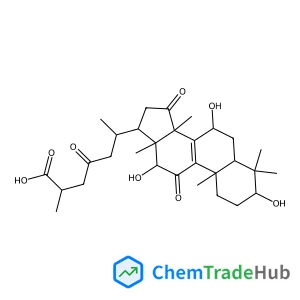
(3beta,7beta,12beta)-3,7,12-Trihydroxy-11,15,23-trioxolanost-8-en-26-oic acid
CAS Number:
98665-22-6
Molecular Formula:
C30H44O8
![N-[(Benzyloxy)carbonyl]serine structure](https://static.chemtradehub.com/structs/276/2768-56-1-77f7.webp "N-[(Benzyloxy)carbonyl]serine structure")
Recommended Suppliers





Disclaimer
This page provides academic journal information for reference and research purposes only. We are not affiliated with any journal publishers and do not handle publication submissions. For publication-related inquiries, please contact the respective journal publishers directly.
If you notice any inaccuracies in the information displayed, please contact us at support@chemtradehub.com. We will promptly review and address your concerns.