












Switchable 19F MRI polymer theranostics: towards in situ quantifiable drug release
Literature Information
Publication Date
2017-04-20
DOI
10.1039/C7PY00345E
Impact Factor
5.582
Authors
A. P. Bapat, G. J. Cowin
View Original
Abstract
A switchable polymeric 19F magnetic resonance imaging (MRI) contrast agent was synthesised whereby the transverse (T2) relaxation times increased as a therapeutic was released from a hyperbranched polymer (HBP) scaffold. The HBP comprised of poly(ethyleneglycol) monomethyl ether methacrylate (PEGMA), a fluorinated monomer (trifluoroethyl acrylate), and a suitable monomer for post-conjugation of a drug molecule. Three different hydrophobic drugs were investigated during design of the theranostic; doxorubicin (DOX) and docetaxel (DTX) were conjugated to the HBPs through an acid-cleavable hydrazone linkage, while camptothecin (CPT) was integrated into the HBP via polymerisation of a self-immolative disulphide-linked monomer. 19F NMR relaxometry measurements showed that the increase in hydrophobicity caused by the incorporation of the therapeutic drug led to a decrease in 19F T2 relaxation times and decrease in image intensity. However, upon drug release, the hydrophobicity of the HBP decreased which in turn led to improved mobility of the fluorinated moieities. This was manifest in a restoration of longer 19F T2 relaxation times and an increased image intensity compared to the drug-loaded polymer. This work provides a basis for a MRI contrast agent capable of quantifying in situ drug release.
Related Literature
DRACON: disconnected graph neural network for atom mapping in chemical reactions
Filipp Nikitin, Olexandr Isayev, Vadim Strijov
2020-11-05
Paper
DOI: 10.1039/D0CP04748A
Effects of a conductive support on the bonding of oxygen containing molecules to transition metal oxide surfaces
Hao Li, Jens K. Nørskov
2020-10-23
Paper
DOI: 10.1039/D0CP04536E
Revealing the biradicaloid nature inherited in the derivatives of thieno[3,4-c][1,2,5]thiadiazole: a computational study‡
Anup Thomas, Chenru Ji, B. Siddlingeshwar, Prashant Uday Manohar, Fuming Ying, Wei Wu
2020-11-13
Paper
DOI: 10.1039/D0CP05106C
Correction: Single-precision open-shell CCSD and CCSD(T) calculations on graphics processing units
Zhifan Wang, Minggang Guo, Fan Wang
2020-12-08
Correction
DOI: 10.1039/D0CP90266G
Correction: Temperature control in DRIFT cells used for in situ and operando studies: where do we stand today?
Ignacio Melián-Cabrera
2020-12-08
Correction
DOI: 10.1039/D0CP90267E
Anchored atomic tungsten on a B40 cage: a highly active and selective single-atom catalyst for nitrogen reduction
Wen-Ying Li, Yi-Bing Sun, Meng-Yang Li, Xiao-Yu Zhang, Xiang Zhao, Jing-Shuang Dang
2020-12-29
Paper
DOI: 10.1039/D0CP06178F
Investigating the mapping of chromophore excitations onto the electron detachment spectrum: photodissociation spectroscopy of iodide ion–thiouracil clusters
Kelechi O. Uleanya, Caroline E. H. Dessent
2021-01-05
Paper
DOI: 10.1039/D0CP05920J
The importance of the bacterial cell wall in uranium(vi) biosorption
Joseph Hufton, John Harding, Thomas Smith
2020-12-17
Paper
DOI: 10.1039/D0CP04067C
Complete equations of state for PETN and its products from atomistic simulations
Andrei E. Mukhanov, Semen A. Murzov
2020-11-16
Paper
DOI: 10.1039/D0CP03648J
Pulsed neutron imaging for differentiation of ice and liquid water towards fuel cell vehicle applications
Yuki Higuchi, Daigo Setoyama, Kazuhisa Isegawa, Yusuke Tsuchikawa, Yoshihiro Matsumoto, Joseph Don Parker, Takenao Shinohara, Yasutaka Nagai
2020-12-10
Paper
DOI: 10.1039/D0CP03887C
You might also like
Compound Q&A
Are there alternatives to 1-(4-Chlorophenyl)-N-hydroxymethanimine (CAS: 3848-36-0) in synthesis?
When considering alternatives to 1-(4-Chlorophenyl)-N-hydroxymethanimine (CAS: 3...
3848-36-01-(4-Chlorophenyl)-N...
Compound Q&A
How should (1R,9S,10S,12S,14E,16S,19R,20R,21S,22R)-3,9,21-Trihydroxy-5,10,12,14,16,20,22-heptamethyl-23,24-dioxatetracyclo[17.3.1.1~6,9~.0~2,7~]tetracosa-2,5,7,14-tetraen-4-one (CAS: 183202-73-5) be stored?
This compound should be stored in a cool, dry place away from direct sunlight. I...
183202-73-5(1R,9S,10S,12S,14E,1...
Compound Q&A
How is 3-(4-Bromophenyl)-5-(2-fluorophenyl)-1,2,4-oxadiazole (CAS: 419553-16-5) typically synthesized?
3-(4-Bromophenyl)-5-(2-fluorophenyl)-1,2,4-oxadiazole is synthesized through a m...
419553-16-53-(4-Bromophenyl)-5-...
Compound Q&A
How is 5-Chloro-2-(4-chlorophenyl)-4-methyl-6-[3-(1-piperidinyl)propoxy]pyrimidine (CAS: 1639220-19-1) typically synthesized?
5-Chloro-2-(4-chlorophenyl)-4-methyl-6-[3-(1-piperidinyl)propoxy]pyrimidine (CAS...
1639220-19-15-Chloro-2-(4-chloro...
Compound Q&A
What industries use 2-Chloro-4-(difluoromethoxy)pyridine (CAS: 1206978-15-5)?
2-Chloro-4-(difluoromethoxy)pyridine is used in the pharmaceutical industry for ...
1206978-15-52-Chloro-4-(difluoro...
Compound Q&A
What regulatory guidelines apply to 3-Chloro-6-methylpyridazine (CAS: 1121-79-5)?
3-Chloro-6-methylpyridazine (CAS: 1121-79-5) is classified under the Globally Ha...
1121-79-53-Chloro-6-methylpyr...
Compound Q&A
Are there alternatives to Methyl 4,5-dimethyl-2-nitrobenzoate in synthesis?
Several alternatives can be used in the synthesis of Methyl 4,5-dimethyl-2-nitro...
90922-74-0Methyl 4,5-dimethyl-...
Compound Q&A
Are there alternatives to (2E,2'E)-3,3'-(1,4-Phenylene)bisacrylaldehyde in synthesis?
Alternatives to (2E,2'E)-3,3'-(1,4-Phenylene)bisacrylaldehyde include other acry...
63405-68-5(2E,2'E)-3,3'-(1,4-P...
Compound Q&A
What is 3-Amino-5-chloropyridin-2-ol hydrochloride (CAS: 1261906-29-9)?
3-Amino-5-chloropyridin-2-ol hydrochloride is an organic compound with the CAS n...
1261906-29-93-Amino-5-chloropyri...
Compound Q&A
What precautions should be taken when handling 6,7-Difluoro-2,3-dihydro-4H-chromen-4-one (CAS: 1092349-93-3)?
When handling 6,7-Difluoro-2,3-dihydro-4H-chromen-4-one, it is essential to wear...
1092349-93-36,7-Difluoro-2,3-dih...
Source Journal
Polymer Chemistry

CiteScore:
8.6
Self-citation Rate:
7.3%
Articles per Year:
457
Polymer Chemistry welcomes submissions in all areas of polymer science that have a strong focus on macromolecular chemistry. Manuscripts may cover a broad range of fields, yet no direct application focus is required.
Recommended Compounds
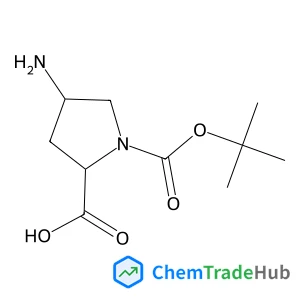
(2R,4R)-1-Boc-4-Aminopyrrolidine-2-carboxylic acid
CAS Number:
132622-98-1
Molecular Formula:
C10H18N2O4
Recommended Suppliers





Disclaimer
This page provides academic journal information for reference and research purposes only. We are not affiliated with any journal publishers and do not handle publication submissions. For publication-related inquiries, please contact the respective journal publishers directly.
If you notice any inaccuracies in the information displayed, please contact us at support@chemtradehub.com. We will promptly review and address your concerns.