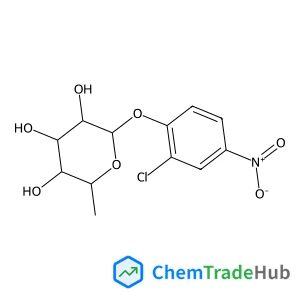
2-Chloro-4-nitrophenyl 6-deoxy-alpha-L-galactopyranoside
CAS Number:
157843-41-9
Molecular Formula:
C12H14ClNO7
A graphical abstract is available for this content
Zhiyong Wang, Gang Zou, Jie Tang
DOI: 10.1039/B401511H
Man-Rong Li, Wei Liu, Ming-Hui Ge, Hao-Hong Chen, Xin-Xin Yang, Jing-Tai Zhao
DOI: 10.1039/B402966F
Jian-Jun Zhang, Sheng-Qing Xia, Tian-Lu Sheng, Sheng-Min Hu, Guido Leibeling, Franc Meyer, Xin-Tao Wu, Sheng-Chang Xiang, Rui-Biao Fu
DOI: 10.1039/B400447G
Taramatee Ramnial, Iain McKenzie, Brian Gorodetsky, Emily M. W. Tsang, Jason A. C. Clyburne
DOI: 10.1039/B314110A
Rajan Venkatesh, Bastiaan B P Staal, Bert Klumperman
DOI: 10.1039/B403342F
Donna C. Arnold, Chris J. Nuttall, Alexandros Lappas
DOI: 10.1039/B405907G
Sophie H. Dale, Mark R. J. Elsegood, Simon J. Richards
DOI: 10.1039/B402922D
Robert J. P. Corriu, Ahmad Mehdi, Catherine Reyé, Chloé Thieuleux
DOI: 10.1039/B314415A
Stéphane Solé, François P. Gabbaï
DOI: 10.1039/B403596H
Cristina Femoni, M. Carmela Iapalucci, Giuliano Longoni, Per H. Svensson
DOI: 10.1039/B409522G
When handling 2-Chloro-1,2-bis(4-methylphenyl)ethanone (CAS: 71193-32-3), it is ...
4-Ethoxy-3-(5-methyl-4-oxo-7-propyl-1,4-dihydroimidazo[5,1-f][1,2,4]triazin-2-yl...
Methyl 3-Oxo-4-Androsten-17-Carboxylate (CAS: 2681-55-2) should be stored in a c...
(R)-3-Amino-4-(3-hexylphenylamino)-4-oxobutylphosphonic acid is primarily used i...
2-Methyl-2-propanyl 3-amino-3-carbamoyl-1-azetidinecarboxylate (CAS: 1254120-14-...
There are alternative reagents that can be used in synthesis instead of (E)-4-(t...
[2-(3-Chlorophenyl)-1,3-thiazol-4-yl]methanol (CAS: 121202-20-8) is a crystallin...
The market and research trends for Methyl (2S)-[(4S)-2,2-dimethyl-1,3-dioxolan-4...
The market for 1-Bromo-2-isocyanatoethane (CAS: 42865-19-0) is driven by its use...
4-Nitro-D-phenylalanine hydrochloride (CAS: 147065-06-3) is primarily used in re...

Organic & Biomolecular Chemistry (OBC) publishes original and high impact research and reviews in organic chemistry. We welcome research that shows new or significantly improved protocols or methodologies in total synthesis, synthetic methodology or physical and theoretical organic chemistry as well as research that shows a significant advance in the organic chemistry or molecular design aspects of chemical biology, catalysis, supramolecular and macromolecular chemistry, theoretical chemistry, mechanism-oriented physical organic chemistry, medicinal chemistry or natural products. Articles published in the journal should report new work which makes a highly-significant impact in the field. Routine and incremental work is generally not suitable for publication in the journal. More details about key areas of our scope are below. In all cases authors should include in their article clear rationale for why their research has been carried out.