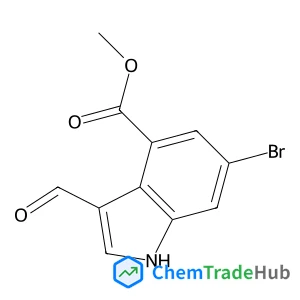
methyl 6-bromo-3-formyl-1H-indole-4-carboxylate
CAS Number:
1353636-63-1
Molecular Formula:
C11H8BrNO3
William D. G. Brittain, Steven L. Cobb
The Negishi cross-coupling is a powerful C–C bond-forming reaction widely utilised in many areas of organic synthesis. This review details the use of Negishi cross-couplings in the synthesis of unnatural amino acids. The application of this reaction in the preparation of aromatic, heteroaromatic, and, complex amino acid derivatives are reviewed and presented herein.
Akihiro Kimura, Haruka Hayama, Hassan Nageh, Yue Wang, Naofumi Naga
DOI: 10.1039/C7PY01509G
Fei Gao, Yaohui Xing, Yuan Yao, Liuying Sun, Yao Sun, Xiaohua He, Shaoliang Lin
DOI: 10.1039/C7PY01591G
I. Terzic, N. L. Meereboer, K. Loos
DOI: 10.1039/C8PY00742J
Stefan Brits, William J. Neary, Goutam Palui, Justin G. Kennemur
DOI: 10.1039/C7PY01922J
Patxi Garra, Céline Dietlin, Fabrice Morlet-Savary, Frédéric Dumur, Didier Gigmes, Jean-Pierre Fouassier, Jacques Lalevée
DOI: 10.1039/C7PY01778B
Ryo Tanaka, Naoki Tonoko, Shin-ichi Kihara, Yuushou Nakayama, Takeshi Shiono
DOI: 10.1039/C8PY00519B
Marcus H. Reis, Cullen L. G. Davidson, IV, Frank A. Leibfarth
DOI: 10.1039/C7PY01938F
Maarten Rubens, Phanumat Latsrisaeng
DOI: 10.1039/C7PY01157A
P. S. Eselem Bungu, H. Pasch
DOI: 10.1039/C7PY02076G
(3.beta.)-3-Hydroxy-N,N-dimethyl-chol-5-en-24-amide (CAS: 79066-03-8) is primari...
5-(Aminomethyl)-2-methoxyphenol (CAS: 89702-89-6) is classified under GHS as a s...
Thieno[2,3-c]pyridin-7(6H)-one (CAS: 28981-13-7) is a heterocyclic organic compo...
1-[(6-Methoxy-3-pyridinyl)methyl]-4-piperidinamine dihydrochloride is generally ...
[(2E)-3-Phenyl-2-propen-1-yl]phosphonic acid (CAS: 146404-58-2) is regulated und...
6-Bromo-7-methoxyquinoline (CAS: 1620515-86-7) falls under the scope of the Glob...
This compound is primarily used in the pharmaceutical industry for the developme...
1-Ethyl-7-[2-methyl-6-(4H-1,2,4-triazol-3-yl)-3-pyridinyl]-3,5-dihydropyrazino[2...
Alternative reagents such as 2-[(dimethylamino)methyl]phenylboronic acid or rela...
3-(Piperidin-4-yloxy)pyridine (CAS: 310881-48-2) is an organic compound with the...

Organic & Biomolecular Chemistry (OBC) publishes original and high impact research and reviews in organic chemistry. We welcome research that shows new or significantly improved protocols or methodologies in total synthesis, synthetic methodology or physical and theoretical organic chemistry as well as research that shows a significant advance in the organic chemistry or molecular design aspects of chemical biology, catalysis, supramolecular and macromolecular chemistry, theoretical chemistry, mechanism-oriented physical organic chemistry, medicinal chemistry or natural products. Articles published in the journal should report new work which makes a highly-significant impact in the field. Routine and incremental work is generally not suitable for publication in the journal. More details about key areas of our scope are below. In all cases authors should include in their article clear rationale for why their research has been carried out.