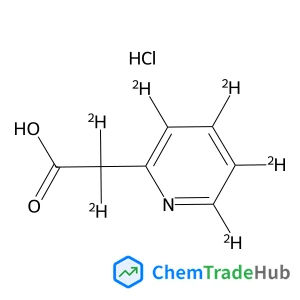
2,2-dideuterio-2-(3,4,5,6-tetradeuterio-2-pyridyl)acetic acid;hydrochloride
CAS Number:
1329799-67-8
Molecular Formula:
C7H2ClD6NO2
Marcus H. Reis, Cullen L. G. Davidson, IV, Frank A. Leibfarth
Presented herein is an operationally simple and reliable approach to the determination of comonomer reactivity ratios using continuous flow. The benefits of continuous-flow chemistry include the precise control of reaction time, heat transfer, and the ability to dynamically alter continuous variables within a single experiment. The flow system produces nine samples reacted to low conversions with systematically varied comonomer compositions in under one hour. The polymer compositions were fit to a model of terminal copolymerization resulting in point estimates for comonomer reactivity ratios. The continuous-flow system was validated by the determination of five comonomer reactivity ratios that provided good agreement with literature values. The method is demonstrated to streamline the determination of especially challenging comonomer systems, such as those with fast kinetics or disparate reactivity. Using sustainably-derived lignin-based methacrylates, our continuous-flow approach enabled the determination of reactivity ratios for three comonomer pairs that have not been previously reported. We envision the continuous-flow method will catalyze the further exploration of statistical copolymers in both batch and continuous flow.
Ali Nematollahzadeh
DOI: 10.1039/D3AY01160G
Shanshan Zhou, Zongxin Li, Yan Li, Xiaoyao Wang, Kun Deng
DOI: 10.1039/D3AY01938A
Guoyun Wan, Xuheng Chen, Ruiling Gou, Chenguang Guan, Jiayu Chen, Qian Wang, Qiqing Zhang, Haijiao Wang
DOI: 10.1039/D3BM01627G
Krishnaja Tikkisetty, Taylor Filewood, Jeffrey Yan, Honoria Kwok, Pamela Brunswick, Robert Cody, Dayue Shang
DOI: 10.1039/D3AY01282D
Yudong Yao
DOI: 10.1039/D3BM01489D
Rhona M. Cowan, Eleanor Birch, Grace Nisbet, Chimaeze Onyeiwu, Clare Campbell, Ian Archer, Dominic J. Campopiano
DOI: 10.1039/D3AY01433A
Dai Junfeng, Fu Li-hui
DOI: 10.1039/D3AY01462B
Clément Praud, Victor Ribay, Arnab Dey, Benoît Charrier, Joris Mandral, Jonathan Farjon, Jean-Nicolas Dumez, Patrick Giraudeau
DOI: 10.1039/D3AY01681A
Mahdi Golsanamlou
DOI: 10.1039/D3AY00828B
4-Nitrophenyl phosphate disodium salt hexahydrate is primarily used as a substra...
2-(Trifluoromethyl)-1,3-oxazole-4-carboxylic Acid (CAS: 1060816-01-4) is widely ...
2-Fluoro-4-biphenylcarboxylic acid should be stored in a cool, dry place at room...
Prednisolone-21-Carboxylic Acid is primarily used in the pharmaceutical industry...
4-(Hydrazinomethyl)-1,2,3-benzenetriol (CAS: 3614-72-0) should be stored in a co...
4-Amino-1-methyl-1H-pyrazole-5-carboxylic acid hydrochloride (CAS: 92534-70-8) i...
Dehydropachymic acid (CAS: 77012-31-8) is regulated by various agencies. It fall...
The market and research trends for 6-[(2,2-Dimethylpropanoyl)amino]nicotinic aci...
1,10-Phenanthroline-2,9-dicarbaldehyde should be stored in a cool, dry place awa...
5-Carbamoyl-11-oxo-10,11-dihydro-5H-dibenzo[b,f]azepin-10-yl acetate can be synt...

Polymer Chemistry welcomes submissions in all areas of polymer science that have a strong focus on macromolecular chemistry. Manuscripts may cover a broad range of fields, yet no direct application focus is required.

![1-[(4-Methylphenyl)sulfonyl]-3-(4,4,5,5-tetramethyl-1,3,2-dioxaborolan-2-yl)-1H-pyrrolo[2,3-b]pyridine-5-carbonitrile structure](https://static.chemtradehub.com/structs/143/1434747-57-5-fc0d.webp "1-[(4-Methylphenyl)sulfonyl]-3-(4,4,5,5-tetramethyl-1,3,2-dioxaborolan-2-yl)-1H-pyrrolo[2,3-b]pyridine-5-carbonitrile structure")