












A nickel catalyzed acceptorless dehydrogenative approach to quinolines
Literature Information
Publication Date
2017-12-05
DOI
10.1039/C7OB02670F
Impact Factor
3.876
Authors
Seuli Parua, Rina Sikari, Suman Sinha, Siuli Das, Gargi Chakraborty, Nanda D. Paul
View Original
Abstract
A general, efficient and environmentally benign, one-step synthesis of substituted quinoline derivatives was achieved by acceptorless dehydrogenative coupling of o-aminobenzylalcohols with ketones and secondary alcohols catalyzed by a cheap, earth abundant and easy to prepare nickel catalyst [Ni(MeTAA)], featuring a tetraaza macrocyclic ligand (tetramethyltetraaza[14]annulene (MeTAA)). A wide variety of substituted quinolines were synthesized in high yields starting from readily available o-aminobenzylalcohols and ketones or secondary alcohols. A few controlled reactions were carried out to establish the acceptorless dehydrogenative nature of the reactions.
Recommended Journals
Related Literature
The natural DNA bending angle in the lac repressor headpiece–O1 operator complex is determined by protein–DNA contacts and water release
Daniel Barr, Arjan van der Vaart
2011-12-09
Paper
DOI: 10.1039/C2CP23780F
Potential-induced phase transition of low-index Au single crystal surfaces in propylene carbonate solution
Youn-Geun Kim, Kazuhiro Sato, Junji Inukai, Kingo Itaya
2011-11-23
Paper
DOI: 10.1039/C2CP23171A
Reversible transient hydrogenstorage in a fuelcell–supercapacitor hybrid device
Jesus E. Zerpa Unda, Emil Roduner
2012-02-09
Paper
DOI: 10.1039/C2CP23140A
Laser pulse trains for controlling excited state dynamics of adenine in water
Jens Petersen, Matthias Wohlgemuth, Bernhard Sellner, Roland Mitrić
2012-01-17
Paper
DOI: 10.1039/C2CP24002E
Photophysics of indole-2-carboxylic acid in an aqueous environment studied by fluorescence spectroscopy in combination with ab initio calculations
Annemarie Huijser, Michał F. Rode, Alice Corani, Andrzej L. Sobolewski, Villy Sundström
2012-01-10
Paper
DOI: 10.1039/C2CP22958G
UV and IR spectroscopy of cold 1,2-dimethoxybenzene complexes with alkali metal ions
Yoshiya Inokuchi, Oleg V. Boyarkin, Takayuki Ebata, Thomas R. Rizzo
2012-01-26
Paper
DOI: 10.1039/C2CP24018A
Hydration and interactions in protein solutions containing concentrated electrolytes studied by small-angle scattering
F. Zhang, F. Roosen-Runge, M. W. A. Skoda, R. M. J. Jacobs, M. Wolf, Ph. Callow, H. Frielinghaus, V. Pipich, S. Prévost, F. Schreiber
2011-12-14
Paper
DOI: 10.1039/C2CP23460B
Magnetic properties of a doped linear polyarylamine bearing a high concentration of coupled spins (S = 1)
Vincent Maurel, Mohammad Jouni, Piotr Baran, Nicolas Onofrio, Serge Gambarelli, Jean-Marie Mouesca, David Djurado, Lionel Dubois, Jean-François Jacquot, Gérard Desfonds, Irena Kulszewicz-Bajer
2011-12-07
Paper
DOI: 10.1039/C1CP22766A
You might also like
Compound Q&A
What are the main uses of (3.beta.)-3-Hydroxy-N,N-dimethyl-chol-5-en-24-amide (CAS: 79066-03-8)?
(3.beta.)-3-Hydroxy-N,N-dimethyl-chol-5-en-24-amide (CAS: 79066-03-8) is primari...
79066-03-8(3.beta.)-3-Hydroxy-...
Compound Q&A
What regulatory guidelines apply to 5-(aminomethyl)-2-methoxyphenol (CAS: 89702-89-6)?
5-(Aminomethyl)-2-methoxyphenol (CAS: 89702-89-6) is classified under GHS as a s...
89702-89-65-(aminomethyl)-2-me...
Compound Q&A
What is Thieno[2,3-c]pyridin-7(6H)-one (CAS: 28981-13-7)?
Thieno[2,3-c]pyridin-7(6H)-one (CAS: 28981-13-7) is a heterocyclic organic compo...
28981-13-7Thieno[2,3-c]pyridin...
Compound Q&A
Is 1-[(6-Methoxy-3-pyridinyl)methyl]-4-piperidinamine dihydrochloride (CAS: 1185311-28-7) safe?
1-[(6-Methoxy-3-pyridinyl)methyl]-4-piperidinamine dihydrochloride is generally ...
1185311-28-71-[(6-Methoxy-3-pyri...
Compound Q&A
What regulatory guidelines apply to [(2E)-3-Phenyl-2-propen-1-yl]phosphonic acid (CAS: 146404-58-2)?
[(2E)-3-Phenyl-2-propen-1-yl]phosphonic acid (CAS: 146404-58-2) is regulated und...
146404-58-2[(2E)-3-Phenyl-2-pro...
Compound Q&A
What regulatory guidelines apply to 6-Bromo-7-methoxyquinoline (CAS: 1620515-86-7)?
6-Bromo-7-methoxyquinoline (CAS: 1620515-86-7) falls under the scope of the Glob...
1620515-86-76-Bromo-7-methoxyqui...
Compound Q&A
What industries use (2R)-1-(1-Benzofuran-2-yl)-N-propyl-2-pentanamine (CAS: 260550-89-8)?
This compound is primarily used in the pharmaceutical industry for the developme...
260550-89-8(2R)-1-(1-Benzofuran...
Compound Q&A
What are the main uses of 1-Ethyl-7-[2-methyl-6-(4H-1,2,4-triazol-3-yl)-3-pyridinyl]-3,5-dihydropyrazino[2,3-b]pyrazin-2(1H)-one (CAS: 1228013-15-7)?
1-Ethyl-7-[2-methyl-6-(4H-1,2,4-triazol-3-yl)-3-pyridinyl]-3,5-dihydropyrazino[2...
1228013-15-71-Ethyl-7-[2-methyl-...
Compound Q&A
Are there alternatives to {5-(Acryloylamino)-2-[(dimethylamino)methyl]phenyl}boronic acid (CAS: 1217500-78-1) in synthesis?
Alternative reagents such as 2-[(dimethylamino)methyl]phenylboronic acid or rela...
1217500-78-1{5-(Acryloylamino)-2...
Compound Q&A
What is 3-(Piperidin-4-yloxy)pyridine (CAS: 310881-48-2)?
3-(Piperidin-4-yloxy)pyridine (CAS: 310881-48-2) is an organic compound with the...
310881-48-23-(Piperidin-4-yloxy...
Source Journal
Organic & Biomolecular Chemistry

CiteScore:
3.4
Self-citation Rate:
10.3%
Articles per Year:
1041
Organic & Biomolecular Chemistry (OBC) publishes original and high impact research and reviews in organic chemistry. We welcome research that shows new or significantly improved protocols or methodologies in total synthesis, synthetic methodology or physical and theoretical organic chemistry as well as research that shows a significant advance in the organic chemistry or molecular design aspects of chemical biology, catalysis, supramolecular and macromolecular chemistry, theoretical chemistry, mechanism-oriented physical organic chemistry, medicinal chemistry or natural products. Articles published in the journal should report new work which makes a highly-significant impact in the field. Routine and incremental work is generally not suitable for publication in the journal. More details about key areas of our scope are below. In all cases authors should include in their article clear rationale for why their research has been carried out.
Recommended Compounds
![Bis(N,N''-dimethylpiperazine)tetra[copper(I) iodide] structure](https://static.chemtradehub.com/structs/140/1401708-91-5-2b86.webp "Bis(N,N''-dimethylpiperazine)tetra[copper(I) iodide] structure")
Bis(N,N''-dimethylpiperazine)tetra[copper(I) iodide]
CAS Number:
1401708-91-5
Molecular Formula:
C12H28Cu4I4N4
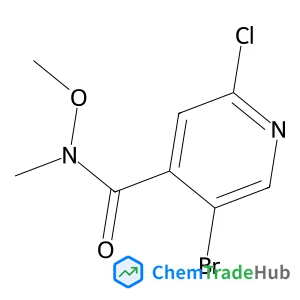
5-Bromo-2-chloro-N-methoxy-N-methylisonicotinamide
CAS Number:
1256790-08-5
Molecular Formula:
C8H8BrClN2O2
![4,4-Difluoro-2-methyl-1-{[(2-methyl-2-propanyl)oxy]carbonyl}-L-proline structure](https://static.chemtradehub.com/structs/119/1194032-23-9-f426.webp "4,4-Difluoro-2-methyl-1-{[(2-methyl-2-propanyl)oxy]carbonyl}-L-proline structure")
4,4-Difluoro-2-methyl-1-{[(2-methyl-2-propanyl)oxy]carbonyl}-L-proline
CAS Number:
1194032-23-9
Molecular Formula:
C11H17F2NO4
Recommended Suppliers






Disclaimer
This page provides academic journal information for reference and research purposes only. We are not affiliated with any journal publishers and do not handle publication submissions. For publication-related inquiries, please contact the respective journal publishers directly.
If you notice any inaccuracies in the information displayed, please contact us at support@chemtradehub.com. We will promptly review and address your concerns.