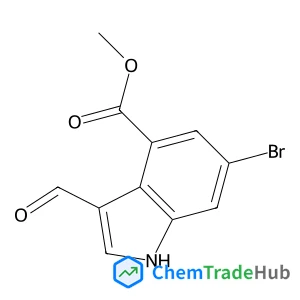
methyl 6-bromo-3-formyl-1H-indole-4-carboxylate
CAS Number:
1353636-63-1
Molecular Formula:
C11H8BrNO3
Yoshiya Inokuchi, Oleg V. Boyarkin, Takayuki Ebata, Thomas R. Rizzo
We report UV photodissociation (UVPD) and IR-UV double-resonance spectra of 1,2-dimethoxybenzene (DMB) complexes with alkali metal ions, M+·DMB (M = Li, Na, K, Rb, and Cs), in a cold, 22-pole ion trap. The UVPD spectrum of the Li+ complex shows a strong origin band. For the K+·DMB, Rb+·DMB, and Cs+·DMB complexes, the origin band is very weak and low-frequency progressions are much more extensive than that of the Li+ ion. In the case of the Na+·DMB complex, spectral features are similar to those of the K+, Rb+, and Cs+ complexes, but vibronic bands are not resolved. Geometry optimization with density functional theory indicates that the metal ions are bonded to the oxygen atoms in all the M+·DMB complexes. For the Li+ complex in the S0 state, the Li+ ion is located in the same plane as the benzene ring, while the Na+, K+, Rb+, and Cs+ ions are located off the plane. In the S1 state, the Li+ complex has a structure similar to that in the S0 state, providing the strong origin band in the UV spectrum. In contrast, the other complexes show a large structural change in the out-of-plane direction upon S1–S0 excitation, which results in the extensive low-frequency progressions in the UVPD spectra. For the Na+·DMB complex, fast charge transfer occurs from Na+ to DMB after the UV excitation, making the bandwidth of the UVPD spectrum much broader than that of the other complexes and producing the photofragment DMB+ ion.
Qian Li, Xiao Li, Zhongying Wu, Yuhao Sun, Jianglin Fang, Dongzhong Chen
DOI: 10.1039/C8PY00710A
Patxi Garra, Céline Dietlin, Fabrice Morlet-Savary, Frédéric Dumur, Didier Gigmes, Jean-Pierre Fouassier, Jacques Lalevée
DOI: 10.1039/C7PY01778B
Wei Song, Ruiyu Jiang, Lei Zhu
DOI: 10.1039/C6PY01743F
Marcus H. Reis, Cullen L. G. Davidson, IV, Frank A. Leibfarth
DOI: 10.1039/C7PY01938F
Tongtong Zhou, Tao Liu, Yu Bao, Ping Zhang, Casey Yan, Fujun Yao, Shuxun Cui, Yongming Chen, Xin Chen, You Yu
DOI: 10.1039/C7PY01844D
Xiaoqi Zhao, Wentao Wu, Jian Zhang, Wenxue Dai, Youliang Zhao
DOI: 10.1039/C8PY00085A
R. W. M. Davidson, G. W. Simpson, J. Chiefari, M. J. Fuchter
DOI: 10.1039/C7PY01363A
Jiaojiao Shang, Shaojian Lin, Patrick Theato
DOI: 10.1039/C7PY01628J
(3.beta.)-3-Hydroxy-N,N-dimethyl-chol-5-en-24-amide (CAS: 79066-03-8) is primari...
5-(Aminomethyl)-2-methoxyphenol (CAS: 89702-89-6) is classified under GHS as a s...
Thieno[2,3-c]pyridin-7(6H)-one (CAS: 28981-13-7) is a heterocyclic organic compo...
1-[(6-Methoxy-3-pyridinyl)methyl]-4-piperidinamine dihydrochloride is generally ...
[(2E)-3-Phenyl-2-propen-1-yl]phosphonic acid (CAS: 146404-58-2) is regulated und...
6-Bromo-7-methoxyquinoline (CAS: 1620515-86-7) falls under the scope of the Glob...
This compound is primarily used in the pharmaceutical industry for the developme...
1-Ethyl-7-[2-methyl-6-(4H-1,2,4-triazol-3-yl)-3-pyridinyl]-3,5-dihydropyrazino[2...
Alternative reagents such as 2-[(dimethylamino)methyl]phenylboronic acid or rela...
3-(Piperidin-4-yloxy)pyridine (CAS: 310881-48-2) is an organic compound with the...

Physical Chemistry Chemical Physics (PCCP) is an international journal co-owned by 19 physical chemistry and physics societies from around the world. This journal publishes original, cutting-edge research in physical chemistry, chemical physics and biophysical chemistry. To be suitable for publication in PCCP, articles must include significant innovation and/or insight into physical chemistry; this is the most important criterion that reviewers and Editors will judge against when evaluating submissions. The journal has a broad scope and welcomes contributions spanning experiment, theory, computation and data science. Topical coverage includes spectroscopy, dynamics, kinetics, statistical mechanics, thermodynamics, electrochemistry, catalysis, surface science, quantum mechanics, quantum computing and machine learning. Interdisciplinary research areas such as polymers and soft matter, materials, nanoscience, energy, surfaces/interfaces, and biophysical chemistry are welcomed if they demonstrate significant innovation and/or insight into physical chemistry. Joined experimental/theoretical studies are particularly appreciated when complementary and based on up-to-date approaches.
![N-[4-(Cyanoethynyl)phenyl]-16-oxo-4,7,10,13-tetraoxa-17-azahenicos-1-yn-21-amide structure](https://static.chemtradehub.com/structs/218/2183440-36-8-68cb.webp "N-[4-(Cyanoethynyl)phenyl]-16-oxo-4,7,10,13-tetraoxa-17-azahenicos-1-yn-21-amide structure")