












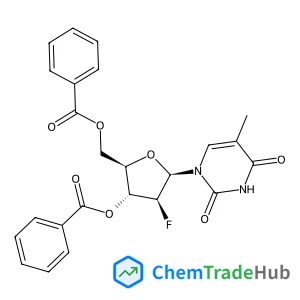
1-(3',5'-Di-O-benzoyl-2'-deoxy-2'-fluoro-b-D-arabinofuranosyl)thymine
CAS Number:
97614-47-6
Molecular Formula:
C24H21FN2O7
Youn-Geun Kim, Kazuhiro Sato, Junji Inukai, Kingo Itaya
In situ scanning tunneling microscopy (STM) was employed to examine the surface structures of Au(111), Au(100), and Au(110) single crystals in propylene carbonate (PC) containing tetrabutylammonium perchlorate (TBAP). All three electrodes exhibited potential-induced phase transition between the reconstructed and unreconstructed (1 × 1) structures at negative and positive potentials, respectively. The potential-induced phase transition of the Au electrode surfaces is attributed to the interaction of the TBA cation and the perchlorate anion at the electrode surface, which is similar to that which takes place in aqueous solutions. In addition to static atomic structures, dynamic processes of both the reconstruction and the lifting of the reconstruction were investigated by means of in situSTM. The lifting of reconstructed Au(111)-(√3 × 22) on Au(111) to the (1 × 1) structure is completed within 1 min at a positive potential. The diffusion of Au atoms on the Au(100) plane in the PC solution proceeds more rapidly than that in the aqueous solution, suggesting that the PC solvent plays an important role in accelerating the diffusion of Au atoms.
Amélie Augé, Daniel Fortin, Xia Tong, Yue Zhao
DOI: 10.1039/C8PY00960K
Zhen Zhang, Yongcun Zhou, Zhuxian Zhou, Ying Piao, Nagendra Kalva, Xiangrui Liu, Jianbin Tang, Youqing Shen
DOI: 10.1039/C7PY01492A
Akihiro Kimura, Haruka Hayama, Hassan Nageh, Yue Wang, Naofumi Naga
DOI: 10.1039/C7PY01509G
Li Yu, Mei Zhang, Fu-Sheng Du, Zi-Chen Li
DOI: 10.1039/C8PY00620B
Tongtong Zhou, Tao Liu, Yu Bao, Ping Zhang, Casey Yan, Fujun Yao, Shuxun Cui, Yongming Chen, Xin Chen, You Yu
DOI: 10.1039/C7PY01844D
Meirong Cai, Bo Yu, Feng Zhou
DOI: 10.1039/C7PY01532A
Ozcan Altintas, Joshua C. Speros, Frank S. Bates, Marc A. Hillmyer
DOI: 10.1039/C8PY00937F
Qinzhi Quan, Honghong Gong, Mao Chen
DOI: 10.1039/C8PY00990B
Yangchun Tao, Siwei Liu, Yi Zhang, Zhenguo Chi, Jiarui Xu
DOI: 10.1039/C7PY02108A
(3.beta.)-3-Hydroxy-N,N-dimethyl-chol-5-en-24-amide (CAS: 79066-03-8) is primari...
5-(Aminomethyl)-2-methoxyphenol (CAS: 89702-89-6) is classified under GHS as a s...
Thieno[2,3-c]pyridin-7(6H)-one (CAS: 28981-13-7) is a heterocyclic organic compo...
1-[(6-Methoxy-3-pyridinyl)methyl]-4-piperidinamine dihydrochloride is generally ...
[(2E)-3-Phenyl-2-propen-1-yl]phosphonic acid (CAS: 146404-58-2) is regulated und...
6-Bromo-7-methoxyquinoline (CAS: 1620515-86-7) falls under the scope of the Glob...
This compound is primarily used in the pharmaceutical industry for the developme...
1-Ethyl-7-[2-methyl-6-(4H-1,2,4-triazol-3-yl)-3-pyridinyl]-3,5-dihydropyrazino[2...
Alternative reagents such as 2-[(dimethylamino)methyl]phenylboronic acid or rela...
3-(Piperidin-4-yloxy)pyridine (CAS: 310881-48-2) is an organic compound with the...

Physical Chemistry Chemical Physics (PCCP) is an international journal co-owned by 19 physical chemistry and physics societies from around the world. This journal publishes original, cutting-edge research in physical chemistry, chemical physics and biophysical chemistry. To be suitable for publication in PCCP, articles must include significant innovation and/or insight into physical chemistry; this is the most important criterion that reviewers and Editors will judge against when evaluating submissions. The journal has a broad scope and welcomes contributions spanning experiment, theory, computation and data science. Topical coverage includes spectroscopy, dynamics, kinetics, statistical mechanics, thermodynamics, electrochemistry, catalysis, surface science, quantum mechanics, quantum computing and machine learning. Interdisciplinary research areas such as polymers and soft matter, materials, nanoscience, energy, surfaces/interfaces, and biophysical chemistry are welcomed if they demonstrate significant innovation and/or insight into physical chemistry. Joined experimental/theoretical studies are particularly appreciated when complementary and based on up-to-date approaches.
![7-Bromo-5-chloro-1H-pyrazolo[4,3-b]pyridine structure](https://static.chemtradehub.com/structs/135/1351813-70-1-a716.webp "7-Bromo-5-chloro-1H-pyrazolo[4,3-b]pyridine structure")




