












Withapubesides A–D: natural inducible nitric oxide synthase (iNOS) inhibitors from Physalis pubescens
Literature Information
Publication Date
2017-11-13
DOI
10.1039/C7OB02551C
Impact Factor
3.876
Authors
Bing-Yang Zhang, Yang Li, Ning Kang, Shi-Jie Cao, Li-Qin Ding, Li-Xia Chen, Feng Qiu
View Original
Abstract
Four new steroid glycosides, withapubesides A–D (1–4), were isolated from the stems of Physalis pubescens L. Their structures were elucidated primarily by NMR experiments. The absolute configurations of 1 and 2 were deduced by single-crystal X-ray diffraction and ECD data analysis, respectively. Compound 3 has shown significant inhibitory activity against LPS-induced nitric oxide production in RAW 264.7 macrophages with an IC50 value of 12.8 μM and moderate cytostatic activity against human carcinoma cells (786-O, C4-2B, 22Rvl, A375 and A375S2) with IC50 values in the range of 3.05–9.47 μM. Molecular docking simulation demonstrated that 3 is bound in the inducible nitric oxide synthase (iNOS) active site heme pocket very well, which suggests that 3 might be a candidate for the development of iNOS inhibitors.
Recommended Journals
Related Literature
Oxy-peptide nucleic acid with a pyrrolidine ring that is configurationally optimized for hybridization with DNA
Mizuki Kitamatsu, Masanori Shigeyasu, Tomoyuki Okada, Masahiko Sisido
2004-04-23
Communication
DOI: 10.1039/B401057D
Desymmetrization of meso-dienyne by asymmetric Pauson–Khand type reaction catalysts
Nakcheol Jeong, Dong Hoon Kim, Jun Hun Choi
2004-04-08
Communication
DOI: 10.1039/B401288G
A novel supramolecular assembly in an iron(iii) compound exhibiting magnetic ordering at 70 K
Donatella Armentano, Giovanni De Munno, Teresa F. Mastropietro, Miguel Julve, Francesc Lloret
2004-04-21
Communication
DOI: 10.1039/B402055C
Direct syntheses of functionalized mesostructured silica by using an inexpensive silica source‡
Robert J. P. Corriu, Ahmad Mehdi, Catherine Reyé, Chloé Thieuleux
2004-05-19
Communication
DOI: 10.1039/B314415A
Effective stabilisation of α-helical structures in short peptides with acetylenic cross-linking agents
Kazuhisa Fujimoto, Natsuko Oimoto, Kahori Katsuno, Masahiko Inouye
2004-05-10
Communication
DOI: 10.1039/B403615H
Strategies toward improving the performance of fluorescence-based sensors for inorganic anions
Radek Pohl, Dmitry Aldakov, Pavel Kubát, Karolina Jursíková, Manuel Marquez, Pavel Anzenbacher, Jr.
2004-05-10
Communication
DOI: 10.1039/B315268E
Solid-state caging of 1,10-phenanthroline π–π stacked dimers by calix[4]arene dihydroxyphosphonic acid
Adina N. Lazar, Alda Navaza, Anthony W. Coleman
2004-03-30
Communication
DOI: 10.1039/B315600C
First cation radical salt of a tetrathiafulvalene–based phosphine metal complex
Narcis Avarvari, Marc Fourmigué
2004-05-05
Communication
DOI: 10.1039/B403168G
Y-shaped two-photon absorbing molecules with an imidazole–thiazole core
Ke Feng, Leonardo De Boni, Lino Misoguti, C. R. Mendonça, Michael Meador, Fu-Lian Hsu, Xiu R. Bu
2004-04-21
Communication
DOI: 10.1039/B402019G
NH4[BPO4F]: A novel open-framework ammonium fluorinated borophosphate with a zeolite-like structure related to gismondine topology
Man-Rong Li, Wei Liu, Ming-Hui Ge, Hao-Hong Chen, Xin-Xin Yang, Jing-Tai Zhao
2004-04-29
Communication
DOI: 10.1039/B402966F
You might also like
Compound Q&A
What precautions should be taken when handling 2-Chloro-1,2-bis(4-methylphenyl)ethanone (CAS: 71193-32-3)?
When handling 2-Chloro-1,2-bis(4-methylphenyl)ethanone (CAS: 71193-32-3), it is ...
71193-32-32-Chloro-1,2-bis(4-m...
Compound Q&A
What industries use 4-Ethoxy-3-(5-methyl-4-oxo-7-propyl-1,4-dihydroimidazo[5,1-f][1,2,4]triazin-2-yl)benzenesulfonyl chloride (CAS: 224789-26-8)?
4-Ethoxy-3-(5-methyl-4-oxo-7-propyl-1,4-dihydroimidazo[5,1-f][1,2,4]triazin-2-yl...
224789-26-84-Ethoxy-3-(5-methyl...
Compound Q&A
How should Methyl 3-Oxo-4-Androsten-17-Carboxylate (CAS: 2681-55-2) be stored?
Methyl 3-Oxo-4-Androsten-17-Carboxylate (CAS: 2681-55-2) should be stored in a c...
2681-55-2Methyl 3-Oxo-4-Andro...
Compound Q&A
What are the main uses of (R)-3-Amino-4-(3-hexylphenylamino)-4-oxobutylphosphonic acid (CAS: 909725-61-7)?
(R)-3-Amino-4-(3-hexylphenylamino)-4-oxobutylphosphonic acid is primarily used i...
909725-61-7(R)-3-Amino-4-(3-hex...
Compound Q&A
What regulatory guidelines apply to 2-Methyl-2-propanyl 3-amino-3-carbamoyl-1-azetidinecarboxylate (CAS: 1254120-14-3)?
2-Methyl-2-propanyl 3-amino-3-carbamoyl-1-azetidinecarboxylate (CAS: 1254120-14-...
1254120-14-32-Methyl-2-propanyl ...
Compound Q&A
Are there alternatives to (E)-4-(tert-Butoxy)-4-oxobut-2-enoic acid (CAS: 135355-96-3) in synthesis?
There are alternative reagents that can be used in synthesis instead of (E)-4-(t...
135355-96-3(E)-4-(tert-Butoxy)-...
Compound Q&A
What are the physical and chemical properties of [2-(3-Chlorophenyl)-1,3-thiazol-4-yl]methanol (CAS: 121202-20-8)?
[2-(3-Chlorophenyl)-1,3-thiazol-4-yl]methanol (CAS: 121202-20-8) is a crystallin...
121202-20-8[2-(3-Chlorophenyl)-...
Compound Q&A
What is the market or research trend for Methyl (2S)-[(4S)-2,2-dimethyl-1,3-dioxolan-4-yl]{[(4-methylphenyl)sulfonyl]oxy}acetate (CAS: 166249-17-8)?
The market and research trends for Methyl (2S)-[(4S)-2,2-dimethyl-1,3-dioxolan-4...
166249-17-8Methyl (2S)-[(4S)-2,...
Compound Q&A
What is the market or research trend for 1-Bromo-2-isocyanatoethane (CAS: 42865-19-0)?
The market for 1-Bromo-2-isocyanatoethane (CAS: 42865-19-0) is driven by its use...
42865-19-01-Bromo-2-isocyanato...
Compound Q&A
What are the main uses of 4-Nitro-D-phenylalanine hydrochloride (CAS: 147065-06-3)?
4-Nitro-D-phenylalanine hydrochloride (CAS: 147065-06-3) is primarily used in re...
147065-06-34-Nitro-D-phenylalan...
Source Journal
Organic & Biomolecular Chemistry

CiteScore:
3.4
Self-citation Rate:
10.3%
Articles per Year:
1041
Organic & Biomolecular Chemistry (OBC) publishes original and high impact research and reviews in organic chemistry. We welcome research that shows new or significantly improved protocols or methodologies in total synthesis, synthetic methodology or physical and theoretical organic chemistry as well as research that shows a significant advance in the organic chemistry or molecular design aspects of chemical biology, catalysis, supramolecular and macromolecular chemistry, theoretical chemistry, mechanism-oriented physical organic chemistry, medicinal chemistry or natural products. Articles published in the journal should report new work which makes a highly-significant impact in the field. Routine and incremental work is generally not suitable for publication in the journal. More details about key areas of our scope are below. In all cases authors should include in their article clear rationale for why their research has been carried out.
Recommended Compounds
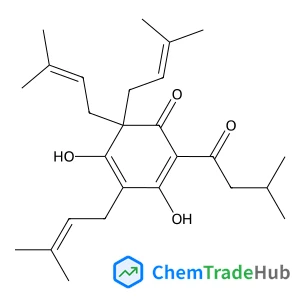
3,5-Dihydroxy-4-(3-methylbutanoyl)-2,6,6-tris(3-methyl-2-buten-1-yl)-2,4-cyclohexadien-1-one
CAS Number:
468-28-0
Molecular Formula:
C26H38O4
Recommended Suppliers





Disclaimer
This page provides academic journal information for reference and research purposes only. We are not affiliated with any journal publishers and do not handle publication submissions. For publication-related inquiries, please contact the respective journal publishers directly.
If you notice any inaccuracies in the information displayed, please contact us at support@chemtradehub.com. We will promptly review and address your concerns.