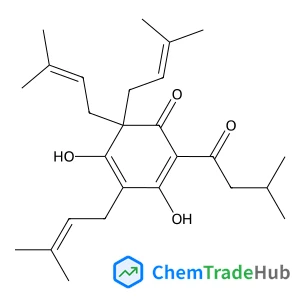
3,5-Dihydroxy-4-(3-methylbutanoyl)-2,6,6-tris(3-methyl-2-buten-1-yl)-2,4-cyclohexadien-1-one
CAS Number:
468-28-0
Molecular Formula:
C26H38O4
Alberto Martis, Alberto Luridiana, Angelo Frongia, Massimiliano Arca, Giorgia Sarais, David J. Aitken, Regis Guillot, Francesco Secci
The acid-promoted syntheses of 2-(benzyloxy)cyclobutanones and bis(benzyloxy)dioxatricyclo decanes were achieved starting from 2-hydroxycyclobutanone and variously functionalized benzyl alcohols. The reaction sequences afforded the desired products in good to high yields and in a solvent-dependent chemoselective fashion.
Narcis Avarvari, Marc Fourmigué
DOI: 10.1039/B403168G
Jianhua Tong, Yasuyuki Matsumura
DOI: 10.1039/B406975G
Wuping Liao, Jörg von Appen, Richard Dronskowski
DOI: 10.1039/B408647C
Hervé Clavier, Nicolas Audic, Marc Mauduit, Jean-Claude Guillemin
DOI: 10.1039/B407964G
Donatella Armentano, Giovanni De Munno, Teresa F. Mastropietro, Miguel Julve, Francesc Lloret
DOI: 10.1039/B402055C
Mauro Pineschi, Federica Del Moro, Adriaan J. Minnaard, Ben L. Feringa
DOI: 10.1039/B403793F
Kyuwon Kim, Haesik Yang, Se Ho Park, Dae-Sik Lee, Sung-Jin Kim, Yong Taik Lim, Youn Tae Kim
DOI: 10.1039/B402914C
Michał K. Cyrański, Siân T. Howard, Michał L. Chodkiewicz
DOI: 10.1039/B408903K
Guan-Sheng Jiao, Kevin Burgess
DOI: 10.1039/B402559H
Sumod George, Ashwini Nangia, Chi-Keung Lam, Thomas C. W. Mak, Jean-François Nicoud
DOI: 10.1039/B402050B
When handling 2-Chloro-1,2-bis(4-methylphenyl)ethanone (CAS: 71193-32-3), it is ...
4-Ethoxy-3-(5-methyl-4-oxo-7-propyl-1,4-dihydroimidazo[5,1-f][1,2,4]triazin-2-yl...
Methyl 3-Oxo-4-Androsten-17-Carboxylate (CAS: 2681-55-2) should be stored in a c...
(R)-3-Amino-4-(3-hexylphenylamino)-4-oxobutylphosphonic acid is primarily used i...
2-Methyl-2-propanyl 3-amino-3-carbamoyl-1-azetidinecarboxylate (CAS: 1254120-14-...
There are alternative reagents that can be used in synthesis instead of (E)-4-(t...
[2-(3-Chlorophenyl)-1,3-thiazol-4-yl]methanol (CAS: 121202-20-8) is a crystallin...
The market and research trends for Methyl (2S)-[(4S)-2,2-dimethyl-1,3-dioxolan-4...
The market for 1-Bromo-2-isocyanatoethane (CAS: 42865-19-0) is driven by its use...
4-Nitro-D-phenylalanine hydrochloride (CAS: 147065-06-3) is primarily used in re...

Organic & Biomolecular Chemistry (OBC) publishes original and high impact research and reviews in organic chemistry. We welcome research that shows new or significantly improved protocols or methodologies in total synthesis, synthetic methodology or physical and theoretical organic chemistry as well as research that shows a significant advance in the organic chemistry or molecular design aspects of chemical biology, catalysis, supramolecular and macromolecular chemistry, theoretical chemistry, mechanism-oriented physical organic chemistry, medicinal chemistry or natural products. Articles published in the journal should report new work which makes a highly-significant impact in the field. Routine and incremental work is generally not suitable for publication in the journal. More details about key areas of our scope are below. In all cases authors should include in their article clear rationale for why their research has been carried out.