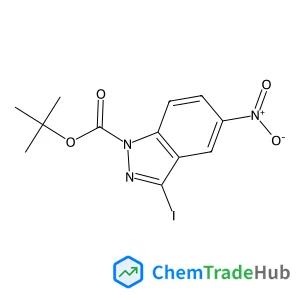
Tert-butyl 3-iodo-5-nitro-1H-indazole-1-carboxylate
CAS Number:
459133-69-8
Molecular Formula:
C12H12IN3O4
Youn Charles-Blin, Hitomi Todoki
We demonstrated the role of fluoroalkylsilane (FAS) self-assembled monolayers in improving the high-voltage durability and C-rate capabilities of spinel LiNi0.5Mn1.5O4 (LNMO) cathodes. The influence of the cathode–electrolyte interface (CEI) layer formation was assessed and compared with various linear carbonates and fluoroethylenecarbon (FEC) additives using electrochemical impedance and X-ray photoemission spectroscopies. The densely grafted FAS monolayer provided a less resistive CEI with a nearly three times lower charge transfer resistance owing to the formation of lower amounts of Li2CO3 and LiPF6 salt degradation byproducts and the significant reduction of Mn dissolution by almost a third in full cells after cycling. Notably, high voltage stabilities dependent on non-cyclic carbonates were proportional to the depth of their HOMO-level positions. However, the addition of FEC drastically degraded the capacity retention in the FAS-grafted LNMO cathode systems during the cycles with the a thick CEI layer formation. This suggests that it was because of the enhancement of affinity, driven by the strong intermolecular interaction among fluorine-containing compounds. Furthermore, we found that the Li+ diffusion coefficient was larger than that for bare LNMO electrodes, which suggested significant changes in the kinetics of the Li+ exchange reaction (Li+ adsorption and diffusion processes) on the electrode/electrolyte associated with polarization mitigation. We believe that the grafted FAS layer plays a role as a molecular gate, and while blocking the diffusion of uncoordinated free-carbonate solvents to the electrode surface, it tends to preferentially permeate both solvated Li+ and counter PF6−, and partially permeate fluorine-substituted additives, which nearly eliminate the oxidation decomposition of free-carbonate solvents and promote an efficient Li+-exchange reaction.

Israel Journal of Chemistry

Journal of Heterocyclic Chemistry

Science

Molecular Pharmacology

Proceedings of the National Academy of Sciences of the United States of America

Science Progress

Organic Preparations and Procedures International

Helvetica Chimica Acta

Journal of Catalysis

Journal of Physics and Chemistry of Solids
Davide Avagliano, Pedro A. Sánchez-Murcia, Leticia González
DOI: 10.1039/C9CP03398J
Yang Liu, Jun Li
DOI: 10.1039/C9CP05693A
Di Huang, Haina Zhu
DOI: 10.1039/C9CP04018H
Pei-Ling Luo, Chen-An Chung
DOI: 10.1039/C9CP03333E
Stella Schmode, Payal Chatterjee, Alexander D. MacKerell, Jr., Christian Schröder
DOI: 10.1039/C9CP03000J
Kunran Yang, Jeremie Zaffran, Bo Yang
DOI: 10.1039/C9CP04885E
Chen Qian, Jiugen Wang
DOI: 10.1039/C9CP03757H
Hujun Xie, Qunfang Lei, Wenjun Fang
DOI: 10.1039/C9CP02999K
C. Grazioli, A. Guarnaccio, F. O. L. Johansson, M. Coreno, M. de Simone, A. Santagata, B. Brena, C. Puglia
DOI: 10.1039/C9CP02423A
Zongbao Li, Xinsheng Liu, Xia Wang, Yusi Yang, Wei Shi, Yong Li, Xiaobo Xing
DOI: 10.1039/C9CP05058B
When handling 4-Methyl-6-(trifluoromethyl)quinoline (CAS: 40716-16-3), safety go...
4-(3,5-Difluorophenyl)aniline is an aromatic organic compound with the CAS numbe...
5-{[4-(Trifluoromethyl)phenyl]sulfanyl}-1,2,3-thiadiazole-4-carboxylic acid can ...
The market for 4-Benzylaniline hydrochloride (CAS: 6317-57-3) is steadily growin...
[3-(Diethylsulfamoyl)phenyl]boronic acid is generally considered safe when handl...
3-Bromo-2,5-dimethoxyaniline is mainly used in the pharmaceutical and chemical i...
N-Methyl-1-(5-methyl-1H-indol-3-yl)methanamine (CAS: 915922-67-7) is subject to ...
This compound is primarily used in the pharmaceutical industry for the synthesis...
2-Methyl-2-propanyl [(1S,3R)-3-aminocyclohexyl]carbamate (CAS: 1298101-47-9) sho...
Ethyl 2-bromo-4,4,4-trifluorobutanoate (CAS: 367-33-9) is utilized in the pharma...