


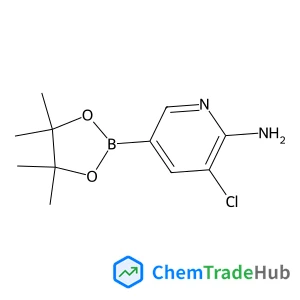
3-Chloro-5-(4,4,5,5-tetramethyl-1,3,2-dioxaborolan-2-yl)-2-pyridinamine
CAS Number:
1032758-99-8
Molecular Formula:
C11H16BClN2O2
Xin Tang, Zachary Hicks, Linjie Wang, Gerd Ganteför, Kit H. Bowen, Roman Tsyshevsky, Jianwei Sun, Maija M. Kuklja
The adsorption and decomposition of dimethyl methylphosphonate (DMMP), a chemical warfare agent (CWA) simulant, on size-selected molybdenum oxide trimer clusters, i.e. (MoO3)3, was studied both experimentally and theoretically. X-ray photoelectron spectroscopy (XPS), temperature programmed reaction (TPR), and density functional theory (DFT)-based simulations were utilized in this study. The XPS and TPR results showed both, desorption of intact DMMP, and decomposition of DMMP through the elimination of methanol at elevated temperatures on (MoO3)3 clusters. Theoretical investigation of DMMP on (MoO3)3 clusters suggested that, in addition to pure (MoO3)3 clusters, reduced molybdenum oxide clusters and hydroxylated molybdenum oxide clusters also play an important role in decomposing DMMP via a “reverse Mars–van Krevelen mechanism”. The present study, which focused on oxide clusters, underlines the importance of surface defects, e.g., the oxygen vacancies and surface hydroxyls, in determining the reaction pathway of DMMP, in agreement with previous studies on thin films. In addition, the structural fluxionality and the Lewis acidity of molybdenum oxide clusters, i.e. (MoO3)3, may make them good candidates for adsorption and decomposition of chemical warfare agents with similar structures to DMMP.

Helvetica Chimica Acta

Journal of Organometallic Chemistry

Journal of Physics and Chemistry of Solids

Proceedings of the National Academy of Sciences of the United States of America

Pure and Applied Chemistry

Russian Chemical Reviews

Journal of Catalysis

Journal of Medicinal Chemistry

Pharmacological Reviews

Nature
Yong-Feng Wang, Shan Xi Tian, Jinlong Yang
DOI: 10.1039/C1CP21267B
Jörg Meyer, Anja Wadewitz, Lokamani, Cormac Toher, Roland Gresser, Karl Leo, Moritz Riede, Francesca Moresco
DOI: 10.1039/C1CP20999J
Tina Ukmar, Miran Gaberšček, Franci Merzel, Aljaž Godec
DOI: 10.1039/C1CP20636B
J. M. Valverde, F. Pontiga, C. Soria-Hoyo, M. A. S. Quintanilla, H. Moreno, F. J. Duran, M. J. Espin
DOI: 10.1039/C1CP21939A
Xavier Aparicio-Anglès, Anna Clotet, Josep M. Poblet
DOI: 10.1039/C0CP02602F
S. Ghanta, V. Sivaranjana Reddy, S. Mahapatra
DOI: 10.1039/C1CP21083A
Cunku Dong, Jingyao Qi
DOI: 10.1039/C1CP21030K
Bounphanh Tonpheng, Junchun Yu, Ove Andersson
DOI: 10.1039/C1CP20785G
This compound is mainly used as an intermediate in the synthesis of antipsychoti...
Waste containing 1-(D-Ribofuranosyl)-1,4-dihydro-3-pyridinecarboxamide (CAS: 191...
2-Methyl-2-propanyl 3-bromo-3-(hydroxymethyl)-1-azetidinecarboxylate (CAS: 20079...
N-(4-Chloro-2-pyridinyl)acetamide (CAS: 245056-66-0) is a chemical compound with...
5-Chloro-2-hydroxybenzoic acid, also known as 5-chlorosalicylic acid, is an arom...
When handling 1,1-Dichloro-1-fluoroethane (CAS: 1717-00-6), it is important to u...
Fmoc-(2S,3R)-3-phenylpyrrolidine-2-carboxylic acid is a white crystalline solid ...
4-Amino-5-bromo-2-pyridinecarboxylic acid is primarily used as a precursor in th...
Handling this compound should be done with personal protective equipment (PPE) i...
When handling 8-bromo-2,2-dimethyl-3,4-dihydro-2H-1,4-benzoxazin-3-one, use prop...

Physical Chemistry Chemical Physics (PCCP) is an international journal co-owned by 19 physical chemistry and physics societies from around the world. This journal publishes original, cutting-edge research in physical chemistry, chemical physics and biophysical chemistry. To be suitable for publication in PCCP, articles must include significant innovation and/or insight into physical chemistry; this is the most important criterion that reviewers and Editors will judge against when evaluating submissions. The journal has a broad scope and welcomes contributions spanning experiment, theory, computation and data science. Topical coverage includes spectroscopy, dynamics, kinetics, statistical mechanics, thermodynamics, electrochemistry, catalysis, surface science, quantum mechanics, quantum computing and machine learning. Interdisciplinary research areas such as polymers and soft matter, materials, nanoscience, energy, surfaces/interfaces, and biophysical chemistry are welcomed if they demonstrate significant innovation and/or insight into physical chemistry. Joined experimental/theoretical studies are particularly appreciated when complementary and based on up-to-date approaches.
![Pyrazolo[1,5-a]pyridine-3-carbothioamide structure](https://static.chemtradehub.com/structs/885/885275-44-5-aae0.webp "Pyrazolo[1,5-a]pyridine-3-carbothioamide structure")




