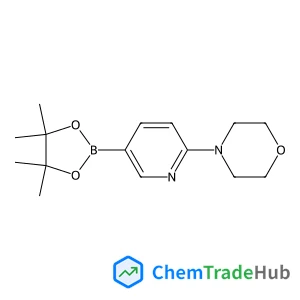
4-(5-(4,4,5,5-tetramethyl-1,3,2-dioxaborolan-2-yl)pyridin-2-yl)morpholine
CAS Number:
485799-04-0
Molecular Formula:
C15H23BN2O3
Carmen Sousa, Miquel Llunell, Alex Domingo
Spin–orbit couplings have been calculated in twenty snapshots of a molecular dynamics trajectory of [Fe(bpy)3]2+ to address the importance of geometrical distortions and second-order spin–orbit coupling on the intersystem crossing rate constants in the light-induced spin crossover process. It was found that the effective spin–orbit coupling between the 3MLCT and 5T2 state is much larger than the direct coupling in the symmetric structure, which opens the possibility of a direct 3MLCT–5T2 deactivation without the intervention of triplet metal-centered states. Based on the calculated deactivation times, we conclude that both the direct pathway and the one involving intermediate triplet states are active in the ultrafast population of the metastable HS state, bringing in agreement two experimental observations that advocate for either deactivation mechanism. This resolves a long-standing dispute about the deactivation mechanism of Fe(II)–polypyridyl complexes in particular, and about light-induced magnetism in transition metal complexes in general.

Russian Chemical Bulletin

Russian Journal of Organic Chemistry

Chemistry Education Research and Practice

Drug Discovery Today

Russian Journal of Bioorganic Chemistry

Current Opinion in Colloid & Interface Science

Nature Medicine

Russian Journal of General Chemistry

Saudi Pharmaceutical Journal

Organic Process Research & Development
Rajesh G. Gonnade, Mohan M. Bhadbhade, Mysore S. Shashidhar
DOI: 10.1039/B410051D
Steven H. Bertz, Toby J. Sommer
DOI: 10.1039/B300935A
Caroline V. Potter, Sarah Thomas, Janet L. Dean, Adrian P. Kybett, Richard Kidd, Melanie James, Helen Saxton
DOI: 10.1039/B417565B
Cédric Tard, Xiaoming Liu, David L. Hughes, Christopher J. Pickett
DOI: 10.1039/B411559G
Giovanni Bottari, Tomás Torres
DOI: 10.1039/B411960F
DOI: 10.1039/B300963G
Yoshihiko Yamamoto, Tomoaki Saigoku, Takashige Ohgai, Hisao Nishiyama, Kenji Itoh
DOI: 10.1039/B411442F
Seong Jin Park, Dong Mok Shin, Shigeru Sakamoto, Kentaro Yamaguchi, Young Keun Chung, Myoung Soo Lah
DOI: 10.1039/B212855A
Sarah E. Lister, Ivana Radosavljevic Evans, Judith A. K. Howard, Alan Coelho, John S. O. Evans
DOI: 10.1039/B408413F
(1R,3S)-1,3-Cyclopentanediol finds applications in various industries. In the ph...
When handling N'-[4-(Dimethylamino)phenyl]-N,N-dimethyl-1,4-benzenediamine, it i...
There are several alternatives to 5-(2,4-Difluorophenyl)-2-methoxypyrimidine in ...
1-(3-Methoxyphenoxy)propan-2-ol (CAS: 382141-68-6) must comply with the Globally...
Tetrodotoxin Citrate is extremely dangerous and should be handled with extreme c...
2-Methyl-2-propanyl [(1R,3S)-3-hydroxycyclopentyl]carbamate (CAS: 225641-84-9) i...
Waste containing 4-(2-Hydroxyhexafluoroisopropyl)Benzoic Acid (CAS: 16261-80-6) ...
2-Methyl-2-proanyl {(2S)-1-[(benzyloxy)amino]-3-hydroxy-3-methyl-1-oxo-2-butanyl...
Benzeneethanamine, α-ethyl-, hydrochloride (1:1) is an organic compound with the...
In the synthesis of compounds similar to 3-{(E)-[4-(Dimethylamino)phenyl]diazeny...

Physical Chemistry Chemical Physics (PCCP) is an international journal co-owned by 19 physical chemistry and physics societies from around the world. This journal publishes original, cutting-edge research in physical chemistry, chemical physics and biophysical chemistry. To be suitable for publication in PCCP, articles must include significant innovation and/or insight into physical chemistry; this is the most important criterion that reviewers and Editors will judge against when evaluating submissions. The journal has a broad scope and welcomes contributions spanning experiment, theory, computation and data science. Topical coverage includes spectroscopy, dynamics, kinetics, statistical mechanics, thermodynamics, electrochemistry, catalysis, surface science, quantum mechanics, quantum computing and machine learning. Interdisciplinary research areas such as polymers and soft matter, materials, nanoscience, energy, surfaces/interfaces, and biophysical chemistry are welcomed if they demonstrate significant innovation and/or insight into physical chemistry. Joined experimental/theoretical studies are particularly appreciated when complementary and based on up-to-date approaches.
![N-[(9H-Fluoren-9-ylmethoxy)carbonyl]-beta-phenyl-L-phenylalanine structure](https://static.chemtradehub.com/structs/201/201484-50-6-c2fc.webp "N-[(9H-Fluoren-9-ylmethoxy)carbonyl]-beta-phenyl-L-phenylalanine structure")