












Exotic species with explicit noble metal–noble gas–noble metal linkages
Literature Information
Publication Date
2018-01-18
DOI
10.1039/C7CP08085A
Impact Factor
3.676
Authors
Norberto Moreno, Albeiro Restrepo, C. Z. Hadad
View Original
Abstract
We present a study of the isoelectronic Pt2Ng2F4 and [Au2Ng2F4]2+ species with noble gas atoms (Ng = Kr, Xe, Rn) acting as links bridging the two noble metal atoms. The stability of the species is investigated using several thermodynamic, kinetic and reactivity indicators. The results are compared against [AuXe4]2+, which is thermodynamically unstable in the gas phase but is stabilized in the solid state to the point that it has been experimentally detected as [AuXe4](Sb2F11)2 (S. Seidel and K. Seppelt, Science, 2000, 290, 117–118). Our results indicate that improving upon [AuXe4]2+, these exotic combinations between the a priori non-reactive noble metals and noble gases lead to metastable species, and, therefore, they have the possibility of existing in the solid state under adequate conditions. Our calculations include accurate energies and geometries at both the CCSD/SDDALL and MP2/SDDALL levels. We offer a detailed description of the nature of the bonding interactions using orbital and density-based analyses. The computational evidence suggests partially covalent and ionic interactions as the stabilization factors.
Related Literature
Identification of a new substrate effect that enhances the electrocatalytic activity of dendritic tin in CO2 reduction
Xiaolong Zhang
2018-01-31
Paper
DOI: 10.1039/C7CP07723H
Factors impacting the aggregation/agglomeration and photocatalytic activity of highly crystalline spheroid- and rod-shaped TiO2 nanoparticles in aqueous solutions
Thomas Degabriel, Elodie Colaço, Rute F. Domingos, Karim El Kirat, Dalil Brouri, Sandra Casale, Jessem Landoulsi, Jolanda Spadavecchia
2018-04-05
Paper
DOI: 10.1039/C7CP08054A
Multi-color electrochromism containing green color based on electrochemically polymerized star-shaped phenyl bithiophene
Yujie Dong, Feifei Luo, Lan Chen, Feiya Yuan, Yuejiao Hou, Weijun Li, Shuanma Yan, Yuyu Dai, Mi Ouyang, Cheng Zhang
2018-04-10
Paper
DOI: 10.1039/C8CP00338F
Thermal activation of methane by vanadium boride cluster cations VBn+ (n = 3–6)
2018-01-17
Communication
DOI: 10.1039/C8CP00071A
Thickness dependent Raman spectra and interfacial interaction between Ag and epitaxial graphene on 6H-SiC(0001)
Xiangtai Liu, Qinglong Fang, Tingwei Hu, Dayan Ma, Xiaohe Zhang, Shuai Liu, Fei Ma
2018-02-02
Paper
DOI: 10.1039/C7CP07338K
Untangling the methane chemistry in interstellar and solar system ices toward ionizing radiation: a combined infrared and reflectron time-of-flight analysis
2017-09-26
Paper
DOI: 10.1039/C7CP05882A
Osteocalcin facilitates calcium phosphate ion complex growth as revealed by free energy calculation
Weilong Zhao, Ziqiu Wang, Zhijun Xu
2018-04-09
Paper
DOI: 10.1039/C8CP01105B
Ultrafast coherent vibrational dynamics in dimethyl methylphosphonate radical cation
Derrick Ampadu Boateng, Gennady L. Gutsev, Puru Jena, Katharine Moore Tibbetts
2017-12-05
Communication
DOI: 10.1039/C7CP07261A
Outstanding Reviewers for Physical Chemistry Chemical Physics in 2017
2018-04-25
Editorial
DOI: 10.1039/C8CP91743D
Real time monitoring of the minute dynamic variation at the crude oil–water interface
Ziling Ding, Yan Xiong
2018-01-26
Paper
DOI: 10.1039/C7CP07491C
You might also like
Compound Q&A
What are the main uses of 1-(3-Aminophenyl)-3-[(3R)-1-(3,3-dimethyl-2-oxobutyl)-2-oxo-5-(2-pyridinyl)-2,3-dihydro-1H-1,4-benzodiazepin-3-yl]urea (CAS: 155412-88-7)?
This compound is mainly used as an intermediate in the synthesis of antipsychoti...
155412-88-71-(3-Aminophenyl)-3-...
Compound Q&A
How should waste containing 1-(D-Ribofuranosyl)-1,4-dihydro-3-pyridinecarboxamide (CAS: 19132-12-8) be handled?
Waste containing 1-(D-Ribofuranosyl)-1,4-dihydro-3-pyridinecarboxamide (CAS: 191...
19132-12-81-(D-Ribofuranosyl)-...
Compound Q&A
What regulatory guidelines apply to 2-Methyl-2-propanyl 3-bromo-3-(hydroxymethyl)-1-azetidinecarboxylate (CAS: 2007919-81-3)?
2-Methyl-2-propanyl 3-bromo-3-(hydroxymethyl)-1-azetidinecarboxylate (CAS: 20079...
2007919-81-32-Methyl-2-propanyl ...
Compound Q&A
What is N-(4-Chloro-2-pyridinyl)acetamide (CAS: 245056-66-0)?
N-(4-Chloro-2-pyridinyl)acetamide (CAS: 245056-66-0) is a chemical compound with...
245056-66-0N-(4-Chloro-2-pyridi...
Compound Q&A
What is 5-Chloro-2-hydroxybenzoic acid (CAS: 321-14-2)?
5-Chloro-2-hydroxybenzoic acid, also known as 5-chlorosalicylic acid, is an arom...
321-14-25-Chloro-2-hydroxybe...
Compound Q&A
What precautions should be taken when handling 1,1-Dichloro-1-fluoroethane (CAS: 1717-00-6)?
When handling 1,1-Dichloro-1-fluoroethane (CAS: 1717-00-6), it is important to u...
1717-00-61,1-Dichloro-1-fluor...
Compound Q&A
What are the physical and chemical properties of Fmoc-(2S,3R)-3-phenylpyrrolidine-2-carboxylic acid (CAS: 281655-32-1)?
Fmoc-(2S,3R)-3-phenylpyrrolidine-2-carboxylic acid is a white crystalline solid ...
281655-32-1Fmoc-(2S,3R)-3-pheny...
Compound Q&A
What are the main uses of 4-Amino-5-bromo-2-pyridinecarboxylic acid (CAS: 1363381-01-4)?
4-Amino-5-bromo-2-pyridinecarboxylic acid is primarily used as a precursor in th...
1363381-01-44-Amino-5-bromo-2-py...
Compound Q&A
What precautions should be taken when handling (S)-tert-butyl 2-((2-(4-bromophenyl)-2-oxoethyl)carbamoyl)pyrrolidine-1-carboxylate (CAS: 1007881-98-2)?
Handling this compound should be done with personal protective equipment (PPE) i...
1007881-98-2(S)-tert-butyl 2-((2...
Compound Q&A
What precautions should be taken when handling 8-bromo-2,2-dimethyl-3,4-dihydro-2H-1,4-benzoxazin-3-one (CAS: 688363-73-7)?
When handling 8-bromo-2,2-dimethyl-3,4-dihydro-2H-1,4-benzoxazin-3-one, use prop...
688363-73-78-bromo-2,2-dimethyl...
Source Journal
Physical Chemistry Chemical Physics

CiteScore:
5.5
Self-citation Rate:
10.3%
Articles per Year:
3036
Physical Chemistry Chemical Physics (PCCP) is an international journal co-owned by 19 physical chemistry and physics societies from around the world. This journal publishes original, cutting-edge research in physical chemistry, chemical physics and biophysical chemistry. To be suitable for publication in PCCP, articles must include significant innovation and/or insight into physical chemistry; this is the most important criterion that reviewers and Editors will judge against when evaluating submissions. The journal has a broad scope and welcomes contributions spanning experiment, theory, computation and data science. Topical coverage includes spectroscopy, dynamics, kinetics, statistical mechanics, thermodynamics, electrochemistry, catalysis, surface science, quantum mechanics, quantum computing and machine learning. Interdisciplinary research areas such as polymers and soft matter, materials, nanoscience, energy, surfaces/interfaces, and biophysical chemistry are welcomed if they demonstrate significant innovation and/or insight into physical chemistry. Joined experimental/theoretical studies are particularly appreciated when complementary and based on up-to-date approaches.
Recommended Compounds

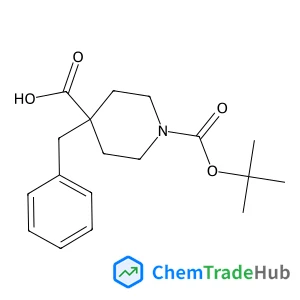
4-Benzyl-1-(tert-butoxycarbonyl)piperidine-4-carboxylic acid
CAS Number:
170838-87-6
Molecular Formula:
C18H25NO4
Recommended Suppliers






Disclaimer
This page provides academic journal information for reference and research purposes only. We are not affiliated with any journal publishers and do not handle publication submissions. For publication-related inquiries, please contact the respective journal publishers directly.
If you notice any inaccuracies in the information displayed, please contact us at support@chemtradehub.com. We will promptly review and address your concerns.