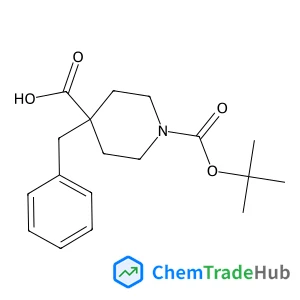
4-Benzyl-1-(tert-butoxycarbonyl)piperidine-4-carboxylic acid
CAS Number:
170838-87-6
Molecular Formula:
C18H25NO4
Bun Chan, John M. Simmie
The kinetics of many reactions are critically dependent upon the barrier heights for which accurate determination can be difficult. From the perspective of attaining such quantities using computational quantum chemistry, it is important to appropriately validate routine and efficient methodologies such as density functional theory (DFT) procedures. In the present study, we embark on the journey of establishing diverse databases using a consistent high-level quantum chemistry procedure, against which new and existing methodologies can be assessed. Thus, we have used the composite protocol W3X-L to provide more than 100 refined reference values for existing databases [e.g., Y. Zhao and D. G. Truhlar, J. Phys. Chem. A, 2005, 109, 5656] and additionally establish benchmark data that are of interest to atmospheric and combustion chemists. While our endeavor has just begun, assessment of various DFT methods with our existing results lends support to the use of MN15 as an adequate method for general kinetics applications. We also recommend the use of less-costly W2X and WG composite protocols for obtaining adequately accurate reference thermochemical values for larger molecular systems.
Seishi Shimizu
DOI: 10.1039/C7CP07309G
Chang Liu, Hang Zhai, Ying Sun, Weiguang Gong, Yan Yan, Quan Li, Weitao Zheng
DOI: 10.1039/C8CP00205C
Xiaolu Xiong, Guangshi Li, Hongwei Cheng, Qian Xu
DOI: 10.1039/C8CP00873F
Longteng Tang, Yanli Wang, Liangdong Zhu, Karen Kallio, S. James Remington, Chong Fang
DOI: 10.1039/C8CP01907J
Robert G. Acres, Xun Cheng, Sofiia Bercha, Tomáš Skála, Vladimír Matolín, Ye Xu, Kevin C. Prince, Nataliya Tsud
DOI: 10.1039/C7CP08102B
H. Tarábková, Z. Zelinger, P. Janda
DOI: 10.1039/C7CP08018B
Jung Hyun Jeong
DOI: 10.1039/C8CP00433A
K. Rytel, M. Widelicka, D. Łukawski, F. Lisiecki, K. Kędzierski, D. Wróbel
DOI: 10.1039/C8CP01363B
Michèle Chevalier, Justinas Ceponkus, Germán A. Rojas-Lorenzo, Claudine Crépin
DOI: 10.1039/C7CP06481K
Marcileia Zanatta, Jairton Dupont, Gabriela Negruni Wentz, Francisco P. dos Santos
DOI: 10.1039/C8CP00066B
This compound is mainly used as an intermediate in the synthesis of antipsychoti...
Waste containing 1-(D-Ribofuranosyl)-1,4-dihydro-3-pyridinecarboxamide (CAS: 191...
2-Methyl-2-propanyl 3-bromo-3-(hydroxymethyl)-1-azetidinecarboxylate (CAS: 20079...
N-(4-Chloro-2-pyridinyl)acetamide (CAS: 245056-66-0) is a chemical compound with...
5-Chloro-2-hydroxybenzoic acid, also known as 5-chlorosalicylic acid, is an arom...
When handling 1,1-Dichloro-1-fluoroethane (CAS: 1717-00-6), it is important to u...
Fmoc-(2S,3R)-3-phenylpyrrolidine-2-carboxylic acid is a white crystalline solid ...
4-Amino-5-bromo-2-pyridinecarboxylic acid is primarily used as a precursor in th...
Handling this compound should be done with personal protective equipment (PPE) i...
When handling 8-bromo-2,2-dimethyl-3,4-dihydro-2H-1,4-benzoxazin-3-one, use prop...

Physical Chemistry Chemical Physics (PCCP) is an international journal co-owned by 19 physical chemistry and physics societies from around the world. This journal publishes original, cutting-edge research in physical chemistry, chemical physics and biophysical chemistry. To be suitable for publication in PCCP, articles must include significant innovation and/or insight into physical chemistry; this is the most important criterion that reviewers and Editors will judge against when evaluating submissions. The journal has a broad scope and welcomes contributions spanning experiment, theory, computation and data science. Topical coverage includes spectroscopy, dynamics, kinetics, statistical mechanics, thermodynamics, electrochemistry, catalysis, surface science, quantum mechanics, quantum computing and machine learning. Interdisciplinary research areas such as polymers and soft matter, materials, nanoscience, energy, surfaces/interfaces, and biophysical chemistry are welcomed if they demonstrate significant innovation and/or insight into physical chemistry. Joined experimental/theoretical studies are particularly appreciated when complementary and based on up-to-date approaches.
![6-Benzyl-4,5,6,7-tetrahydro-1H-pyrazolo[3,4-c]pyridin-3(2H)-one structure](https://static.chemtradehub.com/structs/909/909187-64-0-f54f.webp "6-Benzyl-4,5,6,7-tetrahydro-1H-pyrazolo[3,4-c]pyridin-3(2H)-one structure")