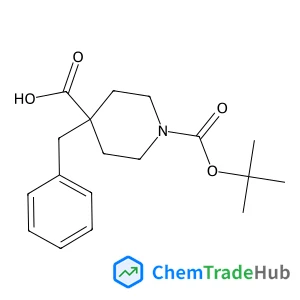
4-Benzyl-1-(tert-butoxycarbonyl)piperidine-4-carboxylic acid
CAS Number:
170838-87-6
Molecular Formula:
C18H25NO4
Jiří Kessler, Valery Andrushchenko, Josef Kapitán, Petr Bouř
Vibrational circular dichroism (VCD) spectroscopy is an excellent method to determine the secondary structure of proteins in solution. Comparison of experimental spectra with quantum-chemical simulations represents a convenient and objective way to extract information on the structure. This has been difficult for such large molecules where approximate theoretical models have to be used. In the present study we applied the Cartesian-coordinate based tensor transfer (CCT) making it possible to extend the density functional theory (DFT) and model spectral intensities of large globular proteins nearly at quantum-chemical precision. Indeed, comparison with experiment provided a better understanding of the dependence of VCD spectral shapes on the geometry, their sensitivity to fine structural details and interactions with the environment. On a model set of globular proteins the simulated spectra correlated well with experimental data and revealed which structural information can (and cannot) be obtained from this kind of spectroscopy. Although the VCD technique has been regarded as being rather insensitive to side-chain variations, we found that the spectra of human and hen lysozyme differing by a few amino acids only are quite distinct. This has been explained by long-distance coupling of the amide vibrations. Likewise, the modeling reproduced some spectral changes caused by protein deuteration even when the protein structure was conserved.

Helvetica Chimica Acta

Journal of Organometallic Chemistry

Organic Preparations and Procedures International

Journal of Physics and Chemistry of Solids

European Journal of Wood and Wood Products

Israel Journal of Chemistry

Molecular Pharmacology

Journal of Medicinal Chemistry

Planta Medica

Journal of Catalysis
Yuhui Lu, Craig Lent
DOI: 10.1039/C1CP21332F
Stefan Zahn, Katharina Wendler, Luigi Delle Site, Barbara Kirchner
DOI: 10.1039/C1CP20288J
Tomoya Uruga, Hajime Tanida, Yasuko Terada, Yasuhiro Iwasawa, Shin-ichi Ohkoshi
DOI: 10.1039/C1CP20895K
DOI: 10.1039/C1CP20622B
Stefanie A. Sherrill, Jonathon Duay, Zhe Gui, Parag Banerjee, Gary W. Rubloff
DOI: 10.1039/C1CP21815H
A. Subha Mahadevi, Y. Indra Neela, G. Narahari Sastry
DOI: 10.1039/C1CP21346F
Yufang Liu, Kai Jiang, Deheng Shi, Jinfeng Sun
DOI: 10.1039/C1CP20729F
J.M. Granadino-Roldán, M. Fernández-Gómez, Lin-Wang Wang
DOI: 10.1039/C1CP20329K
Natalya Schmerl, Gunther Andersson
DOI: 10.1039/C1CP20734B
Xavier Aparicio-Anglès, Anna Clotet, Josep M. Poblet
DOI: 10.1039/C0CP02602F
This compound is mainly used as an intermediate in the synthesis of antipsychoti...
Waste containing 1-(D-Ribofuranosyl)-1,4-dihydro-3-pyridinecarboxamide (CAS: 191...
2-Methyl-2-propanyl 3-bromo-3-(hydroxymethyl)-1-azetidinecarboxylate (CAS: 20079...
N-(4-Chloro-2-pyridinyl)acetamide (CAS: 245056-66-0) is a chemical compound with...
5-Chloro-2-hydroxybenzoic acid, also known as 5-chlorosalicylic acid, is an arom...
When handling 1,1-Dichloro-1-fluoroethane (CAS: 1717-00-6), it is important to u...
Fmoc-(2S,3R)-3-phenylpyrrolidine-2-carboxylic acid is a white crystalline solid ...
4-Amino-5-bromo-2-pyridinecarboxylic acid is primarily used as a precursor in th...
Handling this compound should be done with personal protective equipment (PPE) i...
When handling 8-bromo-2,2-dimethyl-3,4-dihydro-2H-1,4-benzoxazin-3-one, use prop...

Physical Chemistry Chemical Physics (PCCP) is an international journal co-owned by 19 physical chemistry and physics societies from around the world. This journal publishes original, cutting-edge research in physical chemistry, chemical physics and biophysical chemistry. To be suitable for publication in PCCP, articles must include significant innovation and/or insight into physical chemistry; this is the most important criterion that reviewers and Editors will judge against when evaluating submissions. The journal has a broad scope and welcomes contributions spanning experiment, theory, computation and data science. Topical coverage includes spectroscopy, dynamics, kinetics, statistical mechanics, thermodynamics, electrochemistry, catalysis, surface science, quantum mechanics, quantum computing and machine learning. Interdisciplinary research areas such as polymers and soft matter, materials, nanoscience, energy, surfaces/interfaces, and biophysical chemistry are welcomed if they demonstrate significant innovation and/or insight into physical chemistry. Joined experimental/theoretical studies are particularly appreciated when complementary and based on up-to-date approaches.
![Methyl 4-({[(2-methyl-2-propanyl)oxy]carbonyl}amino)bicyclo[2.2.2]octane-1-carboxylate structure](https://static.chemtradehub.com/structs/943/943845-74-7-b7e5.webp "Methyl 4-({[(2-methyl-2-propanyl)oxy]carbonyl}amino)bicyclo[2.2.2]octane-1-carboxylate structure")
![5-Methyl-4,5,6,7-tetrahydropyrazolo[1,5-a]pyrazin-2-amine structure](https://static.chemtradehub.com/structs/122/1227210-33-4-8d64.webp "5-Methyl-4,5,6,7-tetrahydropyrazolo[1,5-a]pyrazin-2-amine structure")
![4-Chloro-3-(trifluoromethyl)-1H-pyrrolo[2,3-b]pyridine structure](https://static.chemtradehub.com/structs/869/869335-75-1-a9d0.webp "4-Chloro-3-(trifluoromethyl)-1H-pyrrolo[2,3-b]pyridine structure")