












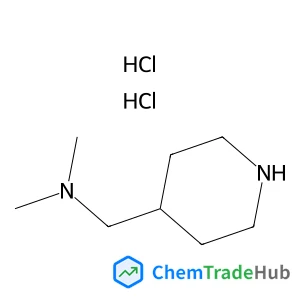
N,N-dimethyl(piperidin-4-yl)methanamine hydrochloride
CAS Number:
172281-72-0
Molecular Formula:
C8H20Cl2N2
Developing a new type of low-cost and high-efficiency non-noble metal catalyst is beneficial for industrially massive synthesis of alcohols from carboxylic acids which can be obtained from renewable biomass. In this work, the effect of active oxygen vacancies on ethanol synthesis from acetic acid hydrogenation over defective In2O3(110) surfaces has been studied using periodic density functional theory (DFT) calculations. The relative stabilities of six surface oxygen vacancies from Ov1 to Ov6 on the In2O3(110) surface were compared. D1 and D4 surfaces with respective Ov1 and Ov4 oxygen vacancies were chosen to map out the reaction paths from acetic acid to ethanol. A reaction cycle mechanism between the perfect and defective states of the In2O3 surface was found to catalyze the formation of ethanol from acetic acid hydrogenation. By H2 reduction the oxygen vacancies on the In2O3 surface play key roles in promoting CH3COO* hydrogenation and C–O bond breaking in acetic acid hydrogenation. The acetic acid, in turn, benefits the creation of oxygen vacancies, while the C–O bond breaking of acetic acid refills the oxygen vacancy and, thereby, sustains the catalytic cycle. The In2O3 based catalysts were shown to be advantageous over traditional noble metal catalysts in this paper by theoretical analysis.
Jairton Dupont, Paulo A. Z. Suarez
DOI: 10.1039/B602046A
Paul Nissenson, Christopher J. H. Knox, Barbara J. Finlayson-Pitts, Leon F. Phillips, Donald Dabdub
DOI: 10.1039/B609219E
George Firanescu, Dana Hermsdorf, Roman Ueberschaer, Ruth Signorell
DOI: 10.1039/B608433H
DOI: 10.1039/B606478G
David G. Nash, Tomas Baer
DOI: 10.1039/B609855J
M. Causà
DOI: 10.1039/B607705F
Leif A. Eriksson
DOI: 10.1039/B605682B
Ethyl 4-chlorothieno[2,3-b]pyridine-5-carboxylate (CAS: 59713-58-5) can be synth...
5-Methyl-1H-indole-3-carbaldehyde (CAS: 52562-50-2) is subject to various regula...
(1,3-Dimethyl-2,4-dioxo-1,2,3,4-tetrahydro-5-pyrimidinyl)boronic acid is a white...
Waste containing Sulfocostunolide A (CAS: 1016983-51-9) should be handled with c...
When handling Murraxocin (CAS: 88478-44-8), ensure proper personal protective eq...
Formvar (CAS: 63148-64-1) is an alkyd resin characterized by a high molecular we...
(S)-4-benzyl-2-((benzyloxy)methyl)morpholine is generally safe when handled with...
Methyl 1-(5-bromo-2-pyrimidinyl)cyclopropanecarboxylate (CAS: 1447607-69-3) is p...
2-Methyl-1-phenyl-1-propanamine hydrochloride (CAS: 24290-47-9) is generally con...
3-(4-Bromophenyl)-2-methylpropanoic acid is synthesized through a multi-step pro...

Physical Chemistry Chemical Physics (PCCP) is an international journal co-owned by 19 physical chemistry and physics societies from around the world. This journal publishes original, cutting-edge research in physical chemistry, chemical physics and biophysical chemistry. To be suitable for publication in PCCP, articles must include significant innovation and/or insight into physical chemistry; this is the most important criterion that reviewers and Editors will judge against when evaluating submissions. The journal has a broad scope and welcomes contributions spanning experiment, theory, computation and data science. Topical coverage includes spectroscopy, dynamics, kinetics, statistical mechanics, thermodynamics, electrochemistry, catalysis, surface science, quantum mechanics, quantum computing and machine learning. Interdisciplinary research areas such as polymers and soft matter, materials, nanoscience, energy, surfaces/interfaces, and biophysical chemistry are welcomed if they demonstrate significant innovation and/or insight into physical chemistry. Joined experimental/theoretical studies are particularly appreciated when complementary and based on up-to-date approaches.
![4-[(1-Methyl-1H-pyrrol-2-yl)methylene]-1,3(2H,4H)-isoquinolinedione structure](https://static.chemtradehub.com/structs/110/1104546-89-5-a600.webp "4-[(1-Methyl-1H-pyrrol-2-yl)methylene]-1,3(2H,4H)-isoquinolinedione structure")
![2-Methyl-2-propanyl 1,6-diazaspiro[3.4]octane-6-carboxylate structure](https://static.chemtradehub.com/structs/115/1158749-79-1-81ee.webp "2-Methyl-2-propanyl 1,6-diazaspiro[3.4]octane-6-carboxylate structure")





