












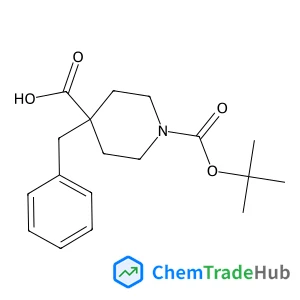
4-Benzyl-1-(tert-butoxycarbonyl)piperidine-4-carboxylic acid
CAS Number:
170838-87-6
Molecular Formula:
C18H25NO4
Li Qin, Jingyun Jiang, Tiancheng Mu, Guohua Gao
Research on ionic liquids has achieved rapid progress in the last several decades. Stability is a prerequisite for the application of ionic liquids. Ionic liquids may be used at elevated temperature, as electrolytes, or under irradiation. Therefore, the thermal, electrochemical, and radiolytic stabilities of ionic liquids are important and need to be known before their usage. Many research papers and some reviews on the stabilities of ionic liquids have been published. However, new results are continuously being published and a comprehensive review and perspective on this topic are still urgently needed. In this perspective, we intend to provide a comprehensive review including characterization methods, the effects of chemical composition of the ionic liquids on the thermal, electrochemical, and radiolytic stabilities of ionic liquids, respectively. Moreover, the thermal stability of some special types of ionic liquids such as poly(ionic liquids) and mixed ionic liquids, and the thermal and electrochemical stabilities of protic ionic liquids are discussed too. For thermal stability, the interactions between ions are less important than the individual anions and cations. The decomposition temperature is mainly determined by the less-stable ion, usually the anion. For electrochemical stability, the electrochemical window is determined by both the cation and anion. The less stable ion could influence the stability by interaction between the generated species from the decomposition with the more stable ion (opposite ion). This perspective is helpful for people to avoid using unstable ionic liquids and choose suitable ionic liquids.
M. Furlani, I. Albinsson, J. L. Ratnasekera, B.-E. Mellander
DOI: 10.1039/C6CP00013D
L. D. Antonov, W. Boomsma, T. Hamelryck
DOI: 10.1039/C5CP04886A
Yeusy Hartadi, Daniel Widmann, R. Jürgen Behm
DOI: 10.1039/C5CP06888F
B. Eggers, M. Metzler, D. Künzel, A. Groß, T. Jacob, U. Ziener
DOI: 10.1039/C5CP07853A
Vu Thi Thu Huong, Truong Ba Tai, Minh Tho Nguyen
DOI: 10.1039/C5CP07277H
DOI: 10.1039/C5CP07724A
Juliano Katrib, Paula A. Palade, Neil R. Champness, Samuel W. Kingman
DOI: 10.1039/C5CP05426E
N. V. Suetin, S. A. Evlashin, A. V. Egorov, K. V. Mironovich, S. A. Dagesyan, L. V. Yashina, E. A. Goodilin, V. A. Krivchenko
DOI: 10.1039/C6CP01638C
Johannes R. Klein, Oliver Flender, Mirko Scholz, Kawon Oum, Thomas Lenzer
DOI: 10.1039/C5CP07167D
Xiaojun Li, Pieterjan Claes, Marko Haertelt, Peter Lievens, Ewald Janssens
DOI: 10.1039/C5CP07298K
This compound is mainly used as an intermediate in the synthesis of antipsychoti...
Waste containing 1-(D-Ribofuranosyl)-1,4-dihydro-3-pyridinecarboxamide (CAS: 191...
2-Methyl-2-propanyl 3-bromo-3-(hydroxymethyl)-1-azetidinecarboxylate (CAS: 20079...
N-(4-Chloro-2-pyridinyl)acetamide (CAS: 245056-66-0) is a chemical compound with...
5-Chloro-2-hydroxybenzoic acid, also known as 5-chlorosalicylic acid, is an arom...
When handling 1,1-Dichloro-1-fluoroethane (CAS: 1717-00-6), it is important to u...
Fmoc-(2S,3R)-3-phenylpyrrolidine-2-carboxylic acid is a white crystalline solid ...
4-Amino-5-bromo-2-pyridinecarboxylic acid is primarily used as a precursor in th...
Handling this compound should be done with personal protective equipment (PPE) i...
When handling 8-bromo-2,2-dimethyl-3,4-dihydro-2H-1,4-benzoxazin-3-one, use prop...

Physical Chemistry Chemical Physics (PCCP) is an international journal co-owned by 19 physical chemistry and physics societies from around the world. This journal publishes original, cutting-edge research in physical chemistry, chemical physics and biophysical chemistry. To be suitable for publication in PCCP, articles must include significant innovation and/or insight into physical chemistry; this is the most important criterion that reviewers and Editors will judge against when evaluating submissions. The journal has a broad scope and welcomes contributions spanning experiment, theory, computation and data science. Topical coverage includes spectroscopy, dynamics, kinetics, statistical mechanics, thermodynamics, electrochemistry, catalysis, surface science, quantum mechanics, quantum computing and machine learning. Interdisciplinary research areas such as polymers and soft matter, materials, nanoscience, energy, surfaces/interfaces, and biophysical chemistry are welcomed if they demonstrate significant innovation and/or insight into physical chemistry. Joined experimental/theoretical studies are particularly appreciated when complementary and based on up-to-date approaches.
![tert-Butyl N-[(2-chloropyridin-4-yl)methyl]carbamate structure](https://static.chemtradehub.com/structs/916/916210-27-0-9f95.webp "tert-Butyl N-[(2-chloropyridin-4-yl)methyl]carbamate structure")
![4-Chloro-3-(trifluoromethyl)-1H-pyrrolo[2,3-b]pyridine structure](https://static.chemtradehub.com/structs/869/869335-75-1-a9d0.webp "4-Chloro-3-(trifluoromethyl)-1H-pyrrolo[2,3-b]pyridine structure")





