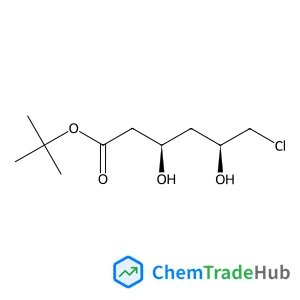
2-Methyl-2-propanyl (3R,5S)-6-chloro-3,5-dihydroxyhexanoate
CAS Number:
154026-93-4
Molecular Formula:
C10H19ClO4
James E. Thorne, Yanyan Zhao, Da He, Shizhao Fan, Srinivas Vanka, Zetian Mi, Dunwei Wang
The addition of a co-catalyst onto the surface of a photocathode often greatly enhances the harvested photovoltage of the system. However, the true nature of how the catalyst improves the onset potential remains poorly understood. As a result, how to best utilize effective co-catalysts is still a limiting factor in achieving high performance earth abundant photoelectrochemical hydrogen evolution. Using intensity modulated photocurrent spectroscopy (IMPS), we have probed charge behaviors at the photoelectrode co-catalyst interface. We find that Pt drastically reduces charge recombination at the semiconductor liquid interface (SCLI). Further studies reveal that the onset potentials can be improved either by accelerating the reaction kinetics or reducing the recombination at the SCLI. The knowledge permits us to understand how earth abundant HER catalysts, such as CoP, behave at the SCLI. It is found that CoP is more effective at accelerating the reaction kinetics than reducing recombination.
Pei Zhao, Hao Jin, Xingshuai Lv, Baibiao Huang, Yandong Ma, Ying Dai
DOI: 10.1039/C8CP02300J
Kejie Meng, Jonnathan Medina-Ramos, Emnet Yibeltal-Ashenafi, Julio C. Alvarez
DOI: 10.1039/C8CP01415A
Sherif Abdulkader Tawfik, Catherine Stampfl, Michael J. Ford
DOI: 10.1039/C7CP06637F
Sang Yeon Lee, Gowoon Shim, Jucheol Park
DOI: 10.1039/C8CP00158H
Kai Xu, Hajime Hirao
DOI: 10.1039/C8CP00858B
A. Ramírez-Solís, J. I. Amaro-Estrada, C. I. León-Pimentel, J. Hernández-Cobos, S. E. Garrido-Hoyos, H. Saint-Martin
DOI: 10.1039/C8CP01673A
Elisa I. Martín, Antonio Sánchez-Coronilla, Javier Navas, Roberto Gómez-Villarejo, Paloma Martínez-Merino, Rodrigo Alcántara, Concha Fernández-Lorenzo
DOI: 10.1039/C7CP05384C
Alexandra Baumann, Hammad Cheema, Md Abdus Sabuj, Louis E. McNamara, Yanbing Zhang, Adithya Peddapuram, Suong T. Nguyen, Davita L. Watkins, Nathan I. Hammer, Neeraj Rai, Jared H. Delcamp
DOI: 10.1039/C8CP03065K
Xiya Wang, Hao Su, Rutao Liu, Yongjun Liu
DOI: 10.1039/C8CP02362J
Yang Hong, Ming Gang Ju, Jingchao Zhang, Xiao Cheng Zeng
DOI: 10.1039/C7CP06874C
(1R,3S)-1,3-Cyclopentanediol finds applications in various industries. In the ph...
When handling N'-[4-(Dimethylamino)phenyl]-N,N-dimethyl-1,4-benzenediamine, it i...
There are several alternatives to 5-(2,4-Difluorophenyl)-2-methoxypyrimidine in ...
1-(3-Methoxyphenoxy)propan-2-ol (CAS: 382141-68-6) must comply with the Globally...
Tetrodotoxin Citrate is extremely dangerous and should be handled with extreme c...
2-Methyl-2-propanyl [(1R,3S)-3-hydroxycyclopentyl]carbamate (CAS: 225641-84-9) i...
Waste containing 4-(2-Hydroxyhexafluoroisopropyl)Benzoic Acid (CAS: 16261-80-6) ...
2-Methyl-2-proanyl {(2S)-1-[(benzyloxy)amino]-3-hydroxy-3-methyl-1-oxo-2-butanyl...
Benzeneethanamine, α-ethyl-, hydrochloride (1:1) is an organic compound with the...
In the synthesis of compounds similar to 3-{(E)-[4-(Dimethylamino)phenyl]diazeny...

Physical Chemistry Chemical Physics (PCCP) is an international journal co-owned by 19 physical chemistry and physics societies from around the world. This journal publishes original, cutting-edge research in physical chemistry, chemical physics and biophysical chemistry. To be suitable for publication in PCCP, articles must include significant innovation and/or insight into physical chemistry; this is the most important criterion that reviewers and Editors will judge against when evaluating submissions. The journal has a broad scope and welcomes contributions spanning experiment, theory, computation and data science. Topical coverage includes spectroscopy, dynamics, kinetics, statistical mechanics, thermodynamics, electrochemistry, catalysis, surface science, quantum mechanics, quantum computing and machine learning. Interdisciplinary research areas such as polymers and soft matter, materials, nanoscience, energy, surfaces/interfaces, and biophysical chemistry are welcomed if they demonstrate significant innovation and/or insight into physical chemistry. Joined experimental/theoretical studies are particularly appreciated when complementary and based on up-to-date approaches.
![N,N'-1,2-Ethanediylbis[2-(vinylsulfonyl)acetamide] structure](https://static.chemtradehub.com/structs/667/66710-66-5-b556.webp "N,N'-1,2-Ethanediylbis[2-(vinylsulfonyl)acetamide] structure")