












Ultrafast dynamics of the ESIPT photoswitch N-(3-pyridinyl)-2-pyridinecarboxamide
Literature Information
Publication Date
2018-01-10
DOI
10.1039/C7CP06145E
Impact Factor
3.676
Authors
Hendrik Böhnke, Julia Bahrenburg, Xiaonan Ma, Katharina Röttger, Christian Näther, Michał F. Rode, Andrzej L. Sobolewski, Friedrich Temps
View Original
Abstract
Molecular switches based on proton transfer that are photochromic and can be interconverted by light at different wavelengths back and forth between two thermodynamically stable tautomeric states in solution at room temperature are rare to date. We report on a study of the ultrafast conversion of the bistable proton transfer switch N-(3-pyridinyl)-2-pyridinecarboxamide (NPPCA) to a corresponding iminol after photoexcitation at λpump ≈ 265 nm by means of femtosecond time-resolved broad-band and single-colour transient electronic absorption spectroscopy (TEAS), transient fluorescence spectroscopy (TFLS), and transient vibrational absorption spectroscopy (TVAS) in acetonitrile solution. The interpretation of the data was accompanied by ab initio quantum chemical calculations of the excited electronic states and the vibrational frequencies of the reactant and product in their ground electronic state. The TEAS experiments provided four time constants, τ1 = 0.09 ± 0.01 ps, τ2 = 0.61 ± 0.01 ps, τ3 = 5.10 ± 0.80 ps, and τ4 = 20.0 ± 1.0 ps. The first two agree well with the measured TFLS lifetimes, τ1,TFL < 0.18 ps and τ2,TFL = 0.50 ± 0.01 ps. τ1 is related to the relaxation of the initially excited Franck–Condon (FC) state of the pyridinecarboxamide, followed by the excited-state intramolecular proton transfer (ESIPT) step to the neighbouring pyridine. The subsequent return of the molecules to the electronic ground state takes place within τ2, mediated by a conical intersection (CI) at a twisted configuration of the pyridinecarboxamide moiety. The main components in all TEAS time profiles feature a rise with τ2 and a decay with τ4 and describe subsequent molecular transformations in the electronic ground state. τ3 is ascribed to vibrational cooling of the molecules. The final iminol exhibits a permanent UV absorption at λ = 247 nm, where its absorbance is stronger than that of the carboxamide reactant. The iminol structure is unambiguously identified by the TVA spectra, which show the build-up of corresponding vibrational bands with τ4,TVA = 23 ± 2 ps after the initial bleach of the reactant vibrational bands, in excellent agreement with the TEAS data. Its lifetime is >10 ns.
Recommended Journals
Related Literature
Iron(iii) salen-type catalysts for the cross-coupling of aryl Grignards with alkyl halides bearing β-hydrogens
Robin B. Bedford, Duncan W. Bruce, Robert M. Frost, John W. Goodby, Michael Hird
2004-10-27
Communication
DOI: 10.1039/B413790F
In situ magnetic resonance imaging of electrically-induced water diffusion in a Nafion ionic polymer film
Richard T. Baker, Leila Naji, Karen Lochhead, John A. Chudek
2003-03-18
Communication
DOI: 10.1039/B301039B
Sextuplet phenyl embrace in a metal–organic Kagomé lattice
John J. Perry, Gregory J. McManus, Michael J. Zaworotko
2004-09-29
Communication
DOI: 10.1039/B408973A
Unusual chromic and doping behavior of ether substituted polythiophenes
Yu Wang, William B. Euler, Brett L. Lucht
2004-02-11
Communication
DOI: 10.1039/B312537H
The role of isomorphism in synthetic analysis. Pruning the search tree by finding disjoint isomorphic substructures
Steven H. Bertz, Toby J. Sommer
2003-03-25
Communication
DOI: 10.1039/B300935A
Ni(iii) vs. Ni(ii)-thiyl radical: charge-delocalisation in a binuclear Ni(iii)Ni(ii)-dithiolate complex
Neil D. J. Branscombe, Andrew J. Atkins, Armando Marin-Becerra, Eric J. L. McInnes, Frank E. Mabbs, Jonathan McMaster, Martin Schröder
2003-04-02
Communication
DOI: 10.1039/B300245D
Excimer formation by interstrand stacked pyrenes
Simon M. Langenegger, Robert Häner
2004-11-09
Communication
DOI: 10.1039/B412831A
Photoactive dimesogen having different pathways of light driven phase transitions at different temperatures
V. Ajay Mallia, Nobuyuki Tamaoki
2004-10-01
Communication
DOI: 10.1039/B410902C
From atactic to isotactic CO/p-methylstyrenecopolymer by proper modification of Pd(ii) catalysts bearing achiral α-diimines
Barbara Binotti, Carla Carfagna, Cristiano Zuccaccia, Alceo Macchioni
2004-11-29
Communication
DOI: 10.1039/B411214H
Supramolecular control of complexation-induced fluorescence change of water-soluble, β-cyclodextrin-modified CdS quantum dots
Kumaranand Palaniappan, Stephen A. Hackney, Jian Liu
2004-10-11
Communication
DOI: 10.1039/B409075F
You might also like
Compound Q&A
What industries use (1R,3S)-1,3-Cyclopentanediol (CAS: 16326-97-9)?
(1R,3S)-1,3-Cyclopentanediol finds applications in various industries. In the ph...
16326-97-9(1R,3S)-1,3-Cyclopen...
Compound Q&A
What precautions should be taken when handling N'-[4-(Dimethylamino)phenyl]-N,N-dimethyl-1,4-benzenediamine (CAS: 637-31-0)?
When handling N'-[4-(Dimethylamino)phenyl]-N,N-dimethyl-1,4-benzenediamine, it i...
637-31-0N'-[4-(Dimethylamino...
Compound Q&A
Are there alternatives to 5-(2,4-Difluorophenyl)-2-methoxypyrimidine (CAS: 1352318-16-1) in synthesis?
There are several alternatives to 5-(2,4-Difluorophenyl)-2-methoxypyrimidine in ...
1352318-16-15-(2,4-Difluoropheny...
Compound Q&A
What regulatory guidelines apply to 1-(3-Methoxyphenoxy)propan-2-ol (CAS: 382141-68-6)?
1-(3-Methoxyphenoxy)propan-2-ol (CAS: 382141-68-6) must comply with the Globally...
382141-68-61-(3-Methoxyphenoxy)...
Compound Q&A
Is Tetrodotoxin Citrate (CAS: 18660-81-6) safe?
Tetrodotoxin Citrate is extremely dangerous and should be handled with extreme c...
18660-81-6Tetrodotoxin Citrate
Compound Q&A
What are the main uses of 2-Methyl-2-propanyl [(1R,3S)-3-hydroxycyclopentyl]carbamate (CAS: 225641-84-9)?
2-Methyl-2-propanyl [(1R,3S)-3-hydroxycyclopentyl]carbamate (CAS: 225641-84-9) i...
225641-84-92-Methyl-2-propanyl ...
Compound Q&A
How should waste containing 4-(2-Hydroxyhexafluoroisopropyl)Benzoic Acid (CAS: 16261-80-6) be handled?
Waste containing 4-(2-Hydroxyhexafluoroisopropyl)Benzoic Acid (CAS: 16261-80-6) ...
16261-80-64-(2-Hydroxyhexafluo...
Compound Q&A
How is 2-Methyl-2-proanyl {(2S)-1-[(benzyloxy)amino]-3-hydroxy-3-methyl-1-oxo-2-butanyl}carbamate (CAS: 102507-19-7) typically synthesized?
2-Methyl-2-proanyl {(2S)-1-[(benzyloxy)amino]-3-hydroxy-3-methyl-1-oxo-2-butanyl...
102507-19-72-Methyl-2-propanyl ...
Compound Q&A
What is Benzeneethanamine, α-ethyl-, hydrochloride (1:1) (CAS: 20735-15-3)?
Benzeneethanamine, α-ethyl-, hydrochloride (1:1) is an organic compound with the...
20735-15-3Benzeneethanamine, α...
Compound Q&A
Are there alternatives to 3-{(E)-[4-(Dimethylamino)phenyl]diazenyl}benzoic acid (CAS: 20691-84-3) in synthesis?
In the synthesis of compounds similar to 3-{(E)-[4-(Dimethylamino)phenyl]diazeny...
20691-84-33-{(E)-[4-(Dimethyla...
Source Journal
Physical Chemistry Chemical Physics

CiteScore:
5.5
Self-citation Rate:
10.3%
Articles per Year:
3036
Physical Chemistry Chemical Physics (PCCP) is an international journal co-owned by 19 physical chemistry and physics societies from around the world. This journal publishes original, cutting-edge research in physical chemistry, chemical physics and biophysical chemistry. To be suitable for publication in PCCP, articles must include significant innovation and/or insight into physical chemistry; this is the most important criterion that reviewers and Editors will judge against when evaluating submissions. The journal has a broad scope and welcomes contributions spanning experiment, theory, computation and data science. Topical coverage includes spectroscopy, dynamics, kinetics, statistical mechanics, thermodynamics, electrochemistry, catalysis, surface science, quantum mechanics, quantum computing and machine learning. Interdisciplinary research areas such as polymers and soft matter, materials, nanoscience, energy, surfaces/interfaces, and biophysical chemistry are welcomed if they demonstrate significant innovation and/or insight into physical chemistry. Joined experimental/theoretical studies are particularly appreciated when complementary and based on up-to-date approaches.
Recommended Compounds
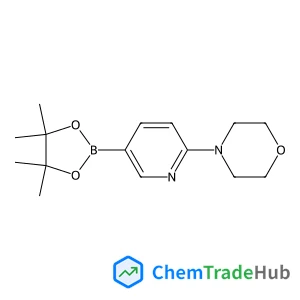
4-(5-(4,4,5,5-tetramethyl-1,3,2-dioxaborolan-2-yl)pyridin-2-yl)morpholine
CAS Number:
485799-04-0
Molecular Formula:
C15H23BN2O3
Recommended Suppliers





Disclaimer
This page provides academic journal information for reference and research purposes only. We are not affiliated with any journal publishers and do not handle publication submissions. For publication-related inquiries, please contact the respective journal publishers directly.
If you notice any inaccuracies in the information displayed, please contact us at support@chemtradehub.com. We will promptly review and address your concerns.