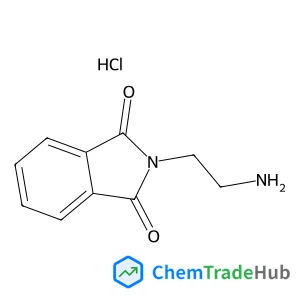
2-(2-Aminoethyl)-1H-isoindole-1,3(2H)-dione hydrochloride (1:1)
CAS Number:
30250-67-0
Molecular Formula:
C10H11ClN2O2
Yury Forov, Mirko Elbers, Christoph J. Sahle, Christopher Weis, Naruki Tsuji, Masayoshi Itou, Yoshiharu Sakurai, Agnieszka Poulain, Christian Sternemann
We present an X-ray Compton scattering study on aqueous trimethylamine N-oxide (TMAO) and guanidine hydrochloride solutions (GdnHCl) as a function of temperature. Independent from the concentration of the solvent, Compton profiles almost resemble results for liquid water as a function of temperature. However, the number of hydrogen bonds per water molecule extracted from the Compton profiles suggests a decrease of hydrogen bonds with rising temperature for all studied samples, and the differences between water and the solutions are weak. Nevertheless, the data indicate a reduced bond weakening with rising TMAO concentration up to 5 M of 7.2% compared to 8% for pure water. In contrast, the addition of GdnHCl appears to behave differently for concentrations up to 3.1 M with a weaker impact on the temperature response of the hydrogen bond structure.

Annual Review of Public Health

Journal of Dispersion Science and Technology

Journal of Natural Products

Organic Geochemistry

Pharmaceutical Chemistry Journal

European Journal of Medicinal Chemistry

Crystal Research and Technology

Drug and Chemical Toxicology

Bioorganic Chemistry

Bulletin of Materials Science
Lai-Hung Lai, Wei-Hsiang Lin, Chin-Chuan Hsieh, Maria Antonietta Loi
DOI: 10.1039/D3LF00089C
Kacper P. Krakowiak, Ruaraidh D. McIntosh, David Ellis
DOI: 10.1039/D3FB00088E
Jin Wook Yang, Hee Ryeong Kwon, Jin Ho Seo, Sangwoo Ryu
DOI: 10.1039/D3LF00094J
Tanongsak Yingnakorn, Jennifer Hartley, Jason S. Terreblanche, Chunhong Lei, Andrew P. Abbott
DOI: 10.1039/D3SU00237C
Ching Yoong Loh, Rui Huang, Roy Bell, Ming Xie
DOI: 10.1039/D3SU00340J
Anna Hu, Yujie Zhang, Jinchuang Zhang, Tongqing Li, Zhaojun Wang, Qiang Wang
DOI: 10.1039/D3FB00171G
Aswathi P. V., Anju Sebastian, Lulu Varghese, Joseph V. P., Jolly Andrews
DOI: 10.1039/D3FB00126A
Francielle Miranda de Matos, Gabriela Boscariol Rasera, Ruann Janser Soares de Castro
DOI: 10.1039/D3FB00097D
(1R,3S)-1,3-Cyclopentanediol finds applications in various industries. In the ph...
When handling N'-[4-(Dimethylamino)phenyl]-N,N-dimethyl-1,4-benzenediamine, it i...
There are several alternatives to 5-(2,4-Difluorophenyl)-2-methoxypyrimidine in ...
1-(3-Methoxyphenoxy)propan-2-ol (CAS: 382141-68-6) must comply with the Globally...
Tetrodotoxin Citrate is extremely dangerous and should be handled with extreme c...
2-Methyl-2-propanyl [(1R,3S)-3-hydroxycyclopentyl]carbamate (CAS: 225641-84-9) i...
Waste containing 4-(2-Hydroxyhexafluoroisopropyl)Benzoic Acid (CAS: 16261-80-6) ...
2-Methyl-2-proanyl {(2S)-1-[(benzyloxy)amino]-3-hydroxy-3-methyl-1-oxo-2-butanyl...
Benzeneethanamine, α-ethyl-, hydrochloride (1:1) is an organic compound with the...
In the synthesis of compounds similar to 3-{(E)-[4-(Dimethylamino)phenyl]diazeny...

Physical Chemistry Chemical Physics (PCCP) is an international journal co-owned by 19 physical chemistry and physics societies from around the world. This journal publishes original, cutting-edge research in physical chemistry, chemical physics and biophysical chemistry. To be suitable for publication in PCCP, articles must include significant innovation and/or insight into physical chemistry; this is the most important criterion that reviewers and Editors will judge against when evaluating submissions. The journal has a broad scope and welcomes contributions spanning experiment, theory, computation and data science. Topical coverage includes spectroscopy, dynamics, kinetics, statistical mechanics, thermodynamics, electrochemistry, catalysis, surface science, quantum mechanics, quantum computing and machine learning. Interdisciplinary research areas such as polymers and soft matter, materials, nanoscience, energy, surfaces/interfaces, and biophysical chemistry are welcomed if they demonstrate significant innovation and/or insight into physical chemistry. Joined experimental/theoretical studies are particularly appreciated when complementary and based on up-to-date approaches.
![N-[(9H-Fluoren-9-ylmethoxy)carbonyl]-beta-phenyl-L-phenylalanine structure](https://static.chemtradehub.com/structs/201/201484-50-6-c2fc.webp "N-[(9H-Fluoren-9-ylmethoxy)carbonyl]-beta-phenyl-L-phenylalanine structure")