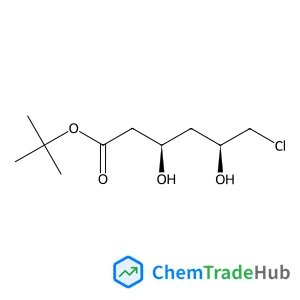
2-Methyl-2-propanyl (3R,5S)-6-chloro-3,5-dihydroxyhexanoate
CAS Number:
154026-93-4
Molecular Formula:
C10H19ClO4
Xiakun Chu
Transcription factors are thought to efficiently search for their target DNA site via a combination of conventional 3D diffusion and 1D diffusion along the DNA molecule mediated by non-specific electrostatic interactions. This process requires the DNA-binding protein to quickly exchange between a search competent and a target recognition mode, but little is known as to how these two binding modes are encoded in the conformational properties of the protein. Here, we investigate this issue on the engrailed homeodomain (EngHD), a DNA-binding domain that folds ultrafast and exhibits a complex conformational behavior consistent with the downhill folding scenario. We explore the interplay between folding and DNA recognition using a coarse-grained computational model that allows us to manipulate the folding properties of the protein and monitor its non-specific and specific binding to DNA. We find that conformational disorder increases the search efficiency of EngHD by promoting a fast gliding search mode in addition to sliding. When gliding, EngHD remains loosely bound to DNA moving linearly along its length. A partially disordered EngHD also binds more dynamically to the target site, reducing the half-life of the specific complex via a spring-loaded mechanism. These findings apply to all conditions leading to partial disorder. However, we also find that at physiologically relevant temperatures EngHD is well folded and can only obtain the conformational flexibility required to accelerate 1D diffusion when it folds/unfolds within the downhill scenario (crossing a marginal free energy barrier). In addition, the conformational flexibility of native downhill EngHD enables its fast reconfiguration to lock into the specific binding site upon arrival, thereby affording finer control of the on- and off-rates of the specific complex. Our results provide key mechanistic insights into how DNA-binding domains optimize specific DNA recognition through the control of their conformational dynamics and folding mechanism.

Russian Chemical Bulletin

Current Opinion in Colloid & Interface Science

Russian Journal of Coordination Chemistry

Russian Journal of General Chemistry

Nature Medicine

Russian Journal of Organic Chemistry

Chemical Communications

Journal of Peptide Science

Russian Journal of Bioorganic Chemistry

Chemistry Education Research and Practice
Toshiaki Mori, Yoshimi Sekine, Kenji Yamamoto, Yoshio Okahata
DOI: 10.1039/B411082J
John J. Perry, Gregory J. McManus, Michael J. Zaworotko
DOI: 10.1039/B408973A
Moonhyun Oh, Charlotte L. Stern, Chad A. Mirkin
DOI: 10.1039/B408084J
Chengwei Gao, Xiaochun Tao, Yanlong Qian, Jiling Huang
DOI: 10.1039/B302890A
Susannah J. Patey, Jeremy E. Turnbull
DOI: 10.1039/B411726C
Jianzhong Yang, Andrew R. Barron
DOI: 10.1039/B411118D
Liangti Qu, Gaoquan Shi
DOI: 10.1039/B412638F
Xurong Xu, Joong Tark Han, Kilwon Cho
DOI: 10.1039/B300581J
Masaharu Ueno, Hideaki Hisamoto, Takehiko Kitamori, Shū Kobayashi
DOI: 10.1039/B301638B
Caroline V. Potter, Sarah Thomas, Janet L. Dean, Adrian P. Kybett, Richard Kidd, Melanie James, Helen Saxton
DOI: 10.1039/B417565B
(1R,3S)-1,3-Cyclopentanediol finds applications in various industries. In the ph...
When handling N'-[4-(Dimethylamino)phenyl]-N,N-dimethyl-1,4-benzenediamine, it i...
There are several alternatives to 5-(2,4-Difluorophenyl)-2-methoxypyrimidine in ...
1-(3-Methoxyphenoxy)propan-2-ol (CAS: 382141-68-6) must comply with the Globally...
Tetrodotoxin Citrate is extremely dangerous and should be handled with extreme c...
2-Methyl-2-propanyl [(1R,3S)-3-hydroxycyclopentyl]carbamate (CAS: 225641-84-9) i...
Waste containing 4-(2-Hydroxyhexafluoroisopropyl)Benzoic Acid (CAS: 16261-80-6) ...
2-Methyl-2-proanyl {(2S)-1-[(benzyloxy)amino]-3-hydroxy-3-methyl-1-oxo-2-butanyl...
Benzeneethanamine, α-ethyl-, hydrochloride (1:1) is an organic compound with the...
In the synthesis of compounds similar to 3-{(E)-[4-(Dimethylamino)phenyl]diazeny...

Physical Chemistry Chemical Physics (PCCP) is an international journal co-owned by 19 physical chemistry and physics societies from around the world. This journal publishes original, cutting-edge research in physical chemistry, chemical physics and biophysical chemistry. To be suitable for publication in PCCP, articles must include significant innovation and/or insight into physical chemistry; this is the most important criterion that reviewers and Editors will judge against when evaluating submissions. The journal has a broad scope and welcomes contributions spanning experiment, theory, computation and data science. Topical coverage includes spectroscopy, dynamics, kinetics, statistical mechanics, thermodynamics, electrochemistry, catalysis, surface science, quantum mechanics, quantum computing and machine learning. Interdisciplinary research areas such as polymers and soft matter, materials, nanoscience, energy, surfaces/interfaces, and biophysical chemistry are welcomed if they demonstrate significant innovation and/or insight into physical chemistry. Joined experimental/theoretical studies are particularly appreciated when complementary and based on up-to-date approaches.