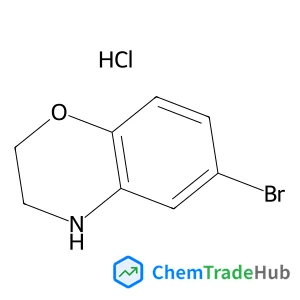
6-Bromo-3,4-dihydro-2H-1,4-benzoxazine hydrochloride (1:1)
CAS Number:
1260803-10-8
Molecular Formula:
C8H9BrClNO
Matthias Degroote, Jinmo Zhao, Yiheng Qiu
Our overarching goal is to be able to describe both weak and strong correlation with a single, computationally affordable method without sacrificing important qualities of the wavefunction, e.g. symmetries of the Hamiltonian. We know that coupled cluster theory with low-order excitations is excellent at describing weakly-correlated systems near equilibrium, but breaks down as systems become more strongly correlated. Projected Hartree–Fock on the other hand is inherently capable of describing multireference character, but misses weak correlation. We are thus exploring how best to combine coupled cluster and projected Hartree–Fock in our search for a computationally feasible method that is applicable across a wide range of correlation strengths. In this manuscript, we adapt our earlier work on the pairing Hamiltonian to repulsive Hamiltonians, resulting in the spin polynomial similarity transformation (SpinPoST) interpolation. SpinPoST parameterizes the wavefunction in order to interpolate between the coupled cluster and spin-projected unrestricted Hartree–Fock ansätze self consistently, and is a spin-symmetry adapted model which involves only single and double excitations. We employ a unique approach of optimizing the wavefunction by minimizing the effect of connected quadruple excitations, resulting in a method which is spin-symmetry adapted and is comparable energetically to coupled cluster with singles and doubles for weak correlation and spin-projected Hartree–Fock for strong correlation.
Changkui Fu, Zixuan Huang, Craig J. Hawker, Graeme Moad, Jiangtao Xu, Cyrille Boyer
DOI: 10.1039/C7PY00713B
Csaba Fodor, Tímea Stumphauser, Ralf Thomann, Yi Thomann, Béla Iván
DOI: 10.1039/C6PY00848H
Yueyue Gao, Yong Zhang, Zhitian Liu, Liancheng Zhao
DOI: 10.1039/C7PY00850C
Lu Zhou, Dapeng Zhang, Sabrina Hocine, Alessia Pilone, Sylvain Trépout, Sergio Marco, Christophe M. Thomas, Jia Guo
DOI: 10.1039/C7PY90126G
Wei Lu, To Ngai, Xiaoxia Le, Jing Zheng, Ning Zhao, Youju Huang, Xiufang Wen, Jiawei Zhang, Tao Chen
DOI: 10.1039/C6PY01112H
Q. Chai, Y. Huang, T. L. Kirley, N. Ayres
DOI: 10.1039/C7PY00204A
Lei Wang, Marcus Cole, Junting Li, Yang Zheng, Yung Pin Chen, Kristen P. Miller
DOI: 10.1039/C4PY01134A
4-Nitrophenyl phosphate disodium salt hexahydrate is primarily used as a substra...
2-(Trifluoromethyl)-1,3-oxazole-4-carboxylic Acid (CAS: 1060816-01-4) is widely ...
2-Fluoro-4-biphenylcarboxylic acid should be stored in a cool, dry place at room...
Prednisolone-21-Carboxylic Acid is primarily used in the pharmaceutical industry...
4-(Hydrazinomethyl)-1,2,3-benzenetriol (CAS: 3614-72-0) should be stored in a co...
4-Amino-1-methyl-1H-pyrazole-5-carboxylic acid hydrochloride (CAS: 92534-70-8) i...
Dehydropachymic acid (CAS: 77012-31-8) is regulated by various agencies. It fall...
The market and research trends for 6-[(2,2-Dimethylpropanoyl)amino]nicotinic aci...
1,10-Phenanthroline-2,9-dicarbaldehyde should be stored in a cool, dry place awa...
5-Carbamoyl-11-oxo-10,11-dihydro-5H-dibenzo[b,f]azepin-10-yl acetate can be synt...

Physical Chemistry Chemical Physics (PCCP) is an international journal co-owned by 19 physical chemistry and physics societies from around the world. This journal publishes original, cutting-edge research in physical chemistry, chemical physics and biophysical chemistry. To be suitable for publication in PCCP, articles must include significant innovation and/or insight into physical chemistry; this is the most important criterion that reviewers and Editors will judge against when evaluating submissions. The journal has a broad scope and welcomes contributions spanning experiment, theory, computation and data science. Topical coverage includes spectroscopy, dynamics, kinetics, statistical mechanics, thermodynamics, electrochemistry, catalysis, surface science, quantum mechanics, quantum computing and machine learning. Interdisciplinary research areas such as polymers and soft matter, materials, nanoscience, energy, surfaces/interfaces, and biophysical chemistry are welcomed if they demonstrate significant innovation and/or insight into physical chemistry. Joined experimental/theoretical studies are particularly appreciated when complementary and based on up-to-date approaches.