












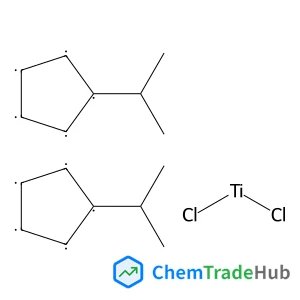
BIS(I-PROPYLCYCLOPENTADIENYL)TITANIUM DICHLORIDE
CAS Number:
12130-65-3
Molecular Formula:
C16H22Cl2Ti
Furong Wang, Pierre Archirel, Yusa Muroya, Shinichi Yamashita, Pascal Pernot, Chengying Yin, Abdel Karim El Omar, Uli Schmidhammer, Jean-Marie Teuler, Mehran Mostafavi
It is generally considered that the pre-solvated electron and the solvated electron reacting with a solute yield the same product. Silver cyanide complex, Ag(CN)2−, is used as a simple probe to demonstrate unambiguously the existence of a different reduction mechanism for pre-hydrated electrons. Using systematic multichannel transient absorption measurements at different solute concentrations from millimolar to decimolar, global data analysis and theoretical calculations, we present the dissociative electron attachment on Ag(CN)2−. The short-lived silver complex, Ag0(CN)22−, formed by hydrated electron with nanosecond pulse radiolysis, can be observed at room temperature. However, at higher temperatures only the free silver atom, Ag0, is detected, suggesting that Ag0(CN)22− dissociation is fast. Surprisingly, pulse radiolysis measurements on Ag(CN)2− reduction, performed by a 7 ps electron pulse at room temperature, show clearly that a new reduced form of silver complex, AgCN−, is produced within the pulse. This species, absorbing at 560 nm, is not formed by the hydrated electron but exclusively by its precursor. DFT calculations show that the different reactivity of the hydrated and pre-hydrated electrons can be due to the formation of different electronic states of Ag0(CN)22−: the prehydrated electron can form an excited state of this complex, which mainly dissociates into Ag0CN− + CN−.
Georgina Sauzier, Wilhelm van Bronswijk, Simon W. Lewis
DOI: 10.1039/D1AN00082A
Haidong Feng, Alex Jafek, Raheel Samuel, James Hotaling, Timothy G. Jenkins, Kenneth I. Aston, Bruce K. Gale
DOI: 10.1039/D1AN00480H
Thanyada Sukmanee, Sanong Ekgasit, Yasutaka Kitahama, Yukihiro Ozaki
DOI: 10.1039/D1AN00069A
Akihiko Ishii, Takeshi Takahashi, Akira Tawata, Aki Furukawa, Hideaki Oshida, Juzo Nakayama
DOI: 10.1039/B207810D
Shanmin Gao, Jun Lu, Yan Zhao, Nan Chen, Yi Xie
DOI: 10.1039/B208076A
Oliver Deeg, Peer Kirsch, Detlef Pauluth, Peter Bäuerle
DOI: 10.1039/B207630F
Uvinduni I. Premadasa, Amber N. Bible, Jennifer L. Morrell-Falvey, Benjamin Doughty, Ying-Zhong Ma
DOI: 10.1039/D1AN00129A
Yali Wang, Yuan Zhang, Lijun Yang, Huiyuan Wu, Nathaniel Finney
DOI: 10.1039/D1AN00147G
Clara Granzotto, Ken Sutherland, Young Ah Goo
DOI: 10.1039/D1AN00228G
2-Methylbenzene-1,4-diamine dihydrochloride (CAS: 615-45-2) should be stored in ...
(1S,4S)-2,5-Diazabicyclo[2.2.1]heptane dihydrobromide is generally considered sa...
(6-Chloropyridazin-3-YL)methanamine finds applications in the pharmaceutical ind...
2-Fluoro-3-methylphenol is primarily used in the synthesis of pharmaceuticals, p...
When handling 3-Methoxy-4-nitrobenzonitrile, it is important to wear appropriate...
When handling 1,3-Oxazolo[4,5-b]pyridine-2(3H)-thione (CAS: 211949-57-4), it is ...
4-Ethynylbenzamide (CAS: 90347-86-7) falls under various regulatory guidelines i...
3-(2-Ethylphenyl)-2-thioxo-4-imidazolidinone is primarily used as an intermediat...
(2-Fluoro-6-methoxyphenyl)acetic acid, also known as 4-fluoro-3-methoxybenzoic a...
Market trends for 2-[4-(Hydroxymethyl)phenoxy]ethanol (CAS: 102196-18-9) indicat...

Physical Chemistry Chemical Physics (PCCP) is an international journal co-owned by 19 physical chemistry and physics societies from around the world. This journal publishes original, cutting-edge research in physical chemistry, chemical physics and biophysical chemistry. To be suitable for publication in PCCP, articles must include significant innovation and/or insight into physical chemistry; this is the most important criterion that reviewers and Editors will judge against when evaluating submissions. The journal has a broad scope and welcomes contributions spanning experiment, theory, computation and data science. Topical coverage includes spectroscopy, dynamics, kinetics, statistical mechanics, thermodynamics, electrochemistry, catalysis, surface science, quantum mechanics, quantum computing and machine learning. Interdisciplinary research areas such as polymers and soft matter, materials, nanoscience, energy, surfaces/interfaces, and biophysical chemistry are welcomed if they demonstrate significant innovation and/or insight into physical chemistry. Joined experimental/theoretical studies are particularly appreciated when complementary and based on up-to-date approaches.
![(3R,4aR,7aS,9aR,10S,11R,13aR,13bS,15aS,15bR)-3,11-Dihydroxy-10-(hydroxymethyl)-4,4,7a,10,13a,15b-hexamethyl-1,2,3,4,4a,7,7a,8,9,9a,10,11,12,13,13a,13b,14,15,15a,15b-icosahydro-5H-naphtho[2',1':4,5]cyc
lohepta[1,2-a]naphthalen-5-one structure](https://static.chemtradehub.com/structs/538/53800-21-8-9f18.webp "(3R,4aR,7aS,9aR,10S,11R,13aR,13bS,15aS,15bR)-3,11-Dihydroxy-10-(hydroxymethyl)-4,4,7a,10,13a,15b-hexamethyl-1,2,3,4,4a,7,7a,8,9,9a,10,11,12,13,13a,13b,14,15,15a,15b-icosahydro-5H-naphtho[2',1':4,5]cyc
lohepta[1,2-a]naphthalen-5-one structure")
![1-Benzyl-1,7-diazaspiro[4.4]nonane dihydrochloride structure](https://static.chemtradehub.com/structs/115/1159822-71-5-0320.webp "1-Benzyl-1,7-diazaspiro[4.4]nonane dihydrochloride structure")





