












Solvent diffusion in polymer-embedded hollow nanoparticles studied by in situ small angle X-ray scattering
Literature Information
Publication Date
2017-07-21
DOI
10.1039/C7CP03741D
Impact Factor
3.676
Authors
Zhi Hong Chen, Sun Hye Hwang, Xiang-bing Zeng, Jongmin Roh, Jyongsik Jang
View Original
Abstract
In situ time-resolved small-angle X-ray scattering is introduced as a method to monitor the diffusion of a solvent in ceramic hollow nanoparticles (HNPs) supported by a polymer gel scaffold. Changes in the form factor were matched to discrete scattering models. A consecutive reaction kinetic model is used to analyze different stages of solvent diffusion. Rate constants and diffusion coefficients are extracted. By taking the diffusion of low molecular poly(ethylene glycol) in poly(ethylene oxide)-embedded HNPs as a model case, it was found that it took about 0.7 s for the solvent to diffuse through the 6 nm thick shell of HNPs and another 1.2 s to fill the inner cavity, while the diffusion coefficient was of the order of 1018 m2 s−1. The results demonstrate that the method can simultaneously measure solvent penetration into the polymer gel and into embedded sub-100 nm HNPs.
Related Literature
Phenyl acrylate is a versatile monomer for the synthesis of acrylic diblock copolymer nano-objects via polymerization-induced self-assembly
S. L. Canning, V. J. Cunningham, L. P. D. Ratcliffe, S. P. Armes
2017-07-25
Paper
DOI: 10.1039/C7PY01161J
Green chain-shattering polymers based on a self-immolative azobenzene motif
2016-02-22
Paper
DOI: 10.1039/C5PY01937K
Shape memory polymer foams prepared from a heparin-inspired polyurethane/urea
Q. Chai, Y. Huang, T. L. Kirley, N. Ayres
2017-03-02
Paper
DOI: 10.1039/C7PY00204A
Mussel-inspired multifunctional supramolecular hydrogels with self-healing, shape memory and adhesive properties
Wei Lu, To Ngai, Xiaoxia Le, Jing Zheng, Ning Zhao, Youju Huang, Xiufang Wen, Jiawei Zhang, Tao Chen
2016-08-04
Communication
DOI: 10.1039/C6PY01112H
Synergetic enhancement of antitumor efficacy with charge-reversal and reduction-sensitive polymer micelles
Shi-Xi Li, Lei Liu, Liu-Jie Zhang, Bo Wu, Cai-Xia Wang, Wei Zhou, Ren-Xi Zhuo, Shi-Wen Huang
2016-07-14
Paper
DOI: 10.1039/C6PY00874G
Selective solvent-induced reconstruction in confined space: one-dimensional mesoporous block copolymer structures in cylindrical nanopores
Chun-Wei Chang, Mu-Huan Chi, Hao-Wen Ko, Chien-Wei Chu, Zhi-Xuan Fang, Yi-Hsuan Tu, Jiun-Tai Chen
2017-05-10
Communication
DOI: 10.1039/C7PY00579B
Correction: Thermoresponsive gels directly obtained via visible light-mediated polymerization-induced self-assembly with oxygen tolerance
Kaixuan Ren
2017-06-05
Correction
DOI: 10.1039/C7PY90088K
Insight into the polymerization mechanism of photoinduced step transfer-addition & radical-termination (START) polymerizations
Tianchi Xu, Lifen Zhang, Zhenping Cheng, Xiulin Zhu
2017-06-13
Paper
DOI: 10.1039/C7PY00709D
Dispersion RAFT polymerization: comparison between the monofunctional and bifunctional macromolecular RAFT agents
Chengqiang Gao, Shentong Li, Quanlong Li, Pengfei Shi, Sayyar Ali Shah, Wangqing Zhang
2014-08-22
Paper
DOI: 10.1039/C4PY01069H
Enhanced stability of conductive polyacetylene in ladder-like surface-grafted brushes
Michał Szuwarzyński, Karol Wolski, Szczepan Zapotoczny
2016-08-22
Paper
DOI: 10.1039/C6PY00977H
You might also like
Compound Q&A
What are the main uses of 4-Nitrophenyl phosphate disodium salt hexahydrate (CAS: 333338-18-4)?
4-Nitrophenyl phosphate disodium salt hexahydrate is primarily used as a substra...
333338-18-44-Nitrophenyl phosph...
Compound Q&A
What are the main uses of 2-(Trifluoromethyl)-1,3-oxazole-4-carboxylic Acid (CAS: 1060816-01-4)?
2-(Trifluoromethyl)-1,3-oxazole-4-carboxylic Acid (CAS: 1060816-01-4) is widely ...
1060816-01-42-(Trifluoromethyl)-...
Compound Q&A
How should 2-Fluoro-4-biphenylcarboxylic acid (CAS: 137045-30-8) be stored?
2-Fluoro-4-biphenylcarboxylic acid should be stored in a cool, dry place at room...
137045-30-82-Fluoro-4-biphenylc...
Compound Q&A
What industries use Prednisolone-21-Carboxylic Acid (CAS: 61549-70-0)?
Prednisolone-21-Carboxylic Acid is primarily used in the pharmaceutical industry...
61549-70-0Prednisolone-21-Carb...
Compound Q&A
How should 4-(Hydrazinomethyl)-1,2,3-benzenetriol (CAS: 3614-72-0) be stored?
4-(Hydrazinomethyl)-1,2,3-benzenetriol (CAS: 3614-72-0) should be stored in a co...
3614-72-04-(Hydrazinomethyl)-...
Compound Q&A
What industries use 4-Amino-1-methyl-1H-pyrazole-5-carboxylic acid hydrochloride (CAS: 92534-70-8)?
4-Amino-1-methyl-1H-pyrazole-5-carboxylic acid hydrochloride (CAS: 92534-70-8) i...
92534-70-84-Amino-1-methyl-1H-...
Compound Q&A
What regulatory guidelines apply to dehydropachymic acid (CAS: 77012-31-8)?
Dehydropachymic acid (CAS: 77012-31-8) is regulated by various agencies. It fall...
77012-31-8Dehydropachymic acid
Compound Q&A
What is the market or research trend for 6-[(2,2-Dimethylpropanoyl)amino]nicotinic acid (CAS: 898561-66-5)?
The market and research trends for 6-[(2,2-Dimethylpropanoyl)amino]nicotinic aci...
898561-66-56-[(2,2-Dimethylprop...
Compound Q&A
How should 1,10-Phenanthroline-2,9-dicarbaldehyde (CAS: 57709-62-3) be stored?
1,10-Phenanthroline-2,9-dicarbaldehyde should be stored in a cool, dry place awa...
57709-62-31,10-Phenanthroline-...
Compound Q&A
How is 5-Carbamoyl-11-oxo-10,11-dihydro-5H-dibenzo[b,f]azepin-10-yl acetate (CAS: 113952-21-9) typically synthesized?
5-Carbamoyl-11-oxo-10,11-dihydro-5H-dibenzo[b,f]azepin-10-yl acetate can be synt...
113952-21-95-Carbamoyl-11-oxo-1...
Source Journal
Physical Chemistry Chemical Physics

CiteScore:
5.5
Self-citation Rate:
10.3%
Articles per Year:
3036
Physical Chemistry Chemical Physics (PCCP) is an international journal co-owned by 19 physical chemistry and physics societies from around the world. This journal publishes original, cutting-edge research in physical chemistry, chemical physics and biophysical chemistry. To be suitable for publication in PCCP, articles must include significant innovation and/or insight into physical chemistry; this is the most important criterion that reviewers and Editors will judge against when evaluating submissions. The journal has a broad scope and welcomes contributions spanning experiment, theory, computation and data science. Topical coverage includes spectroscopy, dynamics, kinetics, statistical mechanics, thermodynamics, electrochemistry, catalysis, surface science, quantum mechanics, quantum computing and machine learning. Interdisciplinary research areas such as polymers and soft matter, materials, nanoscience, energy, surfaces/interfaces, and biophysical chemistry are welcomed if they demonstrate significant innovation and/or insight into physical chemistry. Joined experimental/theoretical studies are particularly appreciated when complementary and based on up-to-date approaches.
Recommended Compounds
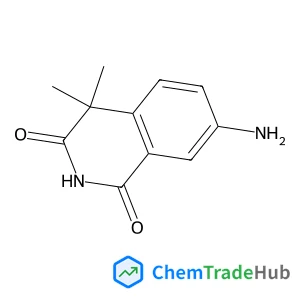
1,3(2H,4H)-Isoquinolinedione, 7-amino-4,4-dimethyl-
CAS Number:
14576-22-8
Molecular Formula:
C11H12N2O2
Recommended Suppliers





Disclaimer
This page provides academic journal information for reference and research purposes only. We are not affiliated with any journal publishers and do not handle publication submissions. For publication-related inquiries, please contact the respective journal publishers directly.
If you notice any inaccuracies in the information displayed, please contact us at support@chemtradehub.com. We will promptly review and address your concerns.