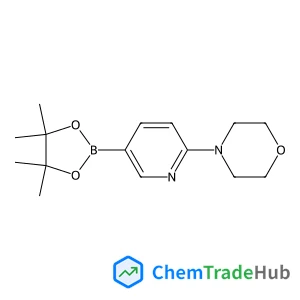
4-(5-(4,4,5,5-tetramethyl-1,3,2-dioxaborolan-2-yl)pyridin-2-yl)morpholine
CAS Number:
485799-04-0
Molecular Formula:
C15H23BN2O3
Patrick R. Batista, Renan V. Viesser, Cláudio F. Tormena, Roberto Rittner, Paulo R. de Oliveira
Intramolecular hydrogen bonding (IAHB) is one of the most important intramolecular interactions and a critical element in adopted molecular arrangements. Moreover, slight substitution in a molecule can affect its strength to a great extent. It is well established that alkyl groups play a positive role in IAHB strength. However, the effects that drive it are specific to each system. To investigate the influence of IAHB and its strength dependency on different acyclic compounds, the conformational preferences of propane-1,3-diol, 3-methoxypropan-1-ol, 3-ethoxypropan-1-ol, 3-isopropoxypropan-1-ol, 3-(tert-butoxy)propan-1-ol, butane-1,3-diol, 3-methoxybutan-1-ol, 3-methylbutane-1-diol, and 3-methoxy-3-methylbutan-1-ol were evaluated experimentally using infrared spectroscopy theoretically supported by topological and natural bond orbital analyses. The most stable conformation of each compound exhibited IAHB and these conformers are more populated in the equilibrium for all studied compounds. Experimental infrared and topological data suggest that the strength of IAHB increases for each methyl group addition. NBO analyses indicate that methyl groups in different positions related to an OH moiety affect the charge transfer energy involved in intramolecular hydrogen bonding. This occurs mostly due to an increase in the spn-hybridized lone pair (LP1O) contribution to the charge transfer , which is a result of changes in s-character and orbital energy caused by geometrical rearrangements, rehybridization, and/or electronic effects.
Zeyu Liu, Zhen Liu, Rui Gao, Jie Su, Yi Qiu, Liangbing Gan
DOI: 10.1039/D1QO01593A
Rahul Nisal, Gregor P. Jose, Chitra Shanbhag, Jeet Kalia
DOI: 10.1039/C8OB00946E
Jian Huang, Wei Chen, Jiazhi Liang, Qin Yang, Zhihong Deng, Zhibin Song, Yiyuan Peng
DOI: 10.1039/D1QO01186C
Chunyu Han, Xianhai Tian, Lina Song, Yaowen Liu
DOI: 10.1039/D1QO01401C
Xiaoyu Xing, Yan Zhao
DOI: 10.1039/C8OB00786A
Takuya Sakai, Takuma Kumoi, Tatsuro Ishikawa, Takahiro Nitta, Hiroki Iida
DOI: 10.1039/C8OB00856F
DOI: 10.1039/C8OB00956B
DeGuang Liu, ZheYuan Xu, MingQiang Liu, Yao Fu
DOI: 10.1039/D1QO01560E
Thomas Toupy, Christopher Kune, Kristof Van Hecke, Loïc Quinton, Jean-Christophe M. Monbaliu
DOI: 10.1039/D1QO01564H
(1R,3S)-1,3-Cyclopentanediol finds applications in various industries. In the ph...
When handling N'-[4-(Dimethylamino)phenyl]-N,N-dimethyl-1,4-benzenediamine, it i...
There are several alternatives to 5-(2,4-Difluorophenyl)-2-methoxypyrimidine in ...
1-(3-Methoxyphenoxy)propan-2-ol (CAS: 382141-68-6) must comply with the Globally...
Tetrodotoxin Citrate is extremely dangerous and should be handled with extreme c...
2-Methyl-2-propanyl [(1R,3S)-3-hydroxycyclopentyl]carbamate (CAS: 225641-84-9) i...
Waste containing 4-(2-Hydroxyhexafluoroisopropyl)Benzoic Acid (CAS: 16261-80-6) ...
2-Methyl-2-proanyl {(2S)-1-[(benzyloxy)amino]-3-hydroxy-3-methyl-1-oxo-2-butanyl...
Benzeneethanamine, α-ethyl-, hydrochloride (1:1) is an organic compound with the...
In the synthesis of compounds similar to 3-{(E)-[4-(Dimethylamino)phenyl]diazeny...

Physical Chemistry Chemical Physics (PCCP) is an international journal co-owned by 19 physical chemistry and physics societies from around the world. This journal publishes original, cutting-edge research in physical chemistry, chemical physics and biophysical chemistry. To be suitable for publication in PCCP, articles must include significant innovation and/or insight into physical chemistry; this is the most important criterion that reviewers and Editors will judge against when evaluating submissions. The journal has a broad scope and welcomes contributions spanning experiment, theory, computation and data science. Topical coverage includes spectroscopy, dynamics, kinetics, statistical mechanics, thermodynamics, electrochemistry, catalysis, surface science, quantum mechanics, quantum computing and machine learning. Interdisciplinary research areas such as polymers and soft matter, materials, nanoscience, energy, surfaces/interfaces, and biophysical chemistry are welcomed if they demonstrate significant innovation and/or insight into physical chemistry. Joined experimental/theoretical studies are particularly appreciated when complementary and based on up-to-date approaches.