












Exploring the working mechanism of graphene patterning by magnetic-assisted UV ozonation
Literature Information
Publication Date
2017-09-18
DOI
10.1039/C7CP03523C
Impact Factor
3.676
Authors
Huan Yue, Yixuan Wu, Shubin Su, Hao Li, Zhenhua Ni, Xianfeng Chen
View Original
Abstract
When assisted with an inhomogenous vertical magnetic field, ultraviolet (UV) ozonation turns directional and is testified to be applicable to graphene patterning. Using a more cost-effective low-pressure mercury lamp, we further explore the underlying working mechanism by changing oxygen content, introducing reactive ozone or inert nitrogen molecules, and study the lateral under-oxidation impeded Dirac point shifts for a graphene field-effect transistor under UV irradiation. The paramagnetic oxygen molecule X3Σ−g accelerates toward graphene with the magnetic moment aligned parallel to the magnetic field. The O(3P) atoms, stemming from such a directional oxygen molecule, have a high initial velocity before being further accelerated, and therefore enhance the oxidation capability compared with those from weak diamagnetic ozone molecules. Intermolecular or atomic-molecular collisions between the high-speed oxygen molecules/atoms and the randomly moved weak diamagnetic molecules, including nitrogen and ozone, appear crucial in deteriorating graphene patterning by increasing the lateral under-oxidation. This study may shed light on our understanding of graphene patterning by magnetic-assisted UV ozonation.
Related Literature
Recent advancements towards the green synthesis of carbon quantum dots as an innovative and eco-friendly solution for metal ion sensing and monitoring
Jyoti Dhariwal, Gyandshwar K. Rao, Dipti Vaya
2023-12-14
Critical Review
DOI: 10.1039/D3SU00375B
Reflecting on the successes of the first full year of RSC Sustainability
2023-12-12
Editorial
DOI: 10.1039/D3SU90059B
A guide to lignin valorization in biorefineries: traditional, recent, and forthcoming approaches to convert raw lignocellulose into valuable materials and chemicals
David Cannella, Diego Montesdeoca, Iwona Cybulska, Damien P. Debecker
2023-11-09
Tutorial Review
DOI: 10.1039/D3SU00140G
Food waste: environmental impact and possible solutions
Ravindra Prajapati, Raj Shah, Mrinaleni Das, Brajendra K. Sharma
2023-12-05
Review Article
DOI: 10.1039/D3FB00141E
Understanding the electrocatalytic oxidation of propionic acid for the sustainable production of ethylene
Andrea Angulo, Carolina Elizarraras, Ju Hee Shin, Alexandra van Riel, Toshihiro Akashige, Miguel Modestino
2023-10-20
Paper
DOI: 10.1039/D3SU00347G
Storage stability assessment of guava fruit (Psidium guajava L.) cv. ‘Gola’ in response to different packaging materials
Ali Asad Yousaf, Kashif Sarfraz Abbasi, Muhammad Suhail Ibrahim, Asma Sohail, Mamoona Faiz, Mehwish Khadim
2023-11-28
Paper
DOI: 10.1039/D3FB00113J
Development of sodium alginate–aloe vera hydrogel films enriched with organic fibers: study of the physical, mechanical, and barrier properties for food-packaging applications
Alina Hadi, Anjum Nawab, Feroz Alam, Sara Naqvi
2023-10-30
Paper
DOI: 10.1039/D3FB00122A
An assessment of spent coffee grounds as a replacement for peat in the production of Scotch whisky: chemical extraction and pyrolysis studies
Kacper P. Krakowiak, Ruaraidh D. McIntosh, David Ellis
2023-11-13
Paper
DOI: 10.1039/D3FB00088E
You might also like
Compound Q&A
What industries use (1R,3S)-1,3-Cyclopentanediol (CAS: 16326-97-9)?
(1R,3S)-1,3-Cyclopentanediol finds applications in various industries. In the ph...
16326-97-9(1R,3S)-1,3-Cyclopen...
Compound Q&A
What precautions should be taken when handling N'-[4-(Dimethylamino)phenyl]-N,N-dimethyl-1,4-benzenediamine (CAS: 637-31-0)?
When handling N'-[4-(Dimethylamino)phenyl]-N,N-dimethyl-1,4-benzenediamine, it i...
637-31-0N'-[4-(Dimethylamino...
Compound Q&A
Are there alternatives to 5-(2,4-Difluorophenyl)-2-methoxypyrimidine (CAS: 1352318-16-1) in synthesis?
There are several alternatives to 5-(2,4-Difluorophenyl)-2-methoxypyrimidine in ...
1352318-16-15-(2,4-Difluoropheny...
Compound Q&A
What regulatory guidelines apply to 1-(3-Methoxyphenoxy)propan-2-ol (CAS: 382141-68-6)?
1-(3-Methoxyphenoxy)propan-2-ol (CAS: 382141-68-6) must comply with the Globally...
382141-68-61-(3-Methoxyphenoxy)...
Compound Q&A
Is Tetrodotoxin Citrate (CAS: 18660-81-6) safe?
Tetrodotoxin Citrate is extremely dangerous and should be handled with extreme c...
18660-81-6Tetrodotoxin Citrate
Compound Q&A
What are the main uses of 2-Methyl-2-propanyl [(1R,3S)-3-hydroxycyclopentyl]carbamate (CAS: 225641-84-9)?
2-Methyl-2-propanyl [(1R,3S)-3-hydroxycyclopentyl]carbamate (CAS: 225641-84-9) i...
225641-84-92-Methyl-2-propanyl ...
Compound Q&A
How should waste containing 4-(2-Hydroxyhexafluoroisopropyl)Benzoic Acid (CAS: 16261-80-6) be handled?
Waste containing 4-(2-Hydroxyhexafluoroisopropyl)Benzoic Acid (CAS: 16261-80-6) ...
16261-80-64-(2-Hydroxyhexafluo...
Compound Q&A
How is 2-Methyl-2-proanyl {(2S)-1-[(benzyloxy)amino]-3-hydroxy-3-methyl-1-oxo-2-butanyl}carbamate (CAS: 102507-19-7) typically synthesized?
2-Methyl-2-proanyl {(2S)-1-[(benzyloxy)amino]-3-hydroxy-3-methyl-1-oxo-2-butanyl...
102507-19-72-Methyl-2-propanyl ...
Compound Q&A
What is Benzeneethanamine, α-ethyl-, hydrochloride (1:1) (CAS: 20735-15-3)?
Benzeneethanamine, α-ethyl-, hydrochloride (1:1) is an organic compound with the...
20735-15-3Benzeneethanamine, α...
Compound Q&A
Are there alternatives to 3-{(E)-[4-(Dimethylamino)phenyl]diazenyl}benzoic acid (CAS: 20691-84-3) in synthesis?
In the synthesis of compounds similar to 3-{(E)-[4-(Dimethylamino)phenyl]diazeny...
20691-84-33-{(E)-[4-(Dimethyla...
Source Journal
Physical Chemistry Chemical Physics

CiteScore:
5.5
Self-citation Rate:
10.3%
Articles per Year:
3036
Physical Chemistry Chemical Physics (PCCP) is an international journal co-owned by 19 physical chemistry and physics societies from around the world. This journal publishes original, cutting-edge research in physical chemistry, chemical physics and biophysical chemistry. To be suitable for publication in PCCP, articles must include significant innovation and/or insight into physical chemistry; this is the most important criterion that reviewers and Editors will judge against when evaluating submissions. The journal has a broad scope and welcomes contributions spanning experiment, theory, computation and data science. Topical coverage includes spectroscopy, dynamics, kinetics, statistical mechanics, thermodynamics, electrochemistry, catalysis, surface science, quantum mechanics, quantum computing and machine learning. Interdisciplinary research areas such as polymers and soft matter, materials, nanoscience, energy, surfaces/interfaces, and biophysical chemistry are welcomed if they demonstrate significant innovation and/or insight into physical chemistry. Joined experimental/theoretical studies are particularly appreciated when complementary and based on up-to-date approaches.
Recommended Compounds
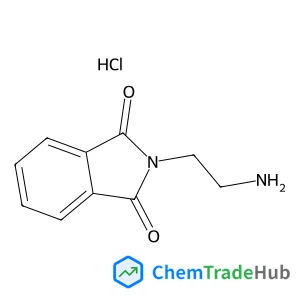
2-(2-Aminoethyl)-1H-isoindole-1,3(2H)-dione hydrochloride (1:1)
CAS Number:
30250-67-0
Molecular Formula:
C10H11ClN2O2
Recommended Suppliers




Disclaimer
This page provides academic journal information for reference and research purposes only. We are not affiliated with any journal publishers and do not handle publication submissions. For publication-related inquiries, please contact the respective journal publishers directly.
If you notice any inaccuracies in the information displayed, please contact us at support@chemtradehub.com. We will promptly review and address your concerns.