












Selective partial hydrolysis of amphiphilic copoly(2-oxazoline)s as basis for temperature and pH responsive micelles
Literature Information
Publication Date
2010-05-21
DOI
10.1039/C0PY00052C
Impact Factor
5.582
Authors
Johan P. A. Heuts, Stephanie Hoeppener
View Original
Abstract
The acidic and basic hydrolyses of gradient and diblock copolymers based on 2-methyl-2-oxazoline (MeOx) and 2-phenyl-2-oxazoline (PhOx) were investigated. Various reaction times were examined revealing polymers with varying ratios of PMeOx, PPhOx and poly(ethylene imine) (PEI). It could be shown that under acidic conditions, PMeOx as well as PPhOx are readily cleaved while under basic conditions PPhOx was almost not hydrolyzed leading to higher selectivity. However, partial degradation of the polymers occurred under basic conditions as evidenced by SEC. Thermal investigations of the polymers cleaved under acidic conditions revealed that most obtained copolymers exhibited a melting temperature due to the large PEI content. Self-assembly studies revealed that the partially hydrolyzed copolymers formed micelles at both ambient and elevated temperatures in acidic medium due to protonation of the ethylene imine units leading to good solubility. In contrast, the copolymers were insoluble at ambient temperature in water or basic medium, but self-assembled into spherical micelles at elevated temperatures as evidenced by transmission electron microscopy and dynamic light scattering. As such, these novel PEI–PPhOx copolymers exhibit thermoresponsive micellization behavior based on the crystallization induced phase separation of linear PEI at lower temperatures. Moreover, the copolymer consisting of 84 ethylene imine repeat units, 16 PPhOx groups also revealed pH responsive micellization due to increased solubility of the ethylene imine units upon protonation in acidic solution.
Related Literature
Catalytic CO oxidation on B-doped and BN co-doped penta-graphene: a computational study
Ranganathan Krishnan, Shiuan-Yau Wu, Hsin-Tsung Chen
2018-09-20
Paper
DOI: 10.1039/C8CP04745F
Conformation-induced separation of 3-chloropropene from 1-chloropropane through nanoporous monolayer graphenes
Steven Wang, Junbo Xu
2019-02-05
Paper
DOI: 10.1039/C9CP00137A
Properties of perhalogenated {closo-B10} and {closo-B11} multiply charged anions and a critical comparison with {closo-B12} in the gas and the condensed phase
Jonas Warneke, Szymon Z. Konieczka, Gao-Lei Hou, Edoardo Aprà, Christoph Kerpen, Fabian Keppner, Thomas C. Schäfer, Michael Deckert, Zheng Yang, Eric J. Bylaska, Grant E. Johnson, Julia Laskin, Xue-Bin Wang, Maik Finze
2018-11-07
Paper
DOI: 10.1039/C8CP05313H
Evidence of the O–Pd–O and Pd–O4 structure units as oxide seeds and their origin on Pd(211): revealing the mechanism of surface oxide formation
Xiran Cheng, Ziyun Wang, Yu Mao, P. Hu
2019-02-19
Paper
DOI: 10.1039/C8CP06224B
The energy level of the Fe2+/3+-transition in BaTiO3 and SrTiO3 single crystals
Issei Suzuki, Leonard Gura, Andreas Klein
2019-02-26
Paper
DOI: 10.1039/C8CP07872F
Using nanotubes to study the phonon spectrum of two-dimensional materials
Jesús Carrete, Vu Ngoc Tuoc, Georg K. H. Madsen
2019-02-06
Paper
DOI: 10.1039/C9CP00052F
The impact of chemical order on defect transport in mixed pyrochlores
Blas P. Uberuaga, Romain Perriot, Ghanshyam Pilania
2019-02-19
Paper
DOI: 10.1039/C8CP07597B
Infrared spectroscopic characterization of phosphate binding at the goethite–water interface
Stella Gypser, Peter Leinweber, Dirk Freese
2019-01-24
Paper
DOI: 10.1039/C8CP07168C
Molecular and dissociative O2 adsorption on the Cu2O(111) surface
Xiaohu Yu, Caibin Zhao, Tianlei Zhang, Zhong Liu
2018-05-23
Paper
DOI: 10.1039/C8CP03035A
You might also like
Compound Q&A
Is 6-(3-Fluorophenyl)picolinic acid (CAS: 887982-40-3) safe?
6-(3-Fluorophenyl)picolinic acid is generally considered safe for laboratory use...
887982-40-36-(3-Fluorophenyl)pi...
Compound Q&A
What industries use (3R)-3-Pyrrolidinol (CAS: 2799-21-5)?
(3R)-3-Pyrrolidinol is used in the pharmaceutical industry as a precursor for dr...
2799-21-5(3R)-3-Pyrrolidinol
Compound Q&A
What precautions should be taken when handling (4R,5R)-4,5-Diethoxycarbonyl-2,2-dimethyldioxolane (CAS: 59779-75-8)?
When handling (4R,5R)-4,5-Diethoxycarbonyl-2,2-dimethyldioxolane (CAS: 59779-75-...
59779-75-8(4R,5R)-4,5-Diethoxy...
Compound Q&A
How is 1-(6-Chloroimidazo[1,2-b]pyridazin-3-yl)ethanone (CAS: 90734-71-7) typically synthesized?
1-(6-Chloroimidazo[1,2-b]pyridazin-3-yl)ethanone is often synthesized via a mult...
90734-71-71-(6-Chloroimidazo[1...
Compound Q&A
What is the market or research trend for N-Ethyl-3,4-dimethylbenzylamine (CAS: 39180-83-1)?
The market for N-Ethyl-3,4-dimethylbenzylamine (CAS: 39180-83-1) remains steady,...
39180-83-1N-Ethyl-3,4-dimethyl...
Compound Q&A
What is Tert-butyl 3-(pyrrolidin-1-yl)azetidine-1-carboxylate (CAS: 1019008-21-9)?
Tert-butyl 3-(pyrrolidin-1-yl)azetidine-1-carboxylate is a chemical compound wit...
1019008-21-9Tert-butyl 3-(pyrrol...
Compound Q&A
What regulatory guidelines apply to 1-Bromo-3-chloro-2,4-dimethoxybenzene (CAS: 1228956-93-1)?
1-Bromo-3-chloro-2,4-dimethoxybenzene (CAS: 1228956-93-1) falls under the classi...
1228956-93-11-Bromo-3-chloro-2,4...
Compound Q&A
Is 8-Bromo-2-methyl-3,4-dihydroisoquinolin-1(2H)-one (CAS: 1368622-07-4) safe?
The safety of 8-Bromo-2-methyl-3,4-dihydroisoquinolin-1(2H)-one (CAS: 1368622-07...
1368622-07-48-Bromo-2-methyl-3,4...
Compound Q&A
Is Benzyl [(3S)-2,6-dioxo-3-piperidinyl]carbamate (CAS: 22785-43-9) safe?
Benzyl [(3S)-2,6-dioxo-3-piperidinyl]carbamate is generally safe when handled wi...
22785-43-9Benzyl [(3S)-2,6-dio...
Compound Q&A
How should 1-{[4-(4,4,5,5-Tetramethyl-1,3,2-dioxaborolan-2-yl)phenyl]sulfonyl}pyrrolidine (CAS: 928657-21-0) be stored?
1-{[4-(4,4,5,5-Tetramethyl-1,3,2-dioxaborolan-2-yl)phenyl]sulfonyl}pyrrolidine s...
928657-21-01-{[4-(4,4,5,5-Tetra...
Source Journal
Polymer Chemistry

CiteScore:
8.6
Self-citation Rate:
7.3%
Articles per Year:
457
Polymer Chemistry welcomes submissions in all areas of polymer science that have a strong focus on macromolecular chemistry. Manuscripts may cover a broad range of fields, yet no direct application focus is required.
Recommended Compounds
![[4-Chloro-3-(diethylcarbamoyl)phenyl]boronic acid structure](https://static.chemtradehub.com/structs/871/871332-68-2-0e3b.webp "[4-Chloro-3-(diethylcarbamoyl)phenyl]boronic acid structure")
[4-Chloro-3-(diethylcarbamoyl)phenyl]boronic acid
CAS Number:
871332-68-2
Molecular Formula:
C11H15BClNO3
![2-Methyl-2-propanyl [(2S)-1-hydroxy-3-(4-hydroxyphenyl)-2-propanyl]carbamate structure](https://static.chemtradehub.com/structs/833/83345-46-4-eec2.webp "2-Methyl-2-propanyl [(2S)-1-hydroxy-3-(4-hydroxyphenyl)-2-propanyl]carbamate structure")
2-Methyl-2-propanyl [(2S)-1-hydroxy-3-(4-hydroxyphenyl)-2-propanyl]carbamate
CAS Number:
83345-46-4
Molecular Formula:
C14H21NO4
![4-[(2,4-Dihydroxyphenyl)diazenyl]-5-hydroxy-2,7-naphthalenedisulfonic acid structure](https://static.chemtradehub.com/structs/362/3627-01-8-79ac.webp "4-[(2,4-Dihydroxyphenyl)diazenyl]-5-hydroxy-2,7-naphthalenedisulfonic acid structure")
4-[(2,4-Dihydroxyphenyl)diazenyl]-5-hydroxy-2,7-naphthalenedisulfonic acid
CAS Number:
3627-01-8
Molecular Formula:
C16H12N2O9S2
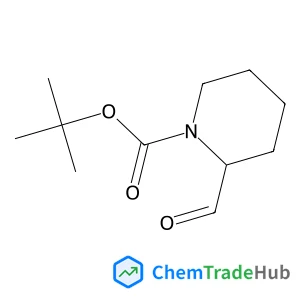
2-Methyl-2-propanyl (2R)-2-formyl-1-piperidinecarboxylate
CAS Number:
134526-69-5
Molecular Formula:
C11H19NO3
Recommended Suppliers






Disclaimer
This page provides academic journal information for reference and research purposes only. We are not affiliated with any journal publishers and do not handle publication submissions. For publication-related inquiries, please contact the respective journal publishers directly.
If you notice any inaccuracies in the information displayed, please contact us at support@chemtradehub.com. We will promptly review and address your concerns.