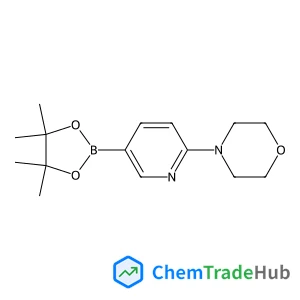
4-(5-(4,4,5,5-tetramethyl-1,3,2-dioxaborolan-2-yl)pyridin-2-yl)morpholine
CAS Number:
485799-04-0
Molecular Formula:
C15H23BN2O3
Donglin Li, Yonggang Yang, Chaozheng Li, Yufang Liu
The fast and accurate detection of amyloid fibrils, which are associated with many neurodegenerative diseases, is important for their early diagnosis. {[50-(p-Hydroxyphenyl)-2,20-bithienyl-5-yl]-methylidene}-propanedinitrile (NIAD-4) is a new promising fluorescent marker for amyloid fibrils, and the photophysical behaviour of NIAD-4 is controversial. Nonadiabatic dynamic simulations, density functional theory (DFT) and time-dependent density functional theory (TDDFT) calculations were performed to determine the influence of the environment on NIAD-4 and the photophysical behaviour of NIAD-4. The results indicate that NIAD-4 is in the NIAD-4·3H2O compound form in the ground state in water. The torsion process of NIAD-4 proposed by Hu et al. (Phys. Chem. Chem. Phys. 2016, 18, 28) does not occur in the excited state. In addition, the fluorescence behaviour of NIAD-4 is sensitive to a hydrogen bonding environment, the maximum fluorescence wavelengths of NIAD-4 show considerable red-shifts, and the fluorescence intensity of NIAD-4 increases significantly in a hydrogen bonding environment. Intermolecular hydrogen bonds are vital for the phenomenon observed in the experiment because the fluorescence intensity of NIAD-4 becomes unusually high with increasing solvent polarities. Therefore, the influence of the intermolecular hydrogen bond should be carefully taken into consideration when NIAD-4 is used to probe the amyloid fibrils in hydrogen-bonding surroundings, especially in complex bioenvironments.
Dominik Göbel, Nils Clamor, Boris J. Nachtsheim
DOI: 10.1039/C8OB01072B
Rui Yan
DOI: 10.1039/C8OB00723C
Thomas Toupy, Christopher Kune, Kristof Van Hecke, Loïc Quinton, Jean-Christophe M. Monbaliu
DOI: 10.1039/D1QO01564H
Xiao Yi, Yirui Chen, An Huang, Dingguo Song, Jiaying He, Fei Ling, Weihui Zhong
DOI: 10.1039/D1QO01443A
Xintao Gu, Yin Wei
DOI: 10.1039/D1QO01373D
Bhavani Shankar Chinta, Harikrishna Sanapa, Kamala Prasad Vasikarla, Beeraiah Baire
DOI: 10.1039/C8OB00434J
Yang Gao, Yuanyou Mao, Biwei Zhang, Yingying Zhan, Yanping Huo
DOI: 10.1039/C8OB00841H
Hai Yu, Abhishek Santra, Yanhong Li, John B. McArthur, Tamashree Ghosh, Xiaoxiao Yang, Peng G. Wang, Xi Chen
DOI: 10.1039/C8OB01087K
Zhichao Chen, Hong Zhang, Shu-Feng Zhou, Xiuling Cui
DOI: 10.1039/D1QO01540K
Duc Duy Vo, Cécile Becquart, Thi Phuong Anh Tran, Audrey Di Giorgio, Fabien Darfeuille, Cathy Staedel, Maria Duca
DOI: 10.1039/C8OB01858H
(1R,3S)-1,3-Cyclopentanediol finds applications in various industries. In the ph...
When handling N'-[4-(Dimethylamino)phenyl]-N,N-dimethyl-1,4-benzenediamine, it i...
There are several alternatives to 5-(2,4-Difluorophenyl)-2-methoxypyrimidine in ...
1-(3-Methoxyphenoxy)propan-2-ol (CAS: 382141-68-6) must comply with the Globally...
Tetrodotoxin Citrate is extremely dangerous and should be handled with extreme c...
2-Methyl-2-propanyl [(1R,3S)-3-hydroxycyclopentyl]carbamate (CAS: 225641-84-9) i...
Waste containing 4-(2-Hydroxyhexafluoroisopropyl)Benzoic Acid (CAS: 16261-80-6) ...
2-Methyl-2-proanyl {(2S)-1-[(benzyloxy)amino]-3-hydroxy-3-methyl-1-oxo-2-butanyl...
Benzeneethanamine, α-ethyl-, hydrochloride (1:1) is an organic compound with the...
In the synthesis of compounds similar to 3-{(E)-[4-(Dimethylamino)phenyl]diazeny...

Physical Chemistry Chemical Physics (PCCP) is an international journal co-owned by 19 physical chemistry and physics societies from around the world. This journal publishes original, cutting-edge research in physical chemistry, chemical physics and biophysical chemistry. To be suitable for publication in PCCP, articles must include significant innovation and/or insight into physical chemistry; this is the most important criterion that reviewers and Editors will judge against when evaluating submissions. The journal has a broad scope and welcomes contributions spanning experiment, theory, computation and data science. Topical coverage includes spectroscopy, dynamics, kinetics, statistical mechanics, thermodynamics, electrochemistry, catalysis, surface science, quantum mechanics, quantum computing and machine learning. Interdisciplinary research areas such as polymers and soft matter, materials, nanoscience, energy, surfaces/interfaces, and biophysical chemistry are welcomed if they demonstrate significant innovation and/or insight into physical chemistry. Joined experimental/theoretical studies are particularly appreciated when complementary and based on up-to-date approaches.