












Visualization of local electrochemical activity and local nickel ion release on laser-welded NiTi/steel joints using combined alternating current mode and stripping mode SECM
Literature Information
Publication Date
2008-09-23
DOI
10.1039/B804718A
Impact Factor
4.616
Authors
D. Ruhlig, H. Gugel, A. Schulte, W. Theisen, W. Schuhmann
View Original
Abstract
Smoothly polished cross-sections of laser-fabricated welds between NiTi shape memory alloy and stainless steel (SS) microwires of approximately the same diameter and, for comparison, between identical stainless steel or NiTi wires have been subjected to local chemical activity and nickel release measurements using scanning electrochemical microscopy (SECM). In the alternating current mode (AC-SECM), the measurements detected clear differences in the local interfacial chemical activity of the passivated weld and the base metals only for the heterogeneous joints of the type NiTi–SS. In this case the local electrochemical acvtivity was lower above the weld material. Subjecting cross-sections of NiTi–SS to stripping mode SECM (SM-SECM), higher Ni2+ concentrations were measured above the regions of the parental NiTi wire, which correlates well with the results from AC-SECM imaging which showed this region as being less passivated. An energy-dispersive elemental analysis of the specimen in a scanning electron microscope revealed the coexistence of Ti and Cr in the weld mass. Possibly, a joint action of these two metals in terms of protective oxide formation is better for passivation of the weld region than the individual action of one or the other element for passivating the original wires. Better passivation of course led to decreased electrochemical activity of the weld surface. Apparently, AC- and SM-mode SECM imaging were sufficiently sensitive to detect and visualize the impact of the changed surface passivation upon laser welding.
Related Literature
Metastable critical lines in (acetone + polystyrene) solutions and the continuity of solvent-quality states
Luís P. N. Rebelo, Zoran P. Visak, Jerzy Szydlowski
Paper
DOI: 10.1039/B109405J
The nature of proton transport in fully hydrated Nafion®
Stephen J. Paddison, Reginald Paul
2002-02-28
Paper
DOI: 10.1039/B109792J
Near-diffusion-controlled reactions of muonium in sub- and supercritical water
Khashayar Ghandi, Brenda Addison-Jones, Jean-Claude Brodovitch, Iain McKenzie, Paul W. Percival, Joachim Schüth
2002-01-16
Paper
DOI: 10.1039/B108656A
Theoretical study on mechanisms of the high-temperature reactions C2H3 + H2O and C2H4 + OH
Gui-xia Liu, Yi-hong Ding, Ze-sheng Li, Qiang Fu, Xu-ri Huang, Chia-chung Sun, Au-chin Tang
2002-02-15
Paper
DOI: 10.1039/B109758J
Liquid–liquid coexistence curves of re-entrant phase transitions beyond the asymptotic range: tetrahydrofuran + water and tetrahydrofuran + heavy water
2002-02-15
Paper
DOI: 10.1039/B109349E
Preferential solvation of Ca2+ in aqueous ammonia solution: Classical and combined ab initio quantum mechanical/molecular mechanical molecular dynamics simulations
Anan Tongraar, Kritsana Sagarik, Bernd Michael Rode
2002-01-08
Paper
DOI: 10.1039/B107786D
Gibbs solution of the van der Waals–Maxwell problem and universality of the liquid–gas coexistence curve
Vitaly B. Rogankov, Leonid Z. Boshkov
2002-02-18
Paper
DOI: 10.1039/B107989C
On the chemical properties of sedimentary sulfur in estuarine environments
G. Billon, B. Ouddane, L. Gengembre, A. Boughriet
2002-01-23
Paper
DOI: 10.1039/B108638N
Heat capacity behaviour of pore confined benzene and hexafluorobenzene in NaY zeolite
Guohua Zhao, Barara Groß, Herbert Dilger, Emil Roduner
2002-02-11
Paper
DOI: 10.1039/B110158G
Transition from local to global feedback control of spiral wave dynamics
Vladimir S. Zykov, Stefan C. Müller
2002-03-14
Paper
DOI: 10.1039/B110641B
You might also like
Compound Q&A
What regulatory guidelines apply to 6-Bromo-2-methylimidazo[1,2-a]pyrimidine (CAS: 1111638-05-1)?
6-Bromo-2-methylimidazo[1,2-a]pyrimidine (CAS: 1111638-05-1) falls under various...
1111638-05-16-Bromo-2-methylimid...
Compound Q&A
Are there alternatives to 1-Pyrrolidineethanol, β-methyl-α-phenyl-, (αS,βR) (CAS: 123620-80-4) in synthesis?
While there are no direct alternatives, similar compounds like 1-Pyrrolidineetha...
123620-80-41-Pyrrolidineethanol...
Compound Q&A
Is 4-Methyl-2,6-bis(2-methyl-2-propanyl)phenyl methylcarbamate (CAS: 1918-11-2) safe?
4-Methyl-2,6-bis(2-methyl-2-propanyl)phenyl methylcarbamate (CAS: 1918-11-2) is ...
1918-11-24-Methyl-2,6-bis(2-m...
Compound Q&A
How should 2-(3-Bromo-4-fluorophenyl)-1,3-dioxolane (CAS: 77771-04-1) be stored?
2-(3-Bromo-4-fluorophenyl)-1,3-dioxolane (CAS: 77771-04-1) should be stored in a...
77771-04-12-(3-Bromo-4-fluorop...
Compound Q&A
What are the physical and chemical properties of 4,5,6,7-Tetrahydro-1H-indazole hydrochloride (CAS: 18161-11-0)?
4,5,6,7-Tetrahydro-1H-indazole hydrochloride is a white crystalline solid with a...
18161-11-04,5,6,7-Tetrahydro-1...
Compound Q&A
What is (2R)-1-Methoxy-3-phenyl-2-propanamine (CAS: 59919-07-2)?
(2R)-1-Methoxy-3-phenyl-2-propanamine is a chiral organic compound with the CAS ...
59919-07-2(2R)-1-Methoxy-3-phe...
Compound Q&A
What industries use Ethyl 1-(1-phenylethyl)-1H-imidazole-5-carboxylate (CAS: 56649-47-9)?
Ethyl 1-(1-phenylethyl)-1H-imidazole-5-carboxylate is used in various industries...
56649-47-9Ethyl 1-(1-phenyleth...
Compound Q&A
What regulatory guidelines apply to 4-[(1E,3S)-1-(4-Hydroxyphenyl)-1,4-pentadien-3-yl]phenol (CAS: 17676-24-3)?
4-[(1E,3S)-1-(4-Hydroxyphenyl)-1,4-pentadien-3-yl]phenol (CAS: 17676-24-3) falls...
17676-24-34-[(1E,3S)-1-(4-Hydr...
Compound Q&A
What industries use (S)-3-Amino-5-phenylpentanoic acid hydrochloride (CAS: 331846-97-0)?
(S)-3-Amino-5-phenylpentanoic acid hydrochloride is primarily used in the pharma...
331846-97-0(S)-3-Amino-5-phenyl...
Compound Q&A
How is 7-methoxy-1-benzothiophene-2-carboxylic acid (CAS: 88791-07-5) typically synthesized?
7-Methoxy-1-benzothiophene-2-carboxylic acid is typically synthesized by reactin...
88791-07-57-methoxy-1-benzothi...
Source Journal
Analyst

CiteScore:
7.8
Self-citation Rate:
5.6%
Articles per Year:
653
Analyst publishes analytical and bioanalytical research that reports premier fundamental discoveries and inventions, and the applications of those discoveries, unconfined by traditional discipline barriers.
Recommended Compounds
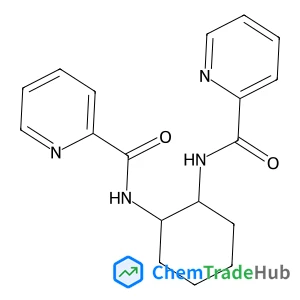
N,N'-(1R,2R)-1,2-Cyclohexanediyldi(2-pyridinecarboxamide)
CAS Number:
218290-24-5
Molecular Formula:
C18H20N4O2
Recommended Suppliers






Disclaimer
This page provides academic journal information for reference and research purposes only. We are not affiliated with any journal publishers and do not handle publication submissions. For publication-related inquiries, please contact the respective journal publishers directly.
If you notice any inaccuracies in the information displayed, please contact us at support@chemtradehub.com. We will promptly review and address your concerns.