












Photoluminescence from vibrational excited-states for organic molecules adsorbed on Si nanoparticles
Literature Information
Publication Date
2017-07-24
DOI
10.1039/C7CP01836C
Impact Factor
3.676
Authors
M. Maeda, T. Matsumoto, H. Kobayashi
View Original
Abstract
Herein, Si nanoparticles have been fabricated from Si swarf using a bead milling method. The adsorption of 9,10-dimethylanthracene (DMA) on Si nanoparticles enhances the photoluminescence (PL) intensity by ∼60 000 times that of DMA in hexane. The PL spectra possess peaked structures due to the vibronic transition of DMA. For the excitation energies higher than 4.0 eV, vibronic bands with energies higher than the (0, 0) band were observed and attributed to PL from the vibrational excited-states. The excitation spectra showed that incident light was absorbed by both DMA and the Si nanoparticles. The lifetime of the photo-generated electron–hole pairs in the Si nanoparticles was much longer than the DMA PL lifetime; this indicated that either a hole or an electron transferred to DMA first, followed by an opposite charge transfer. In the cases where a hole is first transferred to DMA, an electronic ground-state is stabilized via solvation. When an electron is captured by the potential of the electronic excited-state, transitions from the vibrational excited-states proceed due to the high transition probability, generating PL bands with energies higher than the (0, 0) band. In the cases where an electron is first transferred to DMA, internal relaxation to the vibrational ground-state occurs, and the potential of the electronic excited-state is lowered via solvation.
Related Literature
Ultrafast diffusion-controlled thiol–ene based crosslinking of silicone elastomers with tailored mechanical properties for biomedical applications
2016-08-02
Paper
DOI: 10.1039/C6PY01134A
The origin of bisignate circularly polarized luminescence (CPL) spectra from chiral polymer aggregates and molecular camphor: anti-Kasha's rule revealed by CPL excitation (CPLE) spectra
Sang Thi Duong, Michiya Fujiki
2017-07-17
Paper
DOI: 10.1039/C7PY00958E
New catalysts for the synthesis of highly reactive polyisobutylene: chloroaluminate imidazole-based ionic liquids in the presence of diisopropyl ether
Irina V. Vasilenko, Ivan A. Berezianko, Dmitriy I. Shiman, Sergei V. Kostjuk
2016-08-18
Communication
DOI: 10.1039/C6PY01325B
Amphiphilic dendrons with a pyrene functional group at the focal point: synthesis, self-assembly and generation-dependent DNA condensation
Yi Han, Bo Zhu, Ying Chen, Zhishan Bo, Yulan Chen
2017-07-26
Paper
DOI: 10.1039/C7PY01052D
Aqueous RAFT at pH zero: enabling controlled polymerization of unprotected acyl hydrazide methacrylamides
Emily A. Hoff, Brooks A. Abel, Chase A. Tretbar, Charles L. McCormick, Derek L. Patton
2016-10-17
Communication
DOI: 10.1039/C6PY01563H
Multicellular tumor spheroids: a relevant 3D model for the in vitro preclinical investigation of polymer nanomedicines
Gianpiero Lazzari, Patrick Couvreur, Simona Mura
2017-05-15
Review Article
DOI: 10.1039/C7PY00559H
Poly(glycerol sebacate) nanoparticles for encapsulation of hydrophobic anti-cancer drugs
Benoit Louage, Liesa Tack, Yadong Wang, Bruno G. De Geest
2017-01-31
Paper
DOI: 10.1039/C6PY02192A
Synthesis of well-defined epoxy-functional spherical nanoparticles by RAFT aqueous emulsion polymerization
Fiona L. Hatton, Joseph R. Lovett, Steven P. Armes
2017-07-27
Paper
DOI: 10.1039/C7PY01107E
You might also like
Compound Q&A
What are the main uses of 4-Nitrophenyl phosphate disodium salt hexahydrate (CAS: 333338-18-4)?
4-Nitrophenyl phosphate disodium salt hexahydrate is primarily used as a substra...
333338-18-44-Nitrophenyl phosph...
Compound Q&A
What are the main uses of 2-(Trifluoromethyl)-1,3-oxazole-4-carboxylic Acid (CAS: 1060816-01-4)?
2-(Trifluoromethyl)-1,3-oxazole-4-carboxylic Acid (CAS: 1060816-01-4) is widely ...
1060816-01-42-(Trifluoromethyl)-...
Compound Q&A
How should 2-Fluoro-4-biphenylcarboxylic acid (CAS: 137045-30-8) be stored?
2-Fluoro-4-biphenylcarboxylic acid should be stored in a cool, dry place at room...
137045-30-82-Fluoro-4-biphenylc...
Compound Q&A
What industries use Prednisolone-21-Carboxylic Acid (CAS: 61549-70-0)?
Prednisolone-21-Carboxylic Acid is primarily used in the pharmaceutical industry...
61549-70-0Prednisolone-21-Carb...
Compound Q&A
How should 4-(Hydrazinomethyl)-1,2,3-benzenetriol (CAS: 3614-72-0) be stored?
4-(Hydrazinomethyl)-1,2,3-benzenetriol (CAS: 3614-72-0) should be stored in a co...
3614-72-04-(Hydrazinomethyl)-...
Compound Q&A
What industries use 4-Amino-1-methyl-1H-pyrazole-5-carboxylic acid hydrochloride (CAS: 92534-70-8)?
4-Amino-1-methyl-1H-pyrazole-5-carboxylic acid hydrochloride (CAS: 92534-70-8) i...
92534-70-84-Amino-1-methyl-1H-...
Compound Q&A
What regulatory guidelines apply to dehydropachymic acid (CAS: 77012-31-8)?
Dehydropachymic acid (CAS: 77012-31-8) is regulated by various agencies. It fall...
77012-31-8Dehydropachymic acid
Compound Q&A
What is the market or research trend for 6-[(2,2-Dimethylpropanoyl)amino]nicotinic acid (CAS: 898561-66-5)?
The market and research trends for 6-[(2,2-Dimethylpropanoyl)amino]nicotinic aci...
898561-66-56-[(2,2-Dimethylprop...
Compound Q&A
How should 1,10-Phenanthroline-2,9-dicarbaldehyde (CAS: 57709-62-3) be stored?
1,10-Phenanthroline-2,9-dicarbaldehyde should be stored in a cool, dry place awa...
57709-62-31,10-Phenanthroline-...
Compound Q&A
How is 5-Carbamoyl-11-oxo-10,11-dihydro-5H-dibenzo[b,f]azepin-10-yl acetate (CAS: 113952-21-9) typically synthesized?
5-Carbamoyl-11-oxo-10,11-dihydro-5H-dibenzo[b,f]azepin-10-yl acetate can be synt...
113952-21-95-Carbamoyl-11-oxo-1...
Source Journal
Physical Chemistry Chemical Physics

CiteScore:
5.5
Self-citation Rate:
10.3%
Articles per Year:
3036
Physical Chemistry Chemical Physics (PCCP) is an international journal co-owned by 19 physical chemistry and physics societies from around the world. This journal publishes original, cutting-edge research in physical chemistry, chemical physics and biophysical chemistry. To be suitable for publication in PCCP, articles must include significant innovation and/or insight into physical chemistry; this is the most important criterion that reviewers and Editors will judge against when evaluating submissions. The journal has a broad scope and welcomes contributions spanning experiment, theory, computation and data science. Topical coverage includes spectroscopy, dynamics, kinetics, statistical mechanics, thermodynamics, electrochemistry, catalysis, surface science, quantum mechanics, quantum computing and machine learning. Interdisciplinary research areas such as polymers and soft matter, materials, nanoscience, energy, surfaces/interfaces, and biophysical chemistry are welcomed if they demonstrate significant innovation and/or insight into physical chemistry. Joined experimental/theoretical studies are particularly appreciated when complementary and based on up-to-date approaches.
Recommended Compounds
![[(1S,2S,3R,4S,7R,9S,10S,12R,15S)-4,12-Diacetyloxy-15-[(2R,3S)-3-benzamido-3-phenyl-2-(2,2,2-trichloroethoxycarbonyloxy)propanoyl]oxy-1,9-dihydroxy-10,14,17,17-tetramethyl-11-oxo-6-oxatetracyclo[11.3.1.03,10.04,7]heptadec-13-en-2-yl] benzoate structure](https://static.chemtradehub.com/structs/100/100431-55-8-7104.webp "[(1S,2S,3R,4S,7R,9S,10S,12R,15S)-4,12-Diacetyloxy-15-[(2R,3S)-3-benzamido-3-phenyl-2-(2,2,2-trichloroethoxycarbonyloxy)propanoyl]oxy-1,9-dihydroxy-10,14,17,17-tetramethyl-11-oxo-6-oxatetracyclo[11.3.1.03,10.04,7]heptadec-13-en-2-yl] benzoate structure")
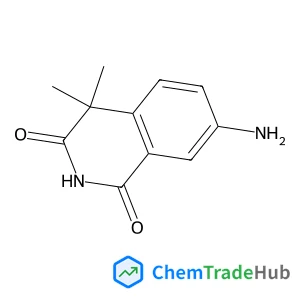
1,3(2H,4H)-Isoquinolinedione, 7-amino-4,4-dimethyl-
CAS Number:
14576-22-8
Molecular Formula:
C11H12N2O2
Recommended Suppliers






Disclaimer
This page provides academic journal information for reference and research purposes only. We are not affiliated with any journal publishers and do not handle publication submissions. For publication-related inquiries, please contact the respective journal publishers directly.
If you notice any inaccuracies in the information displayed, please contact us at support@chemtradehub.com. We will promptly review and address your concerns.