












Fe/Ni core/shell nanowires and nanorods: a combined first-principles and atomistic simulation study
Literature Information
Publication Date
2017-05-26
DOI
10.1039/C7CP01825H
Impact Factor
3.676
Authors
S. López-Moreno, J. Mazo-Zuluaga, J. Mejía-López
View Original
Abstract
In recent years, construction and characterization of core–shell structures have attracted great attention because of their unique functional properties and their integration into technological devices. However, some aspects of their basic physics still remain to be explored. In this study, we report on an extensive hierarchical multiscale modeling methodology applied to Fe–Ni core/shell nanostructures of technological interest. As a first step, supported on a first-principles study, we develop a methodology to compute primordial but unprecedented parameters such as the exchange coupling and the equilibrium bond distances at the interface, namely JFe–Ni = 35.48 meV and d = 2.5 Å. This methodology can be used for computing fundamental parameters in mixed systems by knowing the parameters in the bulk samples, and the so-obtained results can be used in higher size scale simulations. As a proof, the results obtained are used as input parameters for atomistic simulations on Fe–Ni samples made out of a Fe core surrounded by a Ni shell whose external diameter varies finely in the range 60–110 nm. The inner diameter and height are fixed to be 40 and 50 nm, respectively. We address the structural, electronic, static magnetic and hysteresis properties of the Fe–Ni core/shell cylindrical nanostructures in different size ranges. These nanostructures reveal different magnetic properties with novel complex states, which are studied in detail.
Recommended Journals
Related Literature
Comparison of riboflavin-derived flavinium salts applied to catalytic H2O2 oxidations
Takuya Sakai, Takuma Kumoi, Tatsuro Ishikawa, Takahiro Nitta, Hiroki Iida
2018-05-09
Paper
DOI: 10.1039/C8OB00856F
A photoredox/nickel dual-catalytic strategy for benzylic C–H alkoxylation
Min Dong, Yuqi Jia, Wei Zhou, Jinlai Gao, Xiaoqing Lv, Fan Luo, Yongqiang Zhang, Shihui Liu
2021-10-26
Research Article
DOI: 10.1039/D1QO01421H
Elucidation of the catalytic mechanism of 6-hydroxymethyl-7,8-dihydropterin pyrophosphokinase using QM/MM calculations
Nathjanan Jongkon, Duangkamol Gleeson, M. Paul Gleeson
2018-08-03
Paper
DOI: 10.1039/C8OB01428K
Photoredox-catalyzed synthesis of sulfonated oxazolines from N-allylamides through the insertion of sulfur dioxide
Zhichao Chen, Hong Zhang, Shu-Feng Zhou, Xiuling Cui
2021-11-30
Research Article
DOI: 10.1039/D1QO01540K
Highly regioselective, electrophile induced cyclizations of 2-(prop-1-ynyl)benzamides
Bhavani Shankar Chinta, Harikrishna Sanapa, Kamala Prasad Vasikarla, Beeraiah Baire
2018-04-26
Paper
DOI: 10.1039/C8OB00434J
Palladium-catalyzed direct construction of oxazoline-containing polycyclic scaffolds via tandem addition/cyclization of nitriles and arylboronic acids
Shu-Qiang Cui, Na Cheng, Qian-Qian Ma, Zhong-Lin Wei
2021-11-15
Research Article
DOI: 10.1039/D1QO01260F
Mechanistic insights into the rhodium-catalyzed aryl C–H carboxylation
DeGuang Liu, ZheYuan Xu, MingQiang Liu, Yao Fu
2021-12-07
Research Article
DOI: 10.1039/D1QO01560E
A transition-metal-free, base-promoted annulation/ring-cleavage/ring-reconstruction cascade reaction: a facile access to N-protection free indole-indenones
Na Luo, Zhen-Wei Sun, Xing-Xin Xu, Xiao-Qiang Hu, Feng-Cheng Jia
2021-10-05
Research Article
DOI: 10.1039/D1QO01280K
High pressure-assisted low-loading asymmetric organocatalytic conjugate addition of nitroalkanes to chalcones‡
Agnieszka Cholewiak, Kamil Adamczyk, Michał Kopyt, Adrian Kasztelan, Piotr Kwiatkowski
2018-05-22
Paper
DOI: 10.1039/C8OB00561C
Semi-syntheses of the 11-hydroxyrotenoids sumatrol and villosinol
David A. Russell, Julien J. Freudenreich, Hannah L. Stewart, Andrew D. Bond, Hannah F. Sore, David R. Spring
2018-08-22
Communication
DOI: 10.1039/C8OB01919C
You might also like
Compound Q&A
What industries use (1R,3S)-1,3-Cyclopentanediol (CAS: 16326-97-9)?
(1R,3S)-1,3-Cyclopentanediol finds applications in various industries. In the ph...
16326-97-9(1R,3S)-1,3-Cyclopen...
Compound Q&A
What precautions should be taken when handling N'-[4-(Dimethylamino)phenyl]-N,N-dimethyl-1,4-benzenediamine (CAS: 637-31-0)?
When handling N'-[4-(Dimethylamino)phenyl]-N,N-dimethyl-1,4-benzenediamine, it i...
637-31-0N'-[4-(Dimethylamino...
Compound Q&A
Are there alternatives to 5-(2,4-Difluorophenyl)-2-methoxypyrimidine (CAS: 1352318-16-1) in synthesis?
There are several alternatives to 5-(2,4-Difluorophenyl)-2-methoxypyrimidine in ...
1352318-16-15-(2,4-Difluoropheny...
Compound Q&A
What regulatory guidelines apply to 1-(3-Methoxyphenoxy)propan-2-ol (CAS: 382141-68-6)?
1-(3-Methoxyphenoxy)propan-2-ol (CAS: 382141-68-6) must comply with the Globally...
382141-68-61-(3-Methoxyphenoxy)...
Compound Q&A
Is Tetrodotoxin Citrate (CAS: 18660-81-6) safe?
Tetrodotoxin Citrate is extremely dangerous and should be handled with extreme c...
18660-81-6Tetrodotoxin Citrate
Compound Q&A
What are the main uses of 2-Methyl-2-propanyl [(1R,3S)-3-hydroxycyclopentyl]carbamate (CAS: 225641-84-9)?
2-Methyl-2-propanyl [(1R,3S)-3-hydroxycyclopentyl]carbamate (CAS: 225641-84-9) i...
225641-84-92-Methyl-2-propanyl ...
Compound Q&A
How should waste containing 4-(2-Hydroxyhexafluoroisopropyl)Benzoic Acid (CAS: 16261-80-6) be handled?
Waste containing 4-(2-Hydroxyhexafluoroisopropyl)Benzoic Acid (CAS: 16261-80-6) ...
16261-80-64-(2-Hydroxyhexafluo...
Compound Q&A
How is 2-Methyl-2-proanyl {(2S)-1-[(benzyloxy)amino]-3-hydroxy-3-methyl-1-oxo-2-butanyl}carbamate (CAS: 102507-19-7) typically synthesized?
2-Methyl-2-proanyl {(2S)-1-[(benzyloxy)amino]-3-hydroxy-3-methyl-1-oxo-2-butanyl...
102507-19-72-Methyl-2-propanyl ...
Compound Q&A
What is Benzeneethanamine, α-ethyl-, hydrochloride (1:1) (CAS: 20735-15-3)?
Benzeneethanamine, α-ethyl-, hydrochloride (1:1) is an organic compound with the...
20735-15-3Benzeneethanamine, α...
Compound Q&A
Are there alternatives to 3-{(E)-[4-(Dimethylamino)phenyl]diazenyl}benzoic acid (CAS: 20691-84-3) in synthesis?
In the synthesis of compounds similar to 3-{(E)-[4-(Dimethylamino)phenyl]diazeny...
20691-84-33-{(E)-[4-(Dimethyla...
Source Journal
Physical Chemistry Chemical Physics

CiteScore:
5.5
Self-citation Rate:
10.3%
Articles per Year:
3036
Physical Chemistry Chemical Physics (PCCP) is an international journal co-owned by 19 physical chemistry and physics societies from around the world. This journal publishes original, cutting-edge research in physical chemistry, chemical physics and biophysical chemistry. To be suitable for publication in PCCP, articles must include significant innovation and/or insight into physical chemistry; this is the most important criterion that reviewers and Editors will judge against when evaluating submissions. The journal has a broad scope and welcomes contributions spanning experiment, theory, computation and data science. Topical coverage includes spectroscopy, dynamics, kinetics, statistical mechanics, thermodynamics, electrochemistry, catalysis, surface science, quantum mechanics, quantum computing and machine learning. Interdisciplinary research areas such as polymers and soft matter, materials, nanoscience, energy, surfaces/interfaces, and biophysical chemistry are welcomed if they demonstrate significant innovation and/or insight into physical chemistry. Joined experimental/theoretical studies are particularly appreciated when complementary and based on up-to-date approaches.
Recommended Compounds

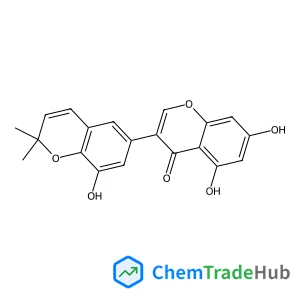
5,7,8'-Trihydroxy-2',2'-dimethyl-2'H,4H-3,6'-bichromen-4-one
CAS Number:
129280-33-7
Molecular Formula:
C20H16O6
Recommended Suppliers






Disclaimer
This page provides academic journal information for reference and research purposes only. We are not affiliated with any journal publishers and do not handle publication submissions. For publication-related inquiries, please contact the respective journal publishers directly.
If you notice any inaccuracies in the information displayed, please contact us at support@chemtradehub.com. We will promptly review and address your concerns.