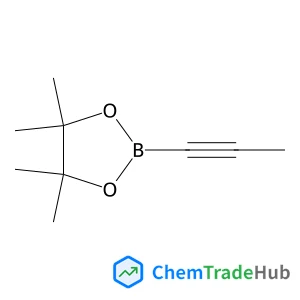
4,4,5,5-Tetramethyl-2-(1-propyn-1-YL)-1,3,2-dioxaborolane
CAS Number:
347389-75-7
Molecular Formula:
C9H15BO2
Shuangyan Zhou, Qianqian Wang, Yuwei Wang, Wei Han, Huanxiang Liu
The structural transition of prion proteins from a native α-helix (PrPC) to a misfolded β-sheet-rich conformation (PrPSc) is believed to be the main cause of a number of prion diseases in humans and animals. Understanding the molecular basis of misfolding and aggregation of prion proteins will be valuable for unveiling the etiology of prion diseases. However, due to the limitation of conventional experimental techniques and the heterogeneous property of oligomers, little is known about the molecular architecture of misfolded PrPSc and the mechanism of structural transition from PrPC to PrPSc. The prion fragment 127–147 (PrP127–147) has been reported to be a critical region for PrPSc formation in Gerstmann–Straussler–Scheinker (GSS) syndrome and thus has been used as a model for the study of prion aggregation. In the present study, we employ molecular dynamics (MD) simulation techniques to study the conformational change of this fragment that could be relevant to the PrPC–PrPSc transition. Employing extensive replica exchange molecular dynamics (REMD) and conventional MD simulations, we sample a huge number of conformations of PrP127–147. Using the Markov state model (MSM), we identify the metastable conformational states of this fragment and the kinetic network of transitions between the states. The resulting MSM reveals that disordered random-coiled conformations are the dominant structures. A key metastable folded state with typical extended β-sheet structures is identified with Pro137 being located in a turn region, consistent with a previous experimental report. Conformational analysis reveals that intrapeptide hydrophobic interaction and two key residue interactions, including Arg136–His140 and Pro137–His140, contribute a lot to the formation of ordered extended β-sheet states. However, network pathway analysis from the most populated disordered state indicates that the formation of extended β-sheet states is quite slow (at the millisecond level), as large structural rearrangement is needed from disordered states. We speculate that the formation process of the extended β-sheet folded states may represent an important event during the early formation of prion oligomers and the results of our study provide insights into the molecular details of the early stage of prion aggregation.

Journal of Saudi Chemical Society

Organic Process Research & Development

Russian Journal of Coordination Chemistry

New Journal of Chemistry

Russian Chemical Bulletin

Russian Journal of Applied Chemistry

Russian Journal of Bioorganic Chemistry

Chemical Communications

Journal of Peptide Science

Journal of Natural Medicines
Ewelina Mikolajska, Søren B. Rasmussen, Anna E. Lewandowska, Miguel A. Bañares
DOI: 10.1039/C1CP22608H
Michael Lartey, Jihan Kim, Maciej Haranczyk, David R. Luebke
DOI: 10.1039/C3CP43923B
Eric C. Tyo, Melanie Nöβler, Sabine Rabe, Christopher L. Harmon, Roland Mitrić, A. W. Castleman, Jr.
DOI: 10.1039/C2CP23243J
G. W. Shu, C. H. Chiu, L. T. Huang, T. N. Lin, C. C. Yang, J. S. Wang, C. T. Yuan, J. L. Shen, H. C. Kuo, C. A. J. Lin, W. H. Chang, H. H. Wang, H. I. Yeh, W. H. Chan, W. C. Fan, W. C. Chou
DOI: 10.1039/C3CP43894E
Makoto Komatsu, Jotaro Nakazaki, Satoshi Uchida, Takaya Kubo, Hiroshi Segawa
DOI: 10.1039/C2CP43598E
Christopher E. Hamilton, Dennis J. Flood
DOI: 10.1039/C3CP50435B
Ilja Ignatjev, Edyta Proniewicz, Leonard M. Proniewicz, Gediminas Niaura
DOI: 10.1039/C2CP42077E
E. Rezabal, F. Ruipérez, J. M. Ugalde
DOI: 10.1039/C2CP43544F
2-Methylbenzene-1,4-diamine dihydrochloride (CAS: 615-45-2) should be stored in ...
(1S,4S)-2,5-Diazabicyclo[2.2.1]heptane dihydrobromide is generally considered sa...
(6-Chloropyridazin-3-YL)methanamine finds applications in the pharmaceutical ind...
2-Fluoro-3-methylphenol is primarily used in the synthesis of pharmaceuticals, p...
When handling 3-Methoxy-4-nitrobenzonitrile, it is important to wear appropriate...
When handling 1,3-Oxazolo[4,5-b]pyridine-2(3H)-thione (CAS: 211949-57-4), it is ...
4-Ethynylbenzamide (CAS: 90347-86-7) falls under various regulatory guidelines i...
3-(2-Ethylphenyl)-2-thioxo-4-imidazolidinone is primarily used as an intermediat...
(2-Fluoro-6-methoxyphenyl)acetic acid, also known as 4-fluoro-3-methoxybenzoic a...
Market trends for 2-[4-(Hydroxymethyl)phenoxy]ethanol (CAS: 102196-18-9) indicat...

Physical Chemistry Chemical Physics (PCCP) is an international journal co-owned by 19 physical chemistry and physics societies from around the world. This journal publishes original, cutting-edge research in physical chemistry, chemical physics and biophysical chemistry. To be suitable for publication in PCCP, articles must include significant innovation and/or insight into physical chemistry; this is the most important criterion that reviewers and Editors will judge against when evaluating submissions. The journal has a broad scope and welcomes contributions spanning experiment, theory, computation and data science. Topical coverage includes spectroscopy, dynamics, kinetics, statistical mechanics, thermodynamics, electrochemistry, catalysis, surface science, quantum mechanics, quantum computing and machine learning. Interdisciplinary research areas such as polymers and soft matter, materials, nanoscience, energy, surfaces/interfaces, and biophysical chemistry are welcomed if they demonstrate significant innovation and/or insight into physical chemistry. Joined experimental/theoretical studies are particularly appreciated when complementary and based on up-to-date approaches.
![(1R,6R)-6-({[(2-Methyl-2-propanyl)oxy]carbonyl}amino)-3-cyclohexene-1-carboxylic acid structure](https://static.chemtradehub.com/structs/865/865689-24-3-5fef.webp "(1R,6R)-6-({[(2-Methyl-2-propanyl)oxy]carbonyl}amino)-3-cyclohexene-1-carboxylic acid structure")