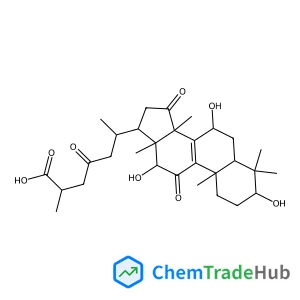
(3beta,7beta,12beta)-3,7,12-Trihydroxy-11,15,23-trioxolanost-8-en-26-oic acid
CAS Number:
98665-22-6
Molecular Formula:
C30H44O8
Tony Pham, Katherine A. Forrest, Matthew Mostrom, Joseph R. Hunt, Hiroyasu Furukawa, Brian Space
A combined inelastic neutron scattering (INS) and theoretical study was carried out on H2 adsorbed in two covalent organic framework (COF) materials: COF-1 and COF-102. These COFs are synthesized from self-condensation reactions of 1,4-benzenediboronic acid (BDBA) and tetra(4-(dihydroxy)borylphenyl)methane (TBPM) molecules, respectively. Molecular simulations of H2 adsorption in COF-1 revealed that the H2 molecules occupy the region between two eclipsed layers of the COF. The most favorable H2 binding site in COF-1 is located between two B3O3 clusters of the eclipsed layers. Two distinct H2 binding sites were identified in COF-102 from the simulations: the B3O3 clusters and the phenyl rings of the tetraphenylmethyl units. Two-dimensional quantum rotation calculations for H2 adsorbed at the considered sites in both COFs resulted in rotational transitions that are in good agreement with those that appear in the corresponding INS spectra. Such calculations were important for interpreting the INS spectra in these materials. Calculation of the rotational potential energy surface for H2 bound at the most favorable adsorption site in COF-1 and COF-102 revealed unusually high rotational barriers that are attributed to the nature of the B3O3 rings. The values for these barriers to rotation are greater than or comparable to those observed in some metal–organic frameworks (MOFs) that possess open-metal sites. This study demonstrates the power of using INS experiments in conjunction with theoretical calculations to gain valuable insights into the nature of the binding sites and, for the first time, the rotational dynamics of H2 adsorbed in COFs.
Deya Das, Seungchul Kim, Kwang-Ryeol Lee, Abhishek K. Singh
DOI: 10.1039/C3CP52891J
Ymène Houari, Adèle D. Laurent
DOI: 10.1039/C3CP50791B
Jhenny F. Galan, Chi Ngong Tang, Shubhashis Chakrabarty, Zhiwei Liu, Vojislava Pophristic
DOI: 10.1039/C3CP50353D
Yuqi Zhang, Loujun Gao, Liping Wen, Liping Heng, Yanlin Song
DOI: 10.1039/C3CP51324F
Jie Yang, Sasan Ghobadian, Payton J. Goodrich, Reza Montazami, Nastaran Hashemi
DOI: 10.1039/C3CP50804H
Bas C. van der Wiel, René M. Williams
DOI: 10.1039/C3CP52148F
Katherine M. Sharples, Emma Carter, Colan E. Hughes, Kenneth D. M. Harris, James A. Platts, Damien M. Murphy
DOI: 10.1039/C3CP52464G
Pyosang Kim, Sujin Ham, Juwon Oh, Hiroki Uoyama, Hajime Watanabe, Kazunari Tagawa, Hidemitsu Uno, Dongho Kim
DOI: 10.1039/C3CP50166C
Waste containing N-Methoxy-N-methyl-1,3-thiazole-5-carboxamide (CAS: 898825-89-3...
N-(4-Biphenylyl)dibenzo[b,d]furan-4-amine should be stored in a tightly sealed c...
The market for 3-Acetamido-5-amino-2,4,6-triiodobenzoic acid (CAS: 1713-07-1) is...
Benzyl 2-O-acetyl-3,4,6-tri-O-benzyl-beta-D-galactopyranoside (CAS: 61820-03-9) ...
2-Ethylpiperazine dihydrochloride (CAS: 438050-52-3) is regulated under the Glob...
1,1'-[1,3-Phenylenebis(methylene)]bis(3-methyl-1H-pyrrole-2,5-dione) (CAS: 11946...
Several alternatives can be used in the synthesis of 5-Fluoro-2-(1-pyrrolidinyl)...
Proper personal protective equipment (PPE) must be worn when handling this compo...
When handling 6-Bromoimidazo[1,2-a]pyridin-8-amine, it is important to wear appr...
Alternatives to (2S,4R)-4-(4-Nitrobenzyl)pyrrolidine-2-carboxylic acid hydrochlo...

Physical Chemistry Chemical Physics (PCCP) is an international journal co-owned by 19 physical chemistry and physics societies from around the world. This journal publishes original, cutting-edge research in physical chemistry, chemical physics and biophysical chemistry. To be suitable for publication in PCCP, articles must include significant innovation and/or insight into physical chemistry; this is the most important criterion that reviewers and Editors will judge against when evaluating submissions. The journal has a broad scope and welcomes contributions spanning experiment, theory, computation and data science. Topical coverage includes spectroscopy, dynamics, kinetics, statistical mechanics, thermodynamics, electrochemistry, catalysis, surface science, quantum mechanics, quantum computing and machine learning. Interdisciplinary research areas such as polymers and soft matter, materials, nanoscience, energy, surfaces/interfaces, and biophysical chemistry are welcomed if they demonstrate significant innovation and/or insight into physical chemistry. Joined experimental/theoretical studies are particularly appreciated when complementary and based on up-to-date approaches.