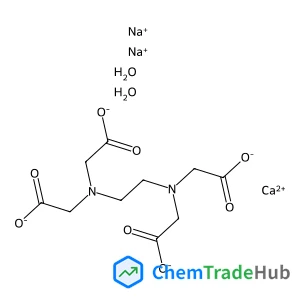
EthylenediaminetetraaceticacidcalciumDisodiumsalthydrate
CAS Number:
23411-34-9
Molecular Formula:
C10H16CaN2Na2O10
Zhen Liu, Vinh Son Nguyen, Jeremy Harvey, Jean-François Müller, Jozef Peeters
In this work we identified and theoretically quantified two photolysis mechanisms of HPALDs (hydroperoxy aldehydes) that result from the isomerization of peroxy radicals in the atmospheric oxidation of isoprene at low/moderate NOx. As a first photolysis mechanism, we show that a fraction of the initially excited S1-state HPALDs isomerizes by a near-barrierless 1,5 H-shift at a rate approaching 1012 s−1 – competing with the ∼equally fast intersystem crossing to the T2 triplet state – forming an unstable biradical that spontaneously expels an OH (hydroxyl) radical. A second mechanism is shown to proceed through the activated T2 triplet biradical – formed from S1 – undergoing a concerted ring-closure and OH-expulsion, yielding an oxiranyl-type co-product radical that quickly ring-opens to enoxy radicals. In both mechanisms, subsequent chemistry of the co-product radicals yields additional first-generation OH. The combined HPALD-photolysis quantum yield by these two mechanisms – which may not be the only photolysis routes – is estimated at 0.55 and the quantum yield of OH generation at 0.9, in fair accordance with experimental data on an HPALD proxy (Wolfe et al., Phys. Chem. Chem. Phys., 2012, 14, 7276–7286).
Dirk Hildebrandt, Wiebke Hüggenberg, Matthias Kanthak, Tobias Plöger, Iris M. Müller, Gerald Dyker
DOI: 10.1039/B602498J
Koichi Mikami, Kazuki Wakabayashi, Yukinori Yusa, Kohsuke Aikawa
DOI: 10.1039/B517585B
Joohan Lee, Juhyoun Kwak
DOI: 10.1039/B601613H
Chinh Q. Nguyen, Adekunle Adeogun, Mohammad Afzaal, Mohammad A. Malik, Paul O'Brien
DOI: 10.1039/B603197H
Praveen Kumar Vemula, George John
DOI: 10.1039/B518289A
Christopher J. Tonzola, Jessica M. Hancock, Amit Babel, Samson A. Jenekhe
DOI: 10.1039/B509322H
Lican Lu, Nianfa Yang, Yuanli Cai
DOI: 10.1039/B512057H
Biljana Bozic, Egbert Figgemeier
DOI: 10.1039/B601587E
Almudena González-Álvarez, Ignacio Alfonso, Vicente Gotor
DOI: 10.1039/B603203F
1H-Indazole-6-carbonitrile finds applications in pharmaceuticals, where it serve...
Waste containing Dioctyl (2E)-2-butenedioate (CAS: 2997-85-5) should be collecte...
Sodium [(1,2-benzoxazol-3-ylmethyl)sulfonyl]azanide is primarily used in pharmac...
Dimethyl 4-(4,4,5,5-tetramethyl-1,3,2-dioxaborolan-2-yl)-2,6-pyridinedicarboxyla...
Waste containing 2-Fluoro-6-hydrazinopyridine (CAS: 80714-39-2) should be manage...
6-Formyl-2-pyridinecarboxylic acid is an organic compound with the molecular for...
Research trends for this compound indicate a focus on its potential applications...
9H-Tribenzo[b,d,f]azepine is typically synthesized via a multi-step process invo...
1-Cyclopropyl-7-ethoxy-6-fluoro-8-methoxy-4-oxo-1,4-dihydro-3-quinolinecarboxyli...
Waste containing Methyl 3-oxo-1,2,3,4-tetrahydro-6-quinoxalinecarboxylate (CAS: ...

Physical Chemistry Chemical Physics (PCCP) is an international journal co-owned by 19 physical chemistry and physics societies from around the world. This journal publishes original, cutting-edge research in physical chemistry, chemical physics and biophysical chemistry. To be suitable for publication in PCCP, articles must include significant innovation and/or insight into physical chemistry; this is the most important criterion that reviewers and Editors will judge against when evaluating submissions. The journal has a broad scope and welcomes contributions spanning experiment, theory, computation and data science. Topical coverage includes spectroscopy, dynamics, kinetics, statistical mechanics, thermodynamics, electrochemistry, catalysis, surface science, quantum mechanics, quantum computing and machine learning. Interdisciplinary research areas such as polymers and soft matter, materials, nanoscience, energy, surfaces/interfaces, and biophysical chemistry are welcomed if they demonstrate significant innovation and/or insight into physical chemistry. Joined experimental/theoretical studies are particularly appreciated when complementary and based on up-to-date approaches.