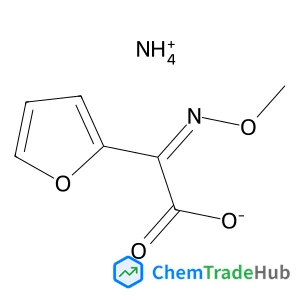
Ammonium (Z)-2-(furan-2-yl)-2-(methoxyimino)acetate
CAS Number:
97148-39-5
Molecular Formula:
C7H10N2O4
Maneesha Esther Mohanty, Chakali Madhu, Vanammoole Lakshmi Reddy, Mahalingavelar Paramasivam, Prakriti Ranjan Bangal, Vaidya Jayathirtha Rao
Dithienylbenzothiadiazole (DTBT) is used as a building block in several molecules having application in organic light emitting devices (OLED) and organic photovoltaic (OPV) devices. Delayed fluorescence (DF) is the preferred design principle employed currently in OLED research. DTBT has excellent delayed fluorescence properties which makes this moiety a potentially viable OLED material. Here, the dynamics of intersystem crossing (ISC) and reverse intersystem crossing (RISC) have been explored using fluorescence, phosphorescence, fluorescence lifetime and transient absorption measurements. Experimentally it is demonstrated that singlet and triplet states of DTBT are close lying or degenerate and after a certain time the molecules can stay in the singlet or the triplet state forming an equilibrium between the two states which hinders the identification of these two states that could be characterized by routine steady state fluorescence and phosphorescence studies. Similarly in OPV material research, DTBT is coupled with strong donors to form push–pull molecules to produce a prolonged charge separated state. In this study DTBT appended with carbazole at both ends (CDTBT) was used to study the dynamics of DTBT within a donor–acceptor–donor system. The study reveals similar kinds of ISC and RISC in CDTBT along with a competitive deactivation pathway of the singlet state and it was concluded to be through the formation of a charge separated species in CDTBT.

Cellulose

Journal of the Indian Institute of Science

Critical Reviews in Solid State and Materials Sciences

NDT & E International

Colloid Journal

Herald of the Russian Academy of Sciences

Topics in Catalysis

Heteroatom Chemistry

Acta Metallurgica Sinica-English Letters

Journal of Asian Natural Products Research
Jordan B. Burton, Cassandra L. Ward, David M. Klemet, Thomas H. Linz
DOI: 10.1039/C9AY01384A
Holger Braunschweig, Mehmet Ali Celik, Rian D. Dewhurst, Magdalena Heid, Florian Hupp, Sakya S. Sen
DOI: 10.1039/C4SC02948H
Xiang-Jin Kong, Chao Peng, Yao-Han Lan, Wen-xiu Li, Shuai-Shuai Chi, Chao Zheng, Lin-Yi Dong, Xian-Hua Wang
DOI: 10.1039/C9AY01229J
Ebrahim Azadniya, Gertrud E. Morlock
DOI: 10.1039/C9AY01465A
Judith H. Cohen, Karin M. Balss, Eugena Akerman-Revis, Mark Inderbitzen, James Lisk, Asha Marathe, Robert O'Brien, Elaine Pottinger-Cooper, William Rudd, Cheryl Wendel, George Papandreou, Cynthia A. Maryanoff
DOI: 10.1039/C2AY25030F
Marcus Koch, Petra Herbeck-Engel, Igor Iatsunskyi
DOI: 10.1039/C9AY01182J
James R. Durrant
DOI: 10.1039/D1CS00577D
Husain A. Naqi, Stephen M. Husbands, Ian S. Blagbrough
DOI: 10.1039/C9AY01403A
Ayoob Rastegar, Ahmad Alahabadi, Ali Esrafili, Zahra Rezai, Shahram Nazari
DOI: 10.1039/C6AY01463A
Wei-Jie Huang, Pang-Hua Huang, Sheng-Hsiung Yang
DOI: 10.1039/C6CC07062K
1H-Indazole-6-carbonitrile finds applications in pharmaceuticals, where it serve...
Waste containing Dioctyl (2E)-2-butenedioate (CAS: 2997-85-5) should be collecte...
Sodium [(1,2-benzoxazol-3-ylmethyl)sulfonyl]azanide is primarily used in pharmac...
Dimethyl 4-(4,4,5,5-tetramethyl-1,3,2-dioxaborolan-2-yl)-2,6-pyridinedicarboxyla...
Waste containing 2-Fluoro-6-hydrazinopyridine (CAS: 80714-39-2) should be manage...
6-Formyl-2-pyridinecarboxylic acid is an organic compound with the molecular for...
Research trends for this compound indicate a focus on its potential applications...
9H-Tribenzo[b,d,f]azepine is typically synthesized via a multi-step process invo...
1-Cyclopropyl-7-ethoxy-6-fluoro-8-methoxy-4-oxo-1,4-dihydro-3-quinolinecarboxyli...
Waste containing Methyl 3-oxo-1,2,3,4-tetrahydro-6-quinoxalinecarboxylate (CAS: ...

Physical Chemistry Chemical Physics (PCCP) is an international journal co-owned by 19 physical chemistry and physics societies from around the world. This journal publishes original, cutting-edge research in physical chemistry, chemical physics and biophysical chemistry. To be suitable for publication in PCCP, articles must include significant innovation and/or insight into physical chemistry; this is the most important criterion that reviewers and Editors will judge against when evaluating submissions. The journal has a broad scope and welcomes contributions spanning experiment, theory, computation and data science. Topical coverage includes spectroscopy, dynamics, kinetics, statistical mechanics, thermodynamics, electrochemistry, catalysis, surface science, quantum mechanics, quantum computing and machine learning. Interdisciplinary research areas such as polymers and soft matter, materials, nanoscience, energy, surfaces/interfaces, and biophysical chemistry are welcomed if they demonstrate significant innovation and/or insight into physical chemistry. Joined experimental/theoretical studies are particularly appreciated when complementary and based on up-to-date approaches.