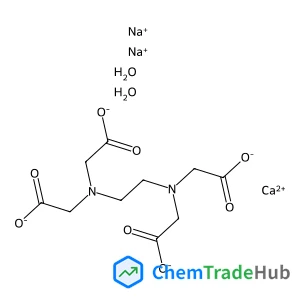
EthylenediaminetetraaceticacidcalciumDisodiumsalthydrate
CAS Number:
23411-34-9
Molecular Formula:
C10H16CaN2Na2O10
Markus Rauhalahti, Stefan Taubert, Dage Sundholm, Vincent Liégeois
Magnetically induced current density susceptibilities and ring-current strengths have been calculated for neutral and doubly charged persubstituted benzenes C6X6 and C6X62+ with X = F, Cl, Br, I, At, SeH, SeMe, TeH, TeMe, and SbH2. The current densities have been calculated using the gauge-including magnetically induced current (GIMIC) method, which has been interfaced to the Gaussian electronic structure code rendering current density calculations using effective core potentials (ECP) feasible. Relativistic effects on the ring-current strengths have been assessed by employing ECP calculations of the current densities. Comparison of the ring-current strengths obtained in calculations on C6At6 and C6At62+ using relativistic and non-relativistic ECPs show that scalar relativistic effects have only a small influence on the ring-current strengths. Comparisons of the ring-current strengths and ring-current profiles show that the C6I62+, C6At62+, C6(SeH)62+, C6(SeMe)62+, C6(TeH)62+, C6(TeMe)62+, and C6(SbH2)62+ dications are doubly aromatic sustaining spatially separated ring currents in the carbon ring and in the exterior of the molecule. The C6I6+ radical cation is also found to be doubly aromatic with a weaker ring current than obtained for the dication.

Cellulose

Polycyclic Aromatic Compounds

Critical Reviews in Solid State and Materials Sciences

Journal of the Indian Institute of Science

Journal of Asian Natural Products Research

Atomization and Sprays

Acta Metallurgica Sinica-English Letters

Medicinal Chemistry Research

Chinese Journal of Chemistry

Topics in Catalysis
Rohan T. Ranasinghe, Tom Brown
DOI: 10.1039/B509522K
Junko Kagimoto, Kenta Fukumoto, Hiroyuki Ohno
DOI: 10.1039/B600771F
Yu Wang, Ashley A. Mills, William B. Euler, Brett L. Lucht
DOI: 10.1039/B600793G
Almudena González-Álvarez, Ignacio Alfonso, Vicente Gotor
DOI: 10.1039/B603203F
Joohan Lee, Juhyoun Kwak
DOI: 10.1039/B601613H
Dirk Hildebrandt, Wiebke Hüggenberg, Matthias Kanthak, Tobias Plöger, Iris M. Müller, Gerald Dyker
DOI: 10.1039/B602498J
Sergi Morais, Raquel Marco-Molés, Rosa Puchades, Ángel Maquieira
DOI: 10.1039/B600049E
Alois Fürstner, Manuel Alcarazo, Vincent César, Christian W. Lehmann
DOI: 10.1039/B604236H
Thomas Neisius, Bernard Chenevier, Aleksandre M. Gaskov, Michel Labeau
DOI: 10.1039/B509826B
1H-Indazole-6-carbonitrile finds applications in pharmaceuticals, where it serve...
Waste containing Dioctyl (2E)-2-butenedioate (CAS: 2997-85-5) should be collecte...
Sodium [(1,2-benzoxazol-3-ylmethyl)sulfonyl]azanide is primarily used in pharmac...
Dimethyl 4-(4,4,5,5-tetramethyl-1,3,2-dioxaborolan-2-yl)-2,6-pyridinedicarboxyla...
Waste containing 2-Fluoro-6-hydrazinopyridine (CAS: 80714-39-2) should be manage...
6-Formyl-2-pyridinecarboxylic acid is an organic compound with the molecular for...
Research trends for this compound indicate a focus on its potential applications...
9H-Tribenzo[b,d,f]azepine is typically synthesized via a multi-step process invo...
1-Cyclopropyl-7-ethoxy-6-fluoro-8-methoxy-4-oxo-1,4-dihydro-3-quinolinecarboxyli...
Waste containing Methyl 3-oxo-1,2,3,4-tetrahydro-6-quinoxalinecarboxylate (CAS: ...

Physical Chemistry Chemical Physics (PCCP) is an international journal co-owned by 19 physical chemistry and physics societies from around the world. This journal publishes original, cutting-edge research in physical chemistry, chemical physics and biophysical chemistry. To be suitable for publication in PCCP, articles must include significant innovation and/or insight into physical chemistry; this is the most important criterion that reviewers and Editors will judge against when evaluating submissions. The journal has a broad scope and welcomes contributions spanning experiment, theory, computation and data science. Topical coverage includes spectroscopy, dynamics, kinetics, statistical mechanics, thermodynamics, electrochemistry, catalysis, surface science, quantum mechanics, quantum computing and machine learning. Interdisciplinary research areas such as polymers and soft matter, materials, nanoscience, energy, surfaces/interfaces, and biophysical chemistry are welcomed if they demonstrate significant innovation and/or insight into physical chemistry. Joined experimental/theoretical studies are particularly appreciated when complementary and based on up-to-date approaches.