












![N-[(9H-Fluoren-9-ylmethoxy)carbonyl]serine structure](https://static.chemtradehub.com/structs/737/73724-45-5-b0dc.webp "N-[(9H-Fluoren-9-ylmethoxy)carbonyl]serine structure")
Cathodic electrochemical activation of Co3O4 nanoarrays: a smart strategy to significantly boost the hydrogen evolution activity
Literature Information
Publication Date
2018-01-31
DOI
10.1039/C7CC09416G
Impact Factor
6.222
Authors
Li Yang, Huang Zhou, Xin Qin, Xiaodong Guo, Guanwei Cui, Abdullah M. Asiri, Xuping Sun
View Original
Abstract
Co(hydro)oxides show unsatisfactory catalytic activity for the hydrogen evolution reaction (HER) in alkaline media, and it is thus highly desirable but still remains a challenge to design and develop Co(hydro)oxide derived materials as superb hydrogen-evolving catalysts using a facile, rapid and less energy-intensive method. Here, we propose a cathodic electrochemical activation strategy toward greatly boosted HER activity of a Co3O4 nanoarray via room-temperature cathodic polarization in sodium hypophosphite solution. After activation, the overpotential significantly decreases from 260 to 73 mV to drive a geometrical catalytic current density of 10 mA cm−2 in 1.0 M KOH. Notably, this activated electrode also shows strong long-term electrochemical durability with the retention of its catalytic activity at 100 mA cm−2 for at least 40 h.
Related Literature
Mixtures of LiTFSI and urea: ideal thermodynamic behavior as key to the formation of deep eutectic solvents?
2019-05-23
Paper
DOI: 10.1039/C9CP01440C
Coarse-grained simulation studies on the adsorption of polyelectrolyte complexes upon lipid membranes
2019-05-21
Paper
DOI: 10.1039/C9CP01448A
Correction: Sub-Doppler infrared spectroscopy of resonance-stabilized hydrocarbon intermediates: ν3/ν4 CH stretch modes and CH2 internal rotor dynamics of benzyl radical
A. Kortyna, A. J. Samin, T. A. Miller
2019-06-06
Correction
DOI: 10.1039/C9CP90148E
Single Pt atom supported on penta-graphene as an efficient catalyst for CO oxidation
Ranganathan Krishnan, Shiuan-Yau Wu, Hsin-Tsung Chen
2019-05-20
Paper
DOI: 10.1039/C9CP02306B
Diverging surface reactions at TiO2- or ZnO-based photoanodes in dye-sensitized solar cells
Raffael Ruess, Sabina Scarabino, Andreas Ringleb, Kazuteru Nonomura, Nick Vlachopoulos, Anders Hagfeldt, Gunther Wittstock, Derck Schlettwein
2019-05-27
Paper
DOI: 10.1039/C9CP01215J
X-ray radiation-induced amorphization of metal–organic frameworks
Remo N. Widmer, Giulio I. Lampronti, Nicola Casati, Stefan Farsang, Thomas D. Bennett, Simon A. T. Redfern
2019-05-29
Paper
DOI: 10.1039/C9CP01463B
Opening 2,2-diphenyl-2H-chromene to infrared light
Benjamin H. Strudwick, Christopher O’Bryen, Hans J. Sanders, Sander Woutersen
2019-05-20
Paper
DOI: 10.1039/C9CP01906E
A heuristic approach for nanodrops on a smooth solid surface
Gersh O. Berim, Eli Ruckenstein
2019-05-28
Paper
DOI: 10.1039/C9CP01791G
Wetting properties of porous high temperature polymer electrolyte fuel cells materials with phosphoric acid
J. Halter, T. Gloor, B. Amoroso, F. N. Büchi
2019-06-06
Paper
DOI: 10.1039/C9CP02149C
Hydrogenation-controlled mechanical properties in graphene helicoids: exceptional distribution-dependent behavior
Ali Sharifian, Hamid Hassanzadeh Afrouzi, Mostafa Baghani
2019-05-07
Paper
DOI: 10.1039/C9CP01361J
You might also like
Compound Q&A
What are the main uses of 1H-Indazole-6-carbonitrile (CAS: 141290-59-7)?
1H-Indazole-6-carbonitrile finds applications in pharmaceuticals, where it serve...
141290-59-71H-Indazole-6-carbon...
Compound Q&A
How should waste containing Dioctyl (2E)-2-butenedioate (CAS: 2997-85-5) be handled?
Waste containing Dioctyl (2E)-2-butenedioate (CAS: 2997-85-5) should be collecte...
2997-85-5Dioctyl (2E)-2-buten...
Compound Q&A
What industries use Sodium [(1,2-benzoxazol-3-ylmethyl)sulfonyl]azanide (CAS: 68291-98-5)?
Sodium [(1,2-benzoxazol-3-ylmethyl)sulfonyl]azanide is primarily used in pharmac...
68291-98-5Sodium [(1,2-benzoxa...
Compound Q&A
Are there alternatives to Dimethyl 4-(4,4,5,5-tetramethyl-1,3,2-dioxaborolan-2-yl)-2,6-pyridinedicarboxylate (CAS: 741709-66-0) in synthesis?
Dimethyl 4-(4,4,5,5-tetramethyl-1,3,2-dioxaborolan-2-yl)-2,6-pyridinedicarboxyla...
741709-66-0Dimethyl 4-(4,4,5,5-...
Compound Q&A
How should waste containing 2-Fluoro-6-hydrazinopyridine (CAS: 80714-39-2) be handled?
Waste containing 2-Fluoro-6-hydrazinopyridine (CAS: 80714-39-2) should be manage...
80714-39-22-Fluoro-6-hydrazino...
Compound Q&A
What is 6-Formyl-2-pyridinecarboxylic acid (CAS: 499214-11-8)?
6-Formyl-2-pyridinecarboxylic acid is an organic compound with the molecular for...
499214-11-86-Formyl-2-pyridinec...
Compound Q&A
What is the market or research trend for 3-(3,4-dimethoxyphenyl)-2,5-dimethyl-N-(2-morpholin-4-ylethyl)pyrazolo[1,5-a]pyrimidin-7-amine (CAS: 900874-91-1)?
Research trends for this compound indicate a focus on its potential applications...
900874-91-13-(3,4-dimethoxyphen...
Compound Q&A
How is 9H-Tribenzo[b,d,f]azepine (CAS: 29875-73-8) typically synthesized?
9H-Tribenzo[b,d,f]azepine is typically synthesized via a multi-step process invo...
29875-73-89H-Tribenzo[b,d,f]az...
Compound Q&A
How is 1-Cyclopropyl-7-ethoxy-6-fluoro-8-methoxy-4-oxo-1,4-dihydro-3-quinolinecarboxylic acid (CAS: 1797982-51-4) typically synthesized?
1-Cyclopropyl-7-ethoxy-6-fluoro-8-methoxy-4-oxo-1,4-dihydro-3-quinolinecarboxyli...
1797982-51-41-Cyclopropyl-7-etho...
Compound Q&A
How should waste containing Methyl 3-oxo-1,2,3,4-tetrahydro-6-quinoxalinecarboxylate (CAS: 671820-52-3) be handled?
Waste containing Methyl 3-oxo-1,2,3,4-tetrahydro-6-quinoxalinecarboxylate (CAS: ...
671820-52-3Methyl 3-oxo-1,2,3,4...
Source Journal
Chemical Communications

CiteScore:
8.6
Self-citation Rate:
4.7%
Articles per Year:
2458
ChemComm publishes urgent research which is of outstanding significance and interest to experts in the field, while also appealing to the journal’s broad chemistry readership. Our communication format is ideally suited to short, urgent studies that are of such importance that they require accelerated publication. Our scope covers all topics in chemistry, and research at the interface of chemistry and other disciplines (such as materials science, nanoscience, physics, engineering and biology) where there is a significant novelty in the chemistry aspects. Major topic areas covered include: Analytical Chemistry Catalysis Chemical Biology and medicinal chemistry Computational Chemistry and Machine Learning Energy and sustainable chemistry Environmental Chemistry Green Chemistry Inorganic Chemistry Materials Chemistry Nanoscience Organic Chemistry Physical Chemistry Polymer Chemistry Supramolecular Chemistry
Recommended Compounds
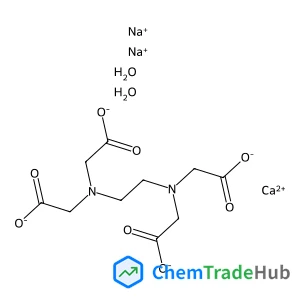
EthylenediaminetetraaceticacidcalciumDisodiumsalthydrate
CAS Number:
23411-34-9
Molecular Formula:
C10H16CaN2Na2O10
Recommended Suppliers




Disclaimer
This page provides academic journal information for reference and research purposes only. We are not affiliated with any journal publishers and do not handle publication submissions. For publication-related inquiries, please contact the respective journal publishers directly.
If you notice any inaccuracies in the information displayed, please contact us at support@chemtradehub.com. We will promptly review and address your concerns.