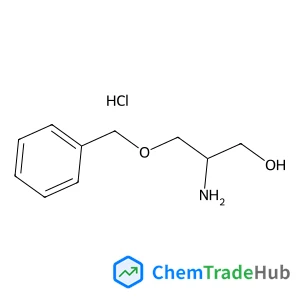
(R)-2-amino-3-(benzyloxy)propan-1-ol hydrochloride
CAS Number:
58577-95-0
Molecular Formula:
C10H16ClNO2
Electron transfer dissociation (ETD) is becoming increasingly important in mass spectrometry-based analysis of peptides and proteins. Supplemental collisional activation of undissociated electron transfer products can significantly increase fragmentation yield and sequence coverage, but hydrogen rearrangements – specifically, transfer of a hydrogen radical from a c to a z fragment – lead to distorted isotope distributions and increased potential for signal overlap. Concomitant collisional activation during the ion/ion reaction significantly reduces these rearrangements, but, in ion traps, also leads to lower reaction rates and reduced overlap of anion and cation clouds. In traveling-wave ion mobility devices, it has been reported – although not under ETD conditions – that significant ion activation can occur depending on the T-wave height and velocity. Here, we investigate this phenomenon in more detail using a commercial instrument (Waters Synapt G2) and report that a similar effect can be induced within the traveling-wave Trap cell where the ETD reaction occurs, using fairly typical T-wave settings. This ion ‘heating’ is demonstrated by analyzing the observed isotope distributions (sensitive to the aforementioned hydrogen rearrangements) of ETD fragments of ubiquitin and substance P. A more detailed investigation of ion activation using cesium iodide clusters (without ETD reagent anions present) shows that the observed behavior is consistent with the known dynamics of ions within traveling-wave devices. The insights gained in this work are potentially relevant both for ‘native ETD’ studies (in which tuning needs to be optimized to avoid unintentional ion activation) as well as the design of future T-wave ETD devices (where this ‘heating’ effect might be exploited to promote fragment release).
J. F. Vianna, K. S. Bezerra, A. H. Lima Costa, E. D. Barbosa, J. X. Lima Neto, J. I. N. Oliveira, V. N. Freire, U. L. Fulco
DOI: 10.1039/D1CP02853G
Konstantin Romanenko, Stuart J. Elliott, Aleksandr A. Shubin, Philip W. Kuchel
DOI: 10.1039/D1CP02515E
O. A. Otmakhova, G. N. Bondarenko, G. A. Shandryuk, A. S. Merekalov, R. V. Talroze
DOI: 10.1039/D1CP00660F
Fernando J. A. L. Cruz, José P. B. Mota
DOI: 10.1039/D1CP00893E
Chenyang Bao, Xiang Peng, Leiying Ying, Yang Mei, Baoping Zhang, Hao Long
DOI: 10.1039/D1CP03794C
Chenxu Zhao, Menghui Xi, Jinrong Huo, Chaozheng He
DOI: 10.1039/D1CP03943A
Ruixuan Zhao, Daxin Wu, Jiao Wen, Qi Zhang, Guanglei Zhang, Jiebo Li
DOI: 10.1039/D1CP02521J
P. Babaev, J. Chalupský, A. E. Volkov
DOI: 10.1039/D1CP02199K
Thanh Lam Nguyen, Jozef Peeters
DOI: 10.1039/D1CP02234B
Ethyl 4-chlorothieno[2,3-b]pyridine-5-carboxylate (CAS: 59713-58-5) can be synth...
5-Methyl-1H-indole-3-carbaldehyde (CAS: 52562-50-2) is subject to various regula...
(1,3-Dimethyl-2,4-dioxo-1,2,3,4-tetrahydro-5-pyrimidinyl)boronic acid is a white...
Waste containing Sulfocostunolide A (CAS: 1016983-51-9) should be handled with c...
When handling Murraxocin (CAS: 88478-44-8), ensure proper personal protective eq...
Formvar (CAS: 63148-64-1) is an alkyd resin characterized by a high molecular we...
(S)-4-benzyl-2-((benzyloxy)methyl)morpholine is generally safe when handled with...
Methyl 1-(5-bromo-2-pyrimidinyl)cyclopropanecarboxylate (CAS: 1447607-69-3) is p...
2-Methyl-1-phenyl-1-propanamine hydrochloride (CAS: 24290-47-9) is generally con...
3-(4-Bromophenyl)-2-methylpropanoic acid is synthesized through a multi-step pro...

Analyst publishes analytical and bioanalytical research that reports premier fundamental discoveries and inventions, and the applications of those discoveries, unconfined by traditional discipline barriers.