



Contents list
Literature Information
Publication Date
DOI
10.1039/C6QO90009G
Impact Factor
5.281
Authors
View Original
Abstract
The first page of this article is displayed as the abstract.
Recommended Journals

New Journal of Chemistry

Current Opinion in Solid State & Materials Science

Journal of Natural Medicines

Russian Journal of Applied Chemistry

Acta Materialia

Journal of Saudi Chemical Society

Russian Journal of General Chemistry

Chemical Communications

Saudi Pharmaceutical Journal

Russian Journal of Bioorganic Chemistry
Related Literature
Synthesis of cationic poly((3-acrylamidopropyl)trimethylammonium chloride) by SARA ATRP in ecofriendly solvent mixtures
Patrícia V. Mendonça, Dominik Konkolewicz, Saadyah E. Averick, Arménio C. Serra, Anatoliy V. Popov, Tamaz Guliashvili, Krzysztof Matyjaszewski, Jorge F. J. Coelho
2014-06-19
Paper
DOI: 10.1039/C4PY00707G
Synthesis and phase behavior of a new 2-vinylbiphenyl-based mesogen-jacketed liquid crystalline polymer with a high glass transition temperature and low threshold molecular weight
Qi-Kai Zhang, Hai-Jian Tian, Yu-Feng Zhu, Yongri Liang, Zhihao Shen, Xing-He Fan
2014-03-11
Paper
DOI: 10.1039/C3PY01755A
How does a tiny terminal alkynyl end group drive fully hydrophilic homopolymers to self-assemble into multicompartment vesicles and flower-like complex particles?
Tingting Liu, Wei Tian, Yunqing Zhu, Yang Bai, Hongxia Yan, Jianzhong Du
2014-05-06
Paper
DOI: 10.1039/C4PY00501E
A water-soluble polymer for selective colorimetric sensing of cysteine and homocysteine with temperature-tunable sensitivity
A. Balamurugan, Hyung-il Lee
2014-05-19
Communication
DOI: 10.1039/C4PY00476K
Synthesis of functionalized polyisobutylenes using the propylene epoxide/TiCl4 initiating system
Alejandra Alvarez Albarran, Elena Silantyeva, Kwang Su Seo
2014-04-23
Paper
DOI: 10.1039/C4PY00363B
Synthesis of triphenylamine based polysiloxane as a blue phosphorescent host
Dianming Sun, Zhaomin Yang, Xiaoli Sun, Huihui Li, Zhongjie Ren, Junteng Liu, Dongge Ma, Shouke Yan
2014-05-02
Paper
DOI: 10.1039/C4PY00450G
Synthesis of a multimodal molecular imaging probe based on a hyperbranched polymer architecture
Barbara E. Rolfe, Karine Mardon
2014-05-13
Paper
DOI: 10.1039/C4PY00513A
You might also like
Compound Q&A
What is Ethyl 3-cyclohexylpropanoate (CAS: 10094-36-7)?
Ethyl 3-cyclohexylpropanoate is a clear, colorless to light yellow liquid with a...
10094-36-7Ethyl 3-cyclohexylpr...
Compound Q&A
How should waste containing 2-(Hydroxymethyl)-5-(methoxycarbonyl)-6-methyl-4-(2-nitrophenyl)nicotinic acid (CAS: 34783-31-8) be handled?
Waste containing 2-(Hydroxymethyl)-5-(methoxycarbonyl)-6-methyl-4-(2-nitrophenyl...
34783-31-82-(Hydroxymethyl)-5-...
Compound Q&A
How should waste containing 2,4,6-Tris(pentafluoroethyl)-1,3,5-triazine (CAS: 858-46-8) be handled?
Waste containing 2,4,6-Tris(pentafluoroethyl)-1,3,5-triazine (CAS: 858-46-8) sho...
858-46-82,4,6-Tris(pentafluo...
Compound Q&A
What precautions should be taken when handling Chloroac-nle-oh (CAS: 56787-36-1)?
When handling Chloroac-nle-oh (CAS: 56787-36-1), it is essential to wear appropr...
56787-36-1Chloroac-nle-oh
Compound Q&A
What industries use Ethyl 6-phenylimidazo[2,1-b][1,3]thiazole-3-carboxylate (CAS: 752244-05-6)?
Ethyl 6-phenylimidazo[2,1-b][1,3]thiazole-3-carboxylate is primarily used in the...
752244-05-6Ethyl 6-phenylimidaz...
Compound Q&A
Are there alternatives to alpha-(2-Bromophenyl)benzylamine (CAS: 55095-15-3) in synthesis?
Alternatives to alpha-(2-Bromophenyl)benzylamine (CAS: 55095-15-3) in synthesis ...
55095-15-3alpha-(2-Bromophenyl...
Compound Q&A
How should waste containing 2-Chloro-5-methoxypyridine (CAS: 139585-48-1) be handled?
Waste containing 2-Chloro-5-methoxypyridine (CAS: 139585-48-1) should be managed...
139585-48-12-Chloro-5-methoxypy...
Compound Q&A
What industries use 1-(4-Methoxyphenyl)-2,5-dimethyl-1H-pyrrole (CAS: 5044-27-9)?
1-(4-Methoxyphenyl)-2,5-dimethyl-1H-pyrrole (CAS: 5044-27-9) is used in various ...
5044-27-91-(4-Methoxyphenyl)-...
Compound Q&A
Are there alternatives to 3-Bromo-5-(N-Boc)aminomethylisoxazole (CAS: 903131-45-3) in synthesis?
There are alternative reagents and compounds that can be used in the synthesis o...
903131-45-33-Bromo-5-(N-Boc)ami...
Compound Q&A
What is Tungsten(IV) oxide (CAS: 12036-22-5)?
Tungsten(IV) oxide, also known as tungsten dioxide, is a chemical compound with ...
12036-22-5Tungsten(IV) oxide
Source Journal
Organic Chemistry Frontiers

CiteScore:
7.8
Self-citation Rate:
8.7%
Articles per Year:
724
Organic Chemistry Frontiers publishes high-quality research from across organic chemistry. Emphases are placed on studies that make significant contributions to the field of organic chemistry by reporting either new or significantly improved protocols or methodologies. Topics include, but are not limited to the following: Organic synthesis Development of synthetic methodologies Catalysis Natural products Functional organic materials Supramolecular and macromolecular chemistry Physical and computational organic chemistry
Recommended Compounds


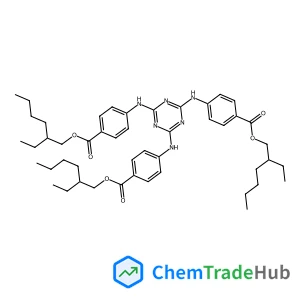
Tris(2-ethylhexyl) 4,4',4''-(1,3,5-triazine-2,4,6-triyltriimino)tribenzoate
CAS Number:
88122-99-0
Molecular Formula:
C48H66N6O6
![1-(Hexopyranosyloxy)-4a,5-dihydroxy-7-methyl-1,4a,5,6,7,7a-hexahydrocyclopenta[c]pyran-7-yl 3-phenylacrylate structure](https://static.chemtradehub.com/structs/192/19210-12-9-ecae.webp "1-(Hexopyranosyloxy)-4a,5-dihydroxy-7-methyl-1,4a,5,6,7,7a-hexahydrocyclopenta[c]pyran-7-yl 3-phenylacrylate structure")
1-(Hexopyranosyloxy)-4a,5-dihydroxy-7-methyl-1,4a,5,6,7,7a-hexahydrocyclopenta[c]pyran-7-yl 3-phenylacrylate
CAS Number:
19210-12-9
Molecular Formula:
C24H30O11
Recommended Suppliers







Disclaimer
This page provides academic journal information for reference and research purposes only. We are not affiliated with any journal publishers and do not handle publication submissions. For publication-related inquiries, please contact the respective journal publishers directly.
If you notice any inaccuracies in the information displayed, please contact us at support@chemtradehub.com. We will promptly review and address your concerns.