












Nickel-catalyzed direct formation of the C–S bonds of aryl sulfides from arylsulfonyl chlorides and aryl iodides using Mn as a reducing agent
Literature Information
Publication Date
2016-10-08
DOI
10.1039/C6QO00451B
Impact Factor
5.281
Authors
Yang Wang, Xiaofeng Zhang, Haixiong Liu, Hui Chen, Deguang Huang
View Original
Abstract
Various unsymmetrical aryl sulfides were synthesized by nickel-catalyzed C–S bond formation in good to excellent yields. The reactions employed arylsulfonyl chlorides as an aryl thiol source and Mn dust as a reducing agent. The scope and versatility of the method have been successfully demonstrated with 42 examples. Mechanistic studies revealed the existence of an intermediate disulfide substance. A catalytic cycle was proposed including a three-step reduction by Mn for the achievement of the reaction, and Ni(0) and Ni(I) species were supposed to be involved in the reaction mechanism.
Recommended Journals
Related Literature
Simple method for the rapid simultaneous screening of photocatalytic activity over multiple positions of self-cleaning films
Andreas Kafizas, Davy Adriaens, Andrew Mills, Ivan P. Parkin
2009-06-30
Paper
DOI: 10.1039/B905222D
Repair of O6-methylguanine to guanine by cysteine in the absence and presence of histidine and by cysteine thiolate anion: a quantum chemical study
P. K. Shukla, P. C. Mishra
2009-07-02
Paper
DOI: 10.1039/B908295F
Electron attachment to trinitrotoluene (TNT) embedded in He droplets: complete freezing of dissociation intermediates in an extended range of electron energies
Eugen Illenberger
2009-06-30
Paper
DOI: 10.1039/B908192E
Photophysics of aromatic thiourea derivatives and their complexes with anions. Fast and ultrafast spectroscopic investigations
Tiziana Del Giacco, Benedetta Carlotti, Stefano De Solis, Arianna Barbafina, Fausto Elisei
2010-06-04
Paper
DOI: 10.1039/B927442A
Molecular configuration transitions of a nematic liquid crystal encapsulated in organically modified silicas
Erick Castellón, Marcos Zayat, David Levy
2009-05-20
Paper
DOI: 10.1039/B903926K
Kinetics of hydrogen-transfer isomerizations of butoxyl radicals
Jingjing Zheng, Donald G. Truhlar
2010-05-25
Paper
DOI: 10.1039/B927504E
The formation of colloidal coppernanoparticles stabilized by zinc stearate: one-pot single-step synthesis and characterization of the core–shell particles
André Rittermeier, Shaojun Miao, Xiaoning Zhang, Maurits W. E. van den Berg, Shankhamala Kundu, Yuemin Wang, Sabine Schimpf, Elke Löffler, Roland A. Fischer, Martin Muhler
2009-07-13
Paper
DOI: 10.1039/B908034A
Complete 1H resonance assignment of β-maltose from 1H–1H DQ-SQ CRAMPS and 1H (DQ-DUMBO)–13CSQ refocused INEPT 2D solid-state NMR spectra and first principles GIPAW calculations
Amy L. Webber, Bénédicte Elena, John M. Griffin, Jonathan R. Yates, Tran N. Pham, Francesco Mauri, Chris J. Pickard, Ana M. Gil, Robin Stein, Anne Lesage, Lyndon Emsley, Steven P. Brown
2010-05-18
Paper
DOI: 10.1039/C001290D
You might also like
Compound Q&A
What precautions should be taken when handling 2-Methyl-2-propanyl 5-amino-2-thiophenecarboxylate (CAS: 1498311-57-1)?
When handling 2-Methyl-2-propanyl 5-amino-2-thiophenecarboxylate (CAS: 1498311-5...
1498311-57-12-Methyl-2-propanyl ...
Compound Q&A
What are the physical and chemical properties of 5-Bromo-1,2-dichloro-3-fluorobenzene (CAS: 1000572-93-9)?
5-Bromo-1,2-dichloro-3-fluorobenzene (CAS: 1000572-93-9) is a crystalline solid ...
1000572-93-95-Bromo-1,2-dichloro...
Compound Q&A
How should (2R)-2-Amino-2-(4-bromophenyl)ethanol (CAS: 354153-64-3) be stored?
(2R)-2-Amino-2-(4-bromophenyl)ethanol (CAS: 354153-64-3) should be stored in a c...
354153-64-3(2R)-2-Amino-2-(4-br...
Compound Q&A
What regulatory guidelines apply to Methyl 4-(aminomethyl)tetrahydro-2H-pyran-4-carboxylate hydrochloride (CAS: 362707-24-2)?
Methyl 4-(aminomethyl)tetrahydro-2H-pyran-4-carboxylate hydrochloride (CAS: 3627...
362707-24-2Methyl 4-(aminomethy...
Compound Q&A
What are the main uses of 1,4-dimethyl-1H-pyrazole-5-sulfonyl chloride (CAS: 1174834-52-6)?
1,4-Dimethyl-1H-pyrazole-5-sulfonyl chloride is primarily used as an intermediat...
1174834-52-61,4-dimethyl-1H-pyra...
Compound Q&A
Is Dinaphtho[1,2-b:2',1'-d]furan (CAS: 239-69-0) safe?
Dinaphtho[1,2-b:2',1'-d]furan is generally safe when handled with appropriate pe...
239-69-0Dinaphtho[1,2-b:2',1...
Compound Q&A
What is the market or research trend for 7-Methyl-7,9-dihydro-1H-purine-2,6,8(3H)-trione (CAS: 612-37-3)?
The market for 7-Methyl-7,9-dihydro-1H-purine-2,6,8(3H)-trione (CAS: 612-37-3) i...
612-37-37-Methyl-7,9-dihydro...
Compound Q&A
What are the physical and chemical properties of 2-(4-Chlorophenyl)malonaldehyde (CAS: 205676-17-1)?
2-(4-Chlorophenyl)malonaldehyde (CAS: 205676-17-1) is a colorless or light yello...
205676-17-12-(4-Chlorophenyl)ma...
Compound Q&A
How is 2-Methylchrysene (CAS: 3351-32-4) typically synthesized?
2-Methylchrysene (CAS: 3351-32-4) is typically synthesized via the reaction of c...
3351-32-42-Methylchrysene
Compound Q&A
Is N-(6-aminopyrimidin-4-yl)acetamide (CAS: 89533-23-3) safe?
N-(6-aminopyrimidin-4-yl)acetamide (CAS: 89533-23-3) is generally considered saf...
89533-23-3N-(6-aminopyrimidin-...
Source Journal
Organic Chemistry Frontiers

CiteScore:
7.8
Self-citation Rate:
8.7%
Articles per Year:
724
Organic Chemistry Frontiers publishes high-quality research from across organic chemistry. Emphases are placed on studies that make significant contributions to the field of organic chemistry by reporting either new or significantly improved protocols or methodologies. Topics include, but are not limited to the following: Organic synthesis Development of synthetic methodologies Catalysis Natural products Functional organic materials Supramolecular and macromolecular chemistry Physical and computational organic chemistry
Recommended Compounds

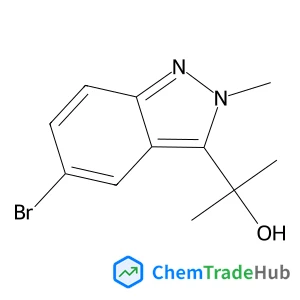
2-(5-Bromo-2-methyl-2H-indazol-3-yl)-2-propanol
CAS Number:
1823787-20-7
Molecular Formula:
C11H13BrN2O
Recommended Suppliers





Disclaimer
This page provides academic journal information for reference and research purposes only. We are not affiliated with any journal publishers and do not handle publication submissions. For publication-related inquiries, please contact the respective journal publishers directly.
If you notice any inaccuracies in the information displayed, please contact us at support@chemtradehub.com. We will promptly review and address your concerns.